
24/7 Customer Support

Free returns

Same-day & Next-day Delivery

Quality Guaranteed

Unlock Your Welcome Offers: FREE Delivery | Up to 80% OFF | Free 30-day JoyPlus trial
Download the APP
A multifunctional electric hot pot can be a game-changer for anyone living in a compact space. Whether you're a university student in halls, a professional in a small city flat or a couple looking for a simple meal solution, these appliances promise convenience. However, the market is filled with options that can easily lead to disappointment. Before you buy, it's crucial to understand the common pitfalls that catch many shoppers out.
Many buyers find their new cooker is either too small for a proper meal, has a non-stick coating that peels after a few uses or features a "dual power" setting that only switches between 'boiling' and 'off', offering no real control. These issues can turn a promising kitchen helper into a cupboard-cluttering regret. This guide will help you navigate the specifications that matter, so you can choose a reliable appliance that genuinely makes your life easier.
To avoid the common traps, focus on these three core parameters. They are the difference between a versatile cooking companion and a wasted purchase.
One of the most frequent complaints is misleading capacity. A pot advertised as 2.4L might have a total volume of 2.4 litres, but its maximum safe fill line—the usable capacity—could be much lower, sometimes only 1.8L. For cooking for one or two people, a usable capacity of between 1.5L and 2.5L is generally ideal. Always check for the 'max' fill line in product images or descriptions, as this indicates the true cooking volume you'll have for soups, noodles or stews.
The term dual power cooking pot is often used, but the functionality can vary wildly. An effective system offers two distinct heat levels: a lower setting (around 400-600W) for gentle simmering, keeping food warm or slow-cooking, and a higher setting (800-1000W) for bringing water to a rapid boil for hot pot or pasta. A simple on/off switch or a single high-power mode lacks the versatility needed for anything beyond boiling water. A good small electric cooker should provide enough control to prevent your dinner from burning or boiling over.
The inner pot's material is critical for both performance and longevity. Look for a non-stick electric pot with steamer that specifies a food-grade coating. This not only makes cleaning far easier but also prevents food from sticking and burning during cooking. Furthermore, for any portable appliance, safety is paramount. Ensure the product is fitted with a proper travel electric cooker UK plug (Type G) to comply with British standards and prevent electrical hazards. A detachable power cord is also a practical feature, making the pot easier to clean and store.
Based on these practical criteria, we've identified a few models that are well-suited for different needs and living situations.
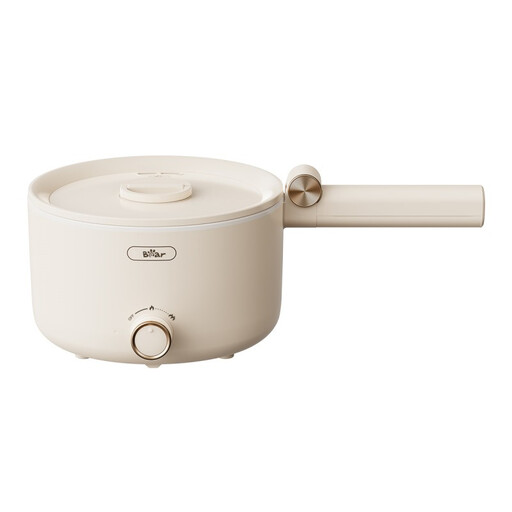
Why This Fits Their Persona: Ideal for a single person in a student hall or studio flat. The 1.6L capacity is perfect for one-person meals like an electric ramen noodle cooker and its foldable handle makes it exceptionally easy to store in tight spaces.
It offers a genuine 2-level power adjustment for real cooking control, avoiding the 'on/off only' problem. The compact design is honest about its purpose for solo use, sidestepping the capacity illusion.
The standout feature is its foldable handle, which significantly reduces its storage footprint. It also includes over-heating and boil-dry protection for added safety.
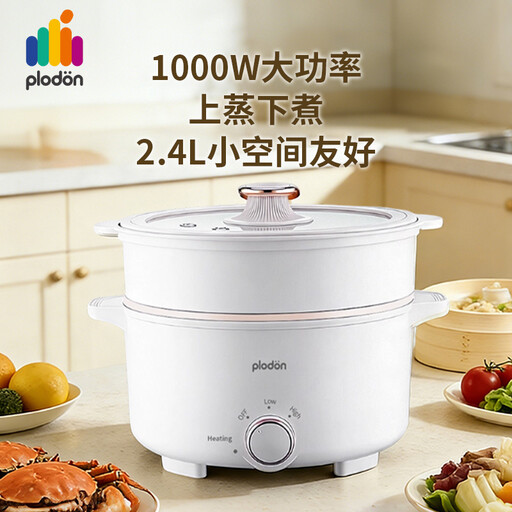
Why This Fits Their Persona: A great all-rounder for couples or small households. The 2.4L capacity is well-suited for preparing meals for two and the included steamer adds a layer of versatility for cooking a main dish and a side simultaneously.
It features a food-grade non-stick interior, addressing concerns about poor-quality coatings. The dual power settings (low/high) provide the necessary control for both simmering and fast boiling.
The detachable steamer allows for flexible dual-layer cooking without mixing flavours. Its 1000W power ensures quick heating, saving time on busy weekdays.

Why This Fits Their Persona: For those who want more precision. This model is great for someone who enjoys experimenting with different dishes, from slow-cooked stews to a communal portable hot pot and wants more granular control over the cooking process.
It directly tackles the 'power problem' by offering an intuitive 3-gear rotary dial (400W/800W/Full Power), providing far better temperature regulation than a basic high/low switch.
The honeycomb-textured non-stick coating is designed for even heat distribution, reducing hot spots. The product description is also transparent about avoiding high-heat frying to protect the coating, which is honest and helpful guidance.
A great meal cooked in your new electric pot deserves to be served properly. Whether it's a hearty soup, a steaming portion of noodles or a shared hot pot, having the right dishware completes the experience.
We have compiled a complete, real-time list of products that fully satisfy these strict selection criteria and UK safety regulations.
Most models are designed primarily for boiling, steaming and stewing. While some can handle light sautéing on a lower heat setting, high-heat frying (like you would in a wok or frying pan) is generally not recommended. It can damage the non-stick coating and may pose a safety risk. Always check the manufacturer's instructions; some, like the IAGREEA model, explicitly advise against it to ensure the product's longevity.
The running cost depends on your electricity tariff. As of mid-2026, the average electricity rate in the UK is around 25p per kilowatt-hour (kWh). A 1000W (1kW) appliance running for one hour would use 1 kWh of electricity, costing approximately 25p. If you use it for 30 minutes to boil pasta, the cost would be about 12.5p. It is generally an energy-efficient way to cook small meals compared to heating a large conventional oven.
To protect the coating, always let the pot cool down completely before cleaning. Unplug it and wipe the interior with a soft sponge or cloth with warm, soapy water. Never use abrasive scourers, steel wool or harsh chemical cleaners, as these will scratch and degrade the non-stick surface. For the exterior, a wipe with a damp cloth is sufficient. Never immerse the entire appliance or its electrical base in water.