
24/7 Customer Support

Free returns

Same-day & Next-day Delivery

Quality Guaranteed

Unlock Your Welcome Offers: FREE Delivery | Up to 80% OFF | Free 30-day JoyPlus trial
Download the APP
An electric hot pot UK shoppers can rely on should make one-pot cooking easier, not create another difficult appliance to store and clean. These cookers are useful for noodles, soup, hot pot, porridge, stir-fries and quick meals, particularly in student accommodation, offices, small flats and busy family kitchens.
However, product listings can make similar appliances look interchangeable. A compact 1.2-litre model and a 7-litre cooker serve very different households, while wattage alone does not tell you how practical a pot will be. Before buying, check the details that affect everyday use.
A 1000W electric pot may heat a small quantity of water efficiently, but it will not necessarily boil a full family-sized pot as quickly as a 1600W electric cooking pot. Higher wattage can shorten heating time, yet it may also increase electricity use when operated for longer periods.
Think about the amount of food you usually prepare. A student making one portion of ramen does not need the same heating capacity as a household cooking hot pot for several people.
A non-stick electric hot pot can be easier to wipe clean, but the listing should explain how the surface should be maintained. Avoid metal utensils, abrasive sponges and overheating an empty pot unless the manufacturer specifically permits them. Coating names such as “marble” or “titanium” describe the finish or material used by the manufacturer; they do not automatically guarantee a particular lifespan.
Look for clear cleaning instructions, a soft-cloth recommendation and protection against dry boiling or overheating where available.
Capacity figures can be misleading if you only consider the internal volume. A cooker may fit enough food but still take up considerable cupboard or worktop space. Check the appliance dimensions, handle design, lid position and whether the cable detaches.
For UK kitchens, a UK plug electric cooker is generally more convenient than a model requiring an adapter. Always confirm the plug type, voltage information and supplied instructions before purchase.
Do not fill the cooker to the rim. The Plodon 2.0L model advises keeping liquid below the maximum line and no more than two-thirds full for some uses. This leaves room for bubbling and reduces the risk of overflow.
A dual-heat hot pot gives you at least two operating levels. Low heat is useful for simmering soup, oatmeal and gentle cooking, while high heat is more suitable for boiling noodles or bringing hot pot broth up to temperature.
For a compact appliance, 500W/1000W control can offer more flexibility than a single fixed setting. Larger pots may use 1600W to heat a fuller vessel but require a stable, heat-resistant surface and careful supervision.
Useful features to check include:
The heating base, plug and cable must not be immersed in water. Allow the appliance to cool before cleaning and follow the supplied manual. For UK purchases, check the product page for appropriate electrical information and a suitable plug; do not assume that every marketplace listing has identical specifications.
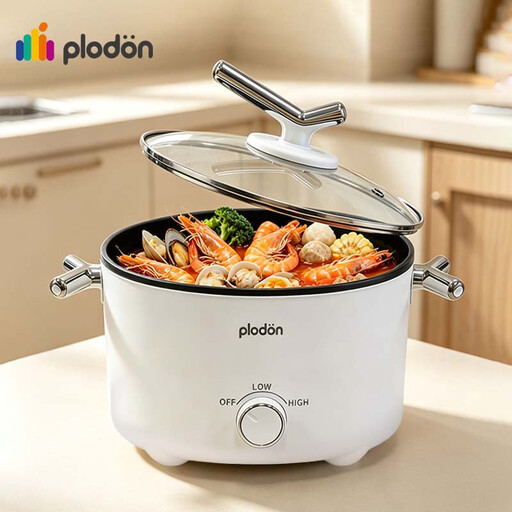
Why This Fits Their Persona: A practical size for students, office kitchens and one- or two-person households making noodles, soup, eggs or porridge.
The two heat levels are more informative than a wattage figure alone, and the stated fill guidance helps reduce overflow during boiling.
2.0L capacity, 1000W heating, non-stick interior, glass lid and detachable power cord.
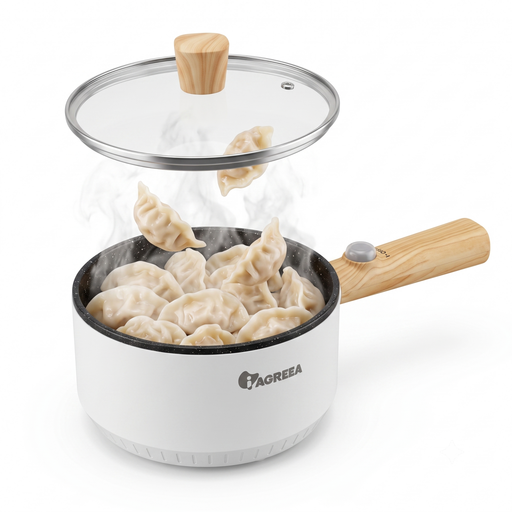
Why This Fits Their Persona: Suits buyers who prioritise a compact design, adjustable heating and convenient storage for personal meals.
Its 500W/1000W control avoids relying on a single high setting, while dry-boil and overheating protection address common misuse risks.
1.2L size, marble-style non-stick coating, glass lid and detachable European two-pin plug.

Why This Fits Their Persona: Designed for families, shared hot pot meals and batch cooking where a small portable hot pot would require repeated refilling.
The 7L capacity and 30.5cm opening are clearly specified, making its suitability easier to judge than vague “large” wording.
1600W power, high/low heat modes, 7L capacity, glass lid and UK plug.
Electricity cost depends on the appliance’s actual energy draw and your tariff. A simple estimate is:
Power in kW × hours used × electricity price per kWh
For example, a 1000W cooker uses approximately 1kWh if it runs continuously for one hour at full power. In practice, thermostatic cycling, cooking time and the selected heat level affect consumption. Use high heat to bring liquid up to temperature, then reduce the setting when the recipe allows.
Place the appliance on a dry, stable, heat-resistant surface with space around it. Avoid using it near curtains or other heat-sensitive items. Never leave a hot pot unattended when oil, boiling liquid or children are nearby.
We have compiled a complete, real-time list of products that fully satisfy these strict selection criteria and UK safety regulations.
For one or two portions, a 1000W model is generally suited to boiling noodles, making soup and preparing small one-pot meals. A larger quantity of cold liquid will take longer to heat than in a 1600W cooker, so match the wattage with the capacity rather than comparing the number in isolation.
Only use one where your accommodation rules permit personal cooking appliances. Choose a compact model with a suitable UK plug or clearly stated electrical requirements and operate it on a stable, heat-resistant surface. Keep the cord away from walkways and never immerse the heating base in water.
Lifespan depends on cleaning, utensil choice, frequency of use and whether the pot is overheated or operated empty. Using wooden or silicone utensils, washing with a soft sponge and following the manufacturer’s instructions can help preserve the coating. Inspect the interior, cable and controls regularly, and stop using the appliance if damage appears.