
24/7 Customer Support

Free returns

Same-day & Next-day Delivery

Quality Guaranteed

Unlock Your Welcome Offers: FREE Delivery | Up to 80% OFF | Free 30-day JoyPlus trial
Download the APP
An electric indoor grill can make steaks, burgers, vegetables, toasted sandwiches and paninis more convenient to prepare in a UK kitchen. However, attractive specifications do not always translate into practical everyday use. The right choice depends on cooking capacity, cleaning design, temperature control and how much work you want the appliance to do.
A high wattage figure can indicate strong heating performance, but it does not guarantee even cooking. The design of the grill plates, heat distribution and preheating behaviour also matter. A 2,000W contact grill may suit quick meals, while a 2,500W tabletop grill may be more appropriate for cooking several ingredients at once.
Check the full specification rather than choosing purely by power. Also remember that higher wattage can increase electricity use when the grill is operated for longer periods.
A non-stick grill may reduce sticking, but cleaning can still be inconvenient if the plates cannot be removed. Grease channels and drip trays are useful for collecting cooking juices, yet they need to be emptied and washed after use.
If convenience is important, look for removable grill plates. Dishwasher-safe grill plates can reduce hand-washing, although you should always follow the manufacturer’s cleaning instructions. For fixed plates, check whether the surface can be wiped easily without allowing water near the electrical components.
Product dimensions can be misleading. A small appliance may fit neatly on a worktop but leave insufficient space for a family meal. Conversely, a wide tabletop grill may need considerable storage space and a suitable heat-resistant surface.
Compare the usable cooking area, not just the external dimensions. For example, a 28 × 22cm plate set is practical for sandwiches and smaller portions, while a 50 × 25cm tabletop surface is more suitable for shared cooking.
A contact grill cooks food between upper and lower plates, making it suitable for burgers, steaks, paninis and toasted sandwiches. A floating top plate can accommodate different food thicknesses without pressing everything flat. Some models open to 180 degrees, creating a larger open cooking surface.
A tabletop grill usually has one broad plate and is designed for cooking at a worktop or dining table. It can work well for vegetables, meat and shared meals, but it may require more space around the appliance.
For an indoor barbecue-style experience, consider whether the grill includes a built-in grease channel or collection tray. These features can help direct excess fat away from food and reduce worktop mess, but they do not remove the need for safe handling and cleaning.
An adjustable temperature grill gives you more control over different ingredients. Lower settings may suit sandwiches and delicate vegetables, while higher settings are useful for searing meat. Simple rotary controls are straightforward, whereas automatic programmes can guide cooking more closely.
Some grills include indicators or sensors linked to food thickness. These features can be useful for busy households, but they do not replace checking food is thoroughly cooked. Follow UK food safety guidance and the instructions supplied with the appliance.
A non-stick grill should be used with wooden, silicone or nylon utensils to avoid scratching the coating. Look for a plate structure that supports even contact and allows grease to drain towards a tray.
Consider whether the plates are removable, whether they are dishwasher-safe and how much food they can hold without overcrowding. Overfilling can reduce contact with the hot surface and lead to uneven browning.

Why This Fits Their Persona: A compact option for UK households wanting one appliance for steaks, burgers, toasted sandwiches and paninis without committing to a larger tabletop model.
Its 28 × 22cm non-stick plates provide a clearly stated cooking area, while double-sided heating avoids relying on a single hot surface.
2000W output, food-grade non-stick coating and a multifunction design covering contact grilling, sandwich making and panini pressing.
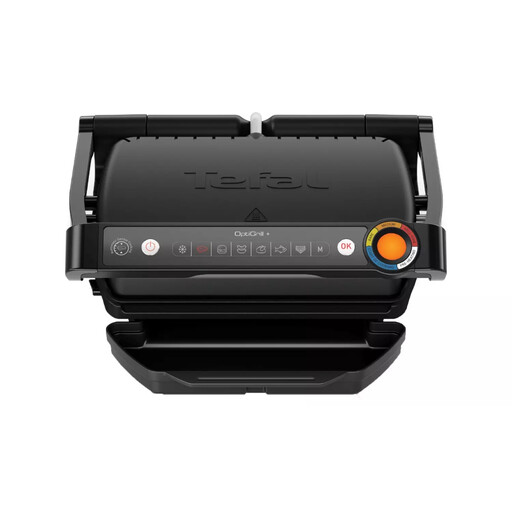
Why This Fits Their Persona: Suits cooks who want guided operation, multiple automatic programmes and less manual judgement when preparing different foods.
The food-thickness measurement system and ready indicator provide more information than a basic on/off grill, while the sloped surface directs grease towards the drip tray.
2000W power, six automatic programmes, removable dishwasher-safe plates and capacity for up to five portions.
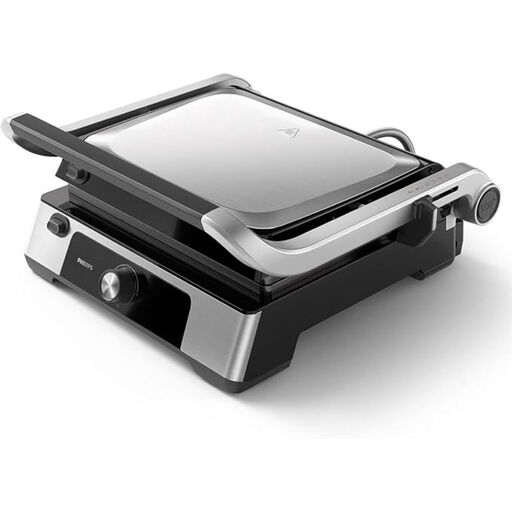
Why This Fits Their Persona: A practical fit for frequent cooks who need one contact grill for family meals, open grilling and foods of different thicknesses.
It combines adjustable temperature, a floating height-adjustable top plate and 180-degree opening, reducing the limitations of a fixed-format grill.
Up to 2200W maximum power, large non-stick plates, removable drip tray and handle lock for storage.
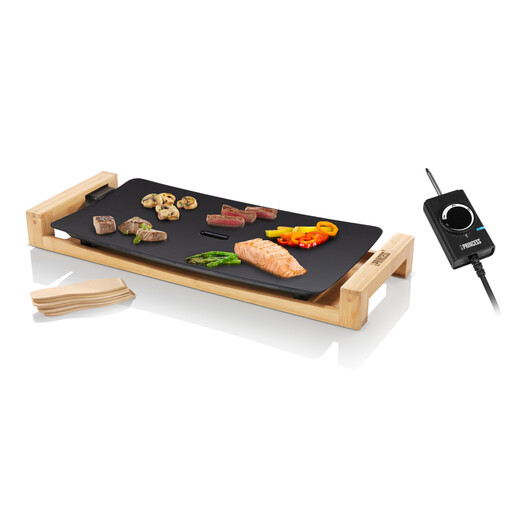
Why This Fits Their Persona: Its broad tabletop format is suited to shared meals, casual entertaining and cooking several ingredients at the same time.
The 50 × 25cm cooking surface makes capacity clear, while the curved plate and integrated collection tray address grease-management concerns.
2500W output, freestanding tabletop design, natural bamboo exterior and a stated two-year manufacturer’s warranty.
Place any electric steak grill or indoor barbecue on a stable, dry, heat-resistant surface with clear space around it. Keep the appliance away from curtains, paper, water and other flammable materials. Hot plates and grease can cause burns, so supervise children and avoid leaving the grill unattended.
To estimate electricity use, multiply the appliance’s kilowatt rating by the hours used, then multiply by your electricity tariff. A 2,000W grill used for 15 minutes at full power would consume approximately 0.5kWh, although actual consumption varies as heating cycles on and off.
Yes, provided it is used on a suitable heat-resistant surface with adequate ventilation and access to a safe mains socket. It does not produce the same smoke as charcoal cooking, but grease and food juices can still create smoke if the grill is overfilled or operated incorrectly.
They are often worthwhile for regular users because they make it easier to remove cooked-on residue and grease. Check whether the plates are dishwasher-safe; this feature is not included on every model.
Lifespan depends on frequency of use, storage, cleaning and how the non-stick surface is treated. Use suitable utensils, allow the grill to cool before cleaning, keep electrical parts dry and stop using it if the cable, plug or appliance becomes damaged.
We have compiled a complete, real-time list of products that fully satisfy these strict selection criteria and UK safety regulations.