
24/7 Customer Support

Free returns

Same-day & Next-day Delivery

Quality Guaranteed

Unlock Your Welcome Offers: FREE Delivery | Up to 80% OFF | Free 30-day JoyPlus trial
Download the APP
Choosing among electric kettles can seem straightforward until you compare capacity, heating power, materials, safety functions and cleaning requirements. A low-priced model may look suitable online, yet small details such as a difficult-to-read water gauge or poor limescale access can make everyday use frustrating.
This guide explains the practical specifications to check before buying, common marketing traps to avoid and our top recommendations for different household needs.
A higher wattage can support faster heating, but boiling speed also depends on the amount of water, starting temperature and the kettle’s heating design. A rapid-boil kettle rated at 3,000W may be useful for several cups, while a 1,500W model can be adequate for occasional single-cup use.
Do not assume you need to boil the full capacity every time. A clear water window or one-cup marker helps avoid heating excess water, which can increase electricity use.
A 1.7L electric kettle is commonly suited to family kitchens, but the maximum fill line is not the amount you should always boil. You need enough room for safe bubbling and steam. Check the minimum-fill mark too, particularly if you usually prepare one mug at a time.
For households with three to five people, a family-size kettle can reduce refilling. For one person or a compact home office, a 1.0L to 1.5L model may take up less worktop space.
Hard water is common in many parts of the UK. Limescale can collect around the heating element, lid and filter, affecting appearance and potentially slowing heating. Look for a removable limescale filter, a concealed element and a lid that opens wide enough for cleaning.
A stainless steel kettle can offer a durable interior, but stainless steel does not remove the need for regular descaling. Always follow the manufacturer’s cleaning instructions.
Select capacity according to the number of drinks you normally make, rather than choosing the largest option automatically.
Also check the kettle’s height, width and handle clearance. A model that fits beneath wall cabinets may still be awkward to lift if the handle is too close to the lid or worktop.
Common electric kettles range from around 1,000W to 3,000W. Higher power may reduce waiting time, but the energy used depends mainly on how much water you heat and how often you boil it.
For a simple running-cost estimate:
Power in kilowatts × operating time in hours × your electricity tariff = cost per boil
The exact figure varies with your tariff and the kettle’s heating time. A one-cup indicator is often more useful for reducing waste than choosing a particular wattage.
A kettle with automatic shut-off should stop heating when the water reaches boiling point. Boil-dry protection is designed to cut power if the kettle is switched on with insufficient water, although it should not be treated as permission to operate the appliance empty.
Useful everyday features include:
Always keep the base, plug and cable away from water. Allow the kettle to cool before cleaning and do not exceed the maximum fill line.
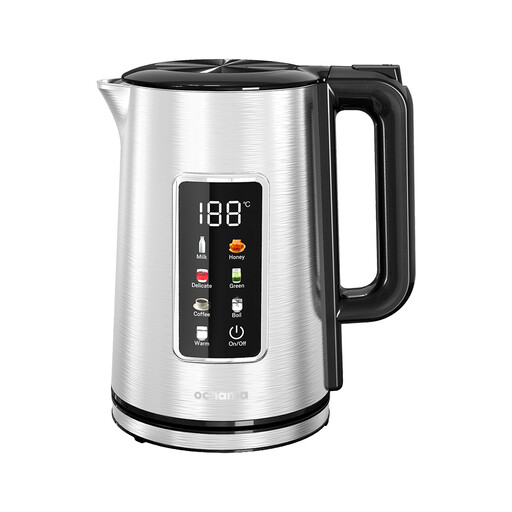
Why This Fits Their Persona: A practical choice for households wanting family capacity, visible temperature information and an insulated design without adding specialist cooking modes.
The 1.7L capacity is paired with a colour temperature display, while automatic power cut-off is listed for dry-boiling protection.
Double-wall stainless steel construction, 2100W power, keep-warm function and a detachable base.
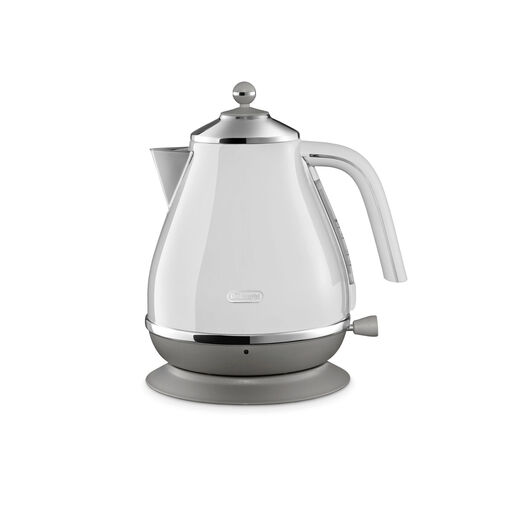
Why This Fits Their Persona: Suits shoppers who want a coordinated kitchen appliance with stainless steel construction and clearly specified safety and maintenance features.
It lists automatic shut-off, thermal cut-off and boil-dry protection, alongside a removable, washable anti-limescale filter.
3000W rated power, 360-degree cordless base, concealed element and transparent water-level indicator.
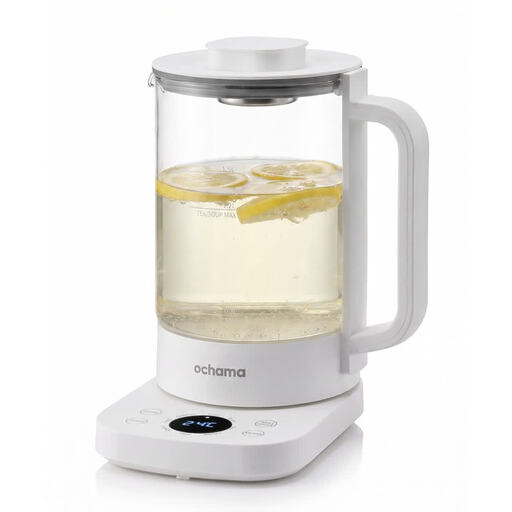
Why This Fits Their Persona: Designed for users who prepare more than tea and coffee, including fruit infusions, porridge and other hot drinks at home or in an office.
Its functions are specified rather than implied, with boil-dry protection and instructions covering minimum and maximum fill levels.
Eight preset modes, 11-level keep-warm adjustment and a 24-hour appointment function.
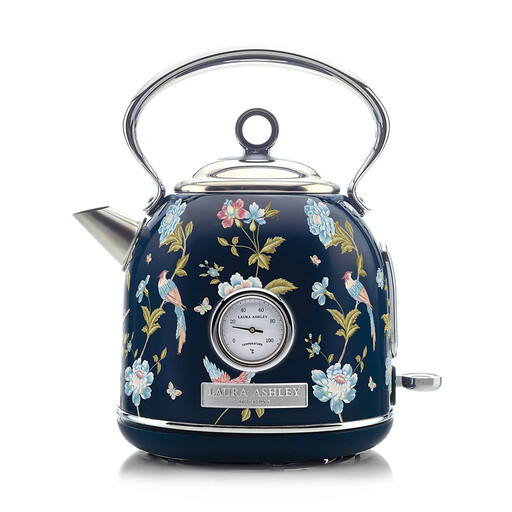
Why This Fits Their Persona: A suitable match for households that want a functional family kettle with a distinctive vintage-inspired worktop appearance.
The decorative finish is supported by practical specifications, including a removable limescale filter, cord storage and a 360-degree swivel base.
1.7L capacity, rapid-boil performance, stainless steel construction and left- or right-handed usability.
We have compiled a complete, real-time list of products that fully satisfy these strict selection criteria and UK safety regulations.
An electric kettle can be practical for heating water directly, but running cost depends on the water volume, heating time, appliance efficiency and your electricity tariff. Boiling only the amount required for each drink generally avoids unnecessary energy use.
Lifespan varies according to construction, frequency of use, water hardness, cleaning and handling. Regular descaling, avoiding overfilling and keeping the base dry can support reliable everyday operation. Check the product warranty and care instructions before buying.
A temperature control kettle is useful if you regularly prepare drinks at different temperatures or want to keep water warm between servings. For straightforward tea and coffee preparation, a standard automatic shut-off model may provide the functions you actually need without extra controls.