
24/7 Customer Support

Free returns

Same-day & Next-day Delivery

Quality Guaranteed

Unlock Your Welcome Offers: FREE Delivery | Up to 80% OFF | Free 30-day JoyPlus trial
Download the APP
Choosing among electric kitchen mixers can be surprisingly difficult. Product listings often highlight wattage, speed counts and attachment numbers, while leaving out the details that affect everyday use: maximum dough capacity, cleaning requirements, storage space and safe operating limits.
For UK households, the right choice depends less on impressive-looking specifications and more on the jobs you actually perform. A compact hand blender may be ideal for soup and sauces, while a stand mixer is more suitable for bread dough, cakes and hands-free preparation.
Motor power is useful, but it does not tell the whole story. A mixer’s gearing, attachment design, bowl shape and stated capacity also influence how it handles ingredients. A 1,000W food mixer may be suitable for demanding dough, but it still needs to be used within the manufacturer’s recommended limits.
Check the maximum flour or dough capacity, rather than comparing wattage alone. For example, the Kenwood Chef Baker lists a maximum dough capacity of 1.3kg, while the Prospero+ lists up to 1.2kg of flour-based dough.
A mixer with attachments can look versatile, but additional tools may increase storage needs and cleaning time. Consider whether you regularly need a whisk, dough hook, chopper, slicing disc or blending shaft.
For cakes, biscuits and bread, three tools are often sufficient: a beater, a whisk and a dough hook. If you mainly prepare soups, smoothies and sauces, an immersion blender with a beaker and whisk may be more practical than a large kitchen mixer with bowl.
“Dishwasher-safe” usually applies only to detachable components, not the motor housing, gearbox or electrical base. Some parts may also require hand washing, depending on the model and finish.
Operating limits matter too. Many hand blenders should not run continuously for more than one minute, while heavy-duty stand mixer use may require cooling intervals. Ignoring these instructions can place unnecessary strain on the motor.
For occasional cake batter, an electric whisk or compact stand mixer may be sufficient. Bread dough, pizza dough and dense fruit cake mixtures require more torque and a suitable dough hook.
Look for:
A hand blender is designed for short, controlled cycles. When blending solid ingredients, add enough liquid to help the blades move freely. Extremely hard foods, bones, shells and large frozen pieces may be unsuitable unless the manual specifically allows them.
A 4–5 litre bowl suits many family baking tasks, but capacity should not be confused with the maximum safe working quantity. A larger bowl may also require more cupboard or worktop space.
For smaller preparations, check the supplied beaker or chopper size. The Monsga set includes a 500ml chopper and 500ml beaker, while the Braun MultiQuick 5 Pro includes a 500ml BPA-free beaker and mini food processor. These smaller containers can be convenient for sauces, herbs, dressings and limited portions.
A baking mixer should include the correct tool for each task:
Variable speeds provide more control than a single button, especially when combining dry ingredients or folding delicate mixtures. A dishwasher-safe mixer can reduce cleaning time, but always check which parts are approved for dishwasher use. Motor units should be unplugged and wiped with a damp cloth rather than immersed in water.
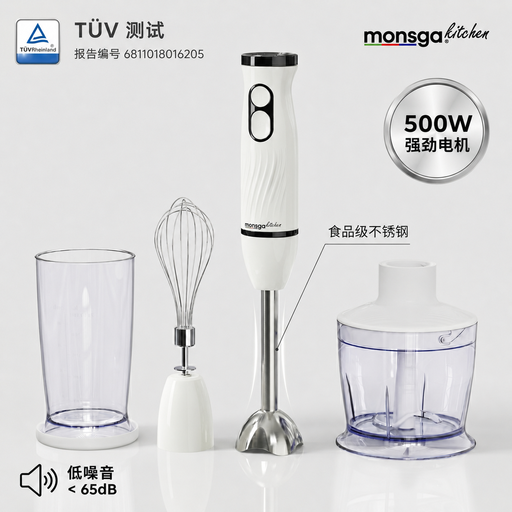
Why This Fits Their Persona: A practical option for smaller UK kitchens and first-time buyers who need blending, whisking and chopping without storing a full-size stand mixer.
It provides named accessories and two operating modes rather than relying on a high wattage claim alone. Detachable accessories are listed as dishwasher safe, while the motor base remains wipe-clean.
Includes a blending shaft, RAPIDWHISK, 500ml chopper and 500ml beaker, plus a 36.5cm reach for deeper pans.
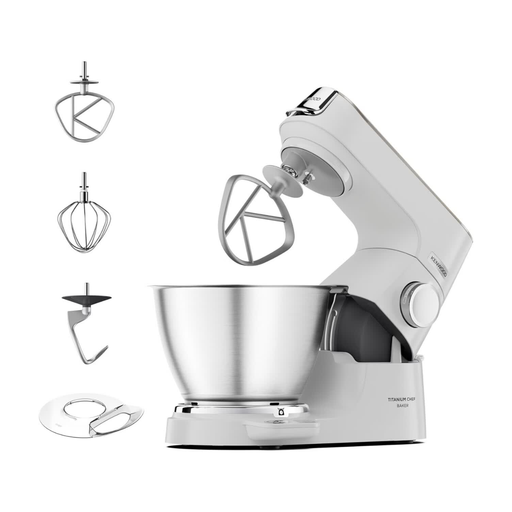
Why This Fits Their Persona: Suits regular home bakers who value built-in weighing, family-sized preparation and the option to expand the mixer’s functions over time.
Its specification lists bowl capacity, dough limits, tools and cleaning guidance, making it easier to compare usable performance rather than headline power.
Features a 1200W motor, 4.6L stainless-steel bowl, EasyWeigh scales and compatibility with over 25 optional attachments.
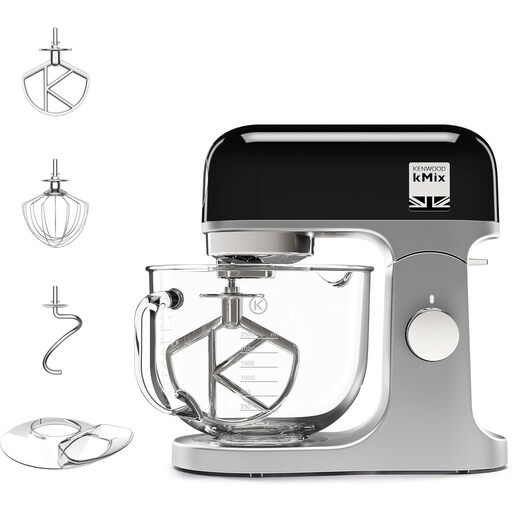
Why This Fits Their Persona: A suitable match for households making bread, brioche, meringue or large cake mixtures and wanting a stable, metal-bodied baking mixer.
The 5L bowl is paired with stated tool types, speed settings and a fold function. Users can still follow the manual’s limits instead of treating the bowl as fully usable capacity.
Offers a 1000W motor, planetary mixing action, 6 speeds plus Fold, and a slow-speed outlet for optional attachments.
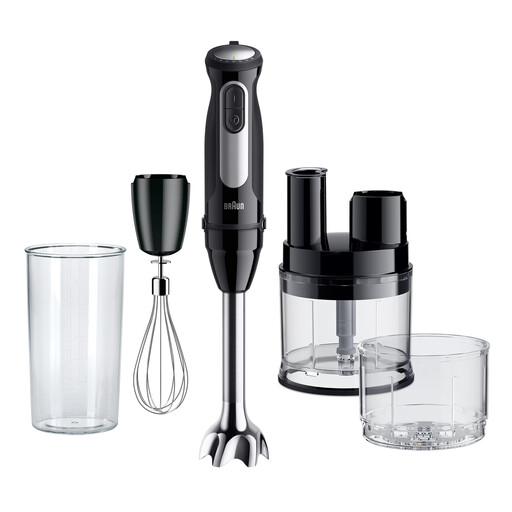
Why This Fits Their Persona: Useful for cooks who prepare soups, sauces, smoothies and chopped ingredients frequently but do not need a permanent worktop appliance.
The 25-speed wheel offers more adjustment than a basic one-speed hand blender, while the detachable system makes accessory changes straightforward.
Includes a 1000W motor, Turbo mode, whisk, mini food processor, slicing/grating disc and ice-crush knife.
We have compiled a complete, real-time list of products that fully satisfy these strict selection criteria and UK safety regulations.
Running cost depends mainly on motor power and operating time. A 1,200W mixer uses more power per hour than a 450W model, but a short mixing cycle may use less electricity than prolonged manual preparation with another appliance. The practical approach is to choose a suitable size and avoid running a powerful motor longer than necessary.
Usually not completely. A stand mixer is designed for bowl-based mixing, whisking and kneading, whereas a hand blender works directly in a saucepan, beaker or chopper. If you make soups and sauces often, a hand blender remains more convenient. Some households use both appliances for different tasks.
There is no single limit for every model. Hand blenders in this selection specify short cycles of up to one minute, while some stand mixer instructions set a ten-minute limit for heavy mixtures followed by a cooling period. Always follow the model-specific manual and never exceed its stated capacity.