Lime-first drinks and cooking makers
If you mainly squeeze limes for drinks, marinades, dressings or desserts, an explicitly suitable cone matters more than a general citrus-juicer label.


For a holiday cottage where you mainly squeeze limes, choose a juicer whose exact model specifies a small cone or a cone designed for fruit of different sizes. A compact model with detachable parts is a practical choice when storage and washing-up matter; a lever-operated press makes more sense if you squeeze fruit often and value its handling and drip control enough to accept a larger appliance.
If you mainly squeeze limes for drinks, marinades, dressings or desserts, an explicitly suitable cone matters more than a general citrus-juicer label.
If you bring an appliance for a short stay, consider where it will sit, how you will put it away and how easily you can clean it after use.
If you prepare several drinks or repeat lime recipes, pay closer attention to pressing effort, pulp control and the parts you will need to wash.
For consumers choosing an electric juicer chiefly for limes in a holiday cottage, start with fruit fit, then balance batch size against storage, pressing effort and clean-up.
Choose when: A small cone suits your limes and you want a model you can put away after use.
Allow for: You hold and press the fruit yourself; jug capacity depends on the model.
Choose when: You squeeze fruit frequently and prefer a handle and drip-control spout.
Allow for: Check the appliance’s dimensions and whether the extra handling features justify the space it takes in your cottage kitchen.
Choose when: You usually serve one drink at a time and want to pour straight into a glass.
Allow for: Check the exact model’s serving arrangement if you plan to prepare several drinks together.
| Concern | What to check | Who this matters to |
|---|---|---|
| Lime fit and batch size | Look for explicit lime suitability and a small or universal cone; match the stated container capacity to your usual servings. | If I make several lime drinks or use juice in a recipe, I need the cone to fit small fruit and the container to suit my batch. Around 42% of consumers put lime fit and batch size first. |
| Storage and setup | Check the exact dimensions, cord arrangement and space available beside a suitable socket. | When I bring a juicer to a cottage or put it away between stays, I need it to fit the available space. For around 33% of consumers, manageable storage and setup come first. |
| Cleaning and handling | Confirm which parts detach, which are dishwasher safe and whether the model offers pulp or drip control. | If I squeeze limes repeatedly in a shared kitchen, I want pressing and clearing up to feel manageable. Easier handling and clean-up are the main concern for around 25% of consumers. |
Fruit size matters: Lakeland and Duronic describe cone sizes suitable for limes, while Sage describes a cone intended to handle fruit from small limes to grapefruit.
Check the exact model’s lime wording and cone design before ordering. If suitability is unclear, ask the manufacturer or retailer.
A larger container may mean less emptying between servings, but it still needs a place on the worktop and in the cupboard.
Choose capacity for the drinks or recipes you usually make, then check dimensions, cord storage and removable parts.
Models list different motors and handling features, but wattage alone does not establish how much juice they will extract from your limes.
Compare explicit lime fit, pressing method, container capacity and cleaning design instead of treating a motor figure as a yield result.
The Health and Safety Executive says visual examination is an essential part of maintaining portable electrical equipment and that annual portable appliance testing is not a universal legal requirement.
Check the plug, cable and casing for visible damage before use, and stop using damaged equipment. If you supply the appliance to guests, follow the electrical-safety duties applicable to your property.
Lakeland’s 600ml electric citrus juicer offers two cone sizes and two adjustable filters.
The Duronic JE407 WE has two cone sizes, an adjustable pulp filter and a stated 700ml capacity.
The Sage Citrus Press is a lever-operated option with a cone described as suitable for limes through to grapefruit.
Smeg describes a direct-to-glass citrus juicer with a 70W motor and non-drip spout.
The Braun CitrusQuick 1 CJ3000WH is a press-down cone juicer with two-way rotation and five pulp settings.
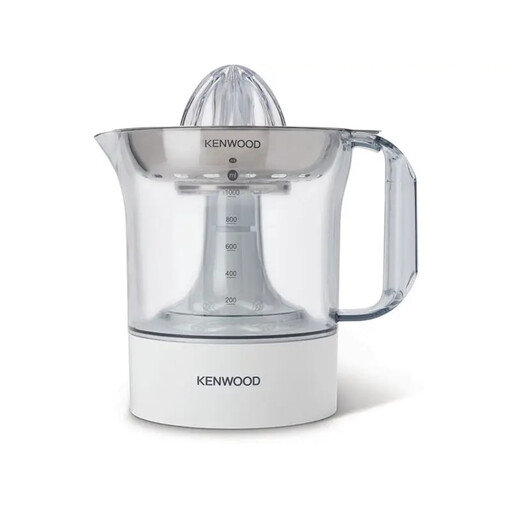
For lime drinks and cooking in a cottage, consider this electric citrus juicer alongside the cone-fit, storage and cleaning checks above.
 No image available
For lime drinks in a cottage, consider the JE290A if its cone and serving arrangement suit the fruit and quantities you use.
Check that the cord reaches your intended socket and that the plug is suitable before buying.
No, but the exact electric citrus juicer should be suitable for small fruit. Duronic specifies a small cone for limes, Lakeland lists limes among fruit for its two-cone model, and Sage describes a cone that adapts from small limes to grapefruit.
Choose removable parts that you can wash soon after use, and consider a drip-control spout if you serve several drinks. Sage specifies dishwasher-safe operating parts and a drip-stop spout; Lakeland and Duronic describe detachable components, with Duronic also describing dishwasher cleaning.
An annual portable appliance test is not a universal legal requirement: the Health and Safety Executive says inspection or testing frequency depends on the equipment and its environment. If you supply a juicer to paying guests, follow the electrical-safety duties applicable to your property; GOV.UK’s holiday-let guidance on this point is specifically for England.
Check the plug, cable and casing for visible damage, keep the electrical base and cable away from water, and follow the appliance manual. The Health and Safety Executive describes visual examination as an essential part of electrical maintenance.
Compare the terms for the exact model you are considering rather than assuming every product from a brand has the same cover. Lakeland states a three-year guarantee for its 600ml electric citrus juicer; check what a guarantee covers before relying on it.