
24/7 Customer Support

Free returns

Same-day & Next-day Delivery

Quality Guaranteed

Unlock Your Welcome Offers: FREE Delivery | Up to 80% OFF | Free 30-day JoyPlus trial
Download the APP
An electric meat mincer can make fresh mince, sausages and kebbe more convenient, but the wrong model may become an expensive cupboard resident. UK households often focus on wattage or the number of attachments, while overlooking operating limits, cleaning requirements and the type of food they actually prepare.
Before choosing a meat mincer, watch for these common buying traps:
Look beyond the largest wattage printed in the product title. For example, a model described as 300W with 1200W maximum power should not automatically be compared with a unit specified at 1600W without checking how each appliance is intended to operate.
For home use, useful features include:
Prepare meat by removing bones, thick skin, gristle and tough sinew. Cut it into pieces of approximately 2–3cm before placing it in the hopper. Chilling the pieces until firm, without freezing them solid, can also help maintain a more defined texture.
Three screens offer more flexibility than a single fixed setting. Fine, medium and coarse plates can be used for different cooking tasks:
Check the actual hole sizes where available. The Kenwood MG510, for example, lists 3mm, 4.5mm and 8mm screens. This is more useful than simply seeing “three settings” in a product description.
If you are searching for a stainless steel meat mincer, also check which parts are actually stainless steel. A stainless steel mincer head or cutting blade does not necessarily mean the entire housing or internal mechanism uses the same material.
A traditional meat mincer is designed around a hopper, auger and cutting plate. A food processor with meat mincer or multifunctional food processor may instead use a bowl and blade system, which can be more suitable for vegetables, purées, sauces and baby food.
Consider:
Never run a mincer empty, overload the feed tube or push food down with cutlery. Unplug the appliance before assembly, dismantling or cleaning, and handle blades and cutting discs carefully.
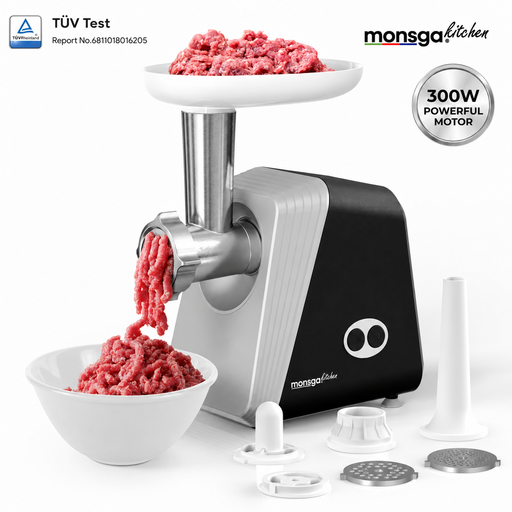
Why This Fits Their Persona: A practical starting point for UK cooks who want fresh mince, occasional sausages or kebbe without buying several separate appliances.
The three included grinding plates provide fine, medium and coarse textures, while overload and overheat protection address common concerns about occasional home use.
Includes sausage stuffer, kibbeh and biscuit-making accessories; compact storage and cord storage support smaller kitchens.
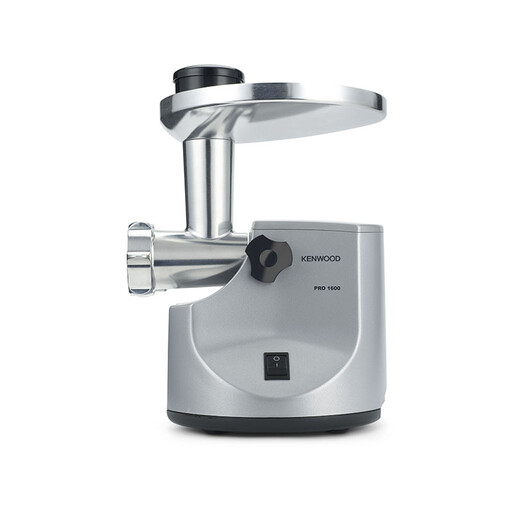
Why This Fits Their Persona: Suits households looking for a substantial appliance for regular mince preparation, larger recipes and batch cooking.
Its listed overload protection, reverse function and specified 15-minute maximum continuous use provide clearer operating guidance than a wattage figure alone.
1600W maximum power, three listed screen sizes, sausage and kebbe attachments, plus dishwasher-safe parts according to the product information.
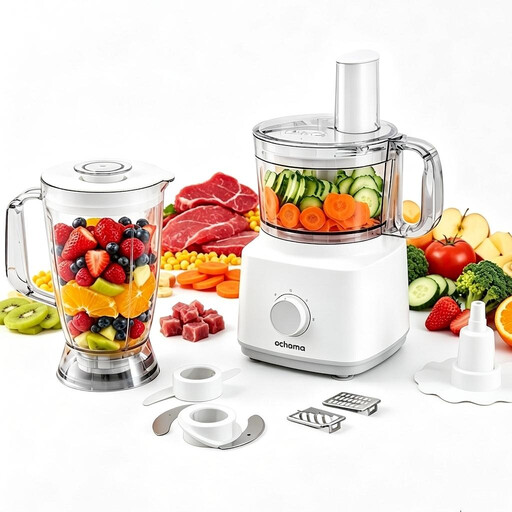
Why This Fits Their Persona: A suitable direction for cooks who need chopping, slicing, grating and purée functions alongside ingredient preparation.
The stated 1.8-litre bowl limit makes capacity easier to assess, while detachable parts are designed for straightforward cleaning.
750W motor, 1.8-litre bowl and functions including chopping, slicing, grating and puréeing.
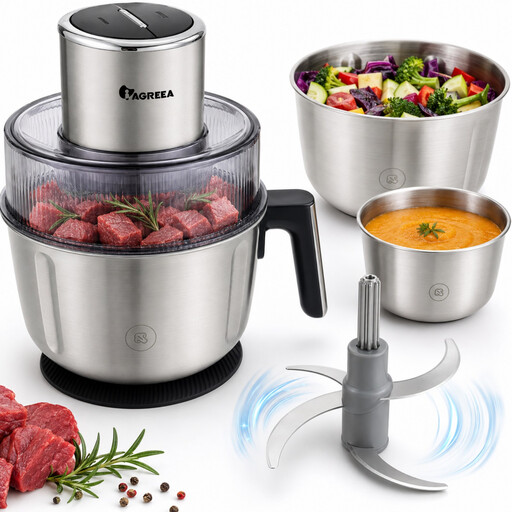
Why This Fits Their Persona: Useful for families preparing meat, chopped vegetables, sauces, purées or baby food in separate bowls.
Three nesting bowls reduce storage pressure, and the stated 30-second pulse cycle sets a clear expectation for controlled preparation.
Includes 2.5L, 2.2L and 1.8L 304 stainless steel bowls, two-speed pulse control and triple-curved blades.
We have compiled a complete, real-time list of products that fully satisfy these strict selection criteria and UK safety regulations.
Yes, provided it matches your batch size and operating instructions. A meat mincer for home use is generally suited to prepared, boneless meat cut into small pieces. Follow the stated cycle and cooling guidance rather than running the motor continuously for an extended period.
Alongside mince for burgers, meatballs and sauces, compatible attachments may support sausage filling and kebbe preparation. A multifunctional food processor can also handle chopped vegetables, purées, sauces and baby food, although its blade-and-bowl system may produce a different texture from a traditional auger mincer.
Running cost depends on the appliance’s rated power, how long it operates and your electricity tariff. Short preparation cycles usually use less energy than extended operation. Compare the stated wattage and recommended operating time, and avoid repeated overloading, which can make preparation slower and place additional strain on the motor.