
24/7 Customer Support

Free returns

Same-day & Next-day Delivery

Quality Guaranteed

Unlock Your Welcome Offers: FREE Delivery | Up to 80% OFF | Free 30-day JoyPlus trial
Download the APP
An electric multi cooker can reduce the need for separate pans, steamers and slow cookers, but not every model suits every kitchen. Some products use “multifunctional” wording for little more than boiling and frying, while others add pressure cooking, rice cooking and timed programmes.
Before choosing an appliance, focus on the specifications that affect everyday use rather than the number of functions printed on the box.
A stated capacity of 5L or 6L does not always mean you can fill the pot to that level. Pressure cooking requires space for steam, while rice, pasta and pulses may expand during cooking. A 5L multi cooker may suit smaller families or meal preparation, but a larger household may benefit from 5.7L, 6L or more.
For steaming, the shape of the basket and the space between tiers matter as much as litres. Check whether the trays can hold the plates or ingredients you normally use.
A cooker described as 9-in-1 or 10-in-1 may include several related settings, such as different pressure or rice programmes. Consider your actual routine:
More presets can be useful, but they should not replace checking temperature controls, timer settings, included accessories and cleaning requirements.
A non-stick cooking pot can make washing easier, but the coating still needs suitable care. Metal utensils, abrasive scourers and overheating may shorten its useful life. Check whether the inner pot is removable, whether accessories are dishwasher-safe and whether replacement parts are available.
Stainless steel avoids a chemical non-stick coating, but food can stick more readily if temperature and oil are not managed correctly. The practical choice depends on whether easy release or long-term scratch resistance is more important to you.
For everyday UK cooking, capacity should match the number of portions rather than the advertised maximum. A 5L cooker can be practical for one to six people when used as a hot pot or steamer, while a 5.7L or 6L pressure multi-cooker gives more room for batch cooking.
If you often cook for guests, look for:
Wattage indicates the electrical input, not a guarantee of cooking speed. A 1200W electric hot pot may be suitable for rapid boiling and simmering, while a 2000W steamer is designed to generate steam across larger, dual-tier trays.
At minimum, look for separate high and low settings or adjustable controls. High heat is useful for boiling and frying; low heat is more appropriate for simmering, slow cooking and keeping food warm. Always place the appliance on a stable, heat-resistant surface and follow the supplied instructions for UK electrical use.
A pressure cooker requires more careful setup than a standard hot pot. The lid must lock correctly, the pot must not be overfilled and steam must be released according to the recipe. Keep your hands and face away from the steam valve, and never force the lid open while pressure remains inside.
When comparing models, check for:
For a non-pressure electric steamer, check water-tank size, refill access and whether the trays can be removed without contacting hot surfaces.

Why This Fits Their Persona: A straightforward option for renters, students and smaller households needing one appliance for boiling, frying, simmering and steaming.
The stated 5L capacity, dual heat control and detachable steamer make its intended uses clear, rather than relying only on a long feature list.
1200W power, non-stick inner pot, detachable steamer and dual-layer cooking design.

Why This Fits Their Persona: Suitable for organised home cooks who want pressure cooking, steaming, rice, slow cooking, sautéing and additional programmes in one countertop appliance.
The pressure function is paired with stated fill-line, steam-release and lid-locking instructions, helping buyers understand the extra care required.
5.7L capacity, 14 preset programmes, ceramic non-stick inner pot and keep-warm function.
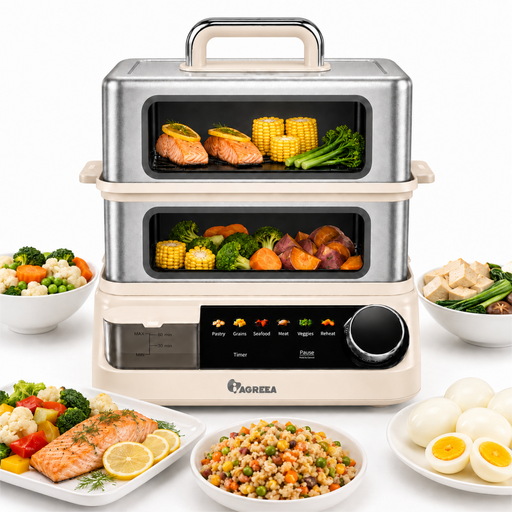
Why This Fits Their Persona: Designed for households that regularly steam several ingredients at once, including vegetables, fish, meat, grains and desserts.
Its 14L volume is supported by two trays, a 2.5L external water tank and six named presets, making it more specific than a generic multifunction claim.
Dual-tier layout, 2000W heating input, viewing windows and external refillable water tank.
We have compiled a complete, real-time list of products that fully satisfy these strict selection criteria and UK safety regulations.
An electric multi cooker uses power according to its wattage and cooking time. A higher-wattage model may heat water or generate steam more quickly, but longer programmes still consume energy. Use the smallest appliance that comfortably handles your portions, avoid unnecessary preheating and switch off the unit when the keep-warm function is no longer needed.
For longer service life:
If your main priority is steaming and boiling, a stainless-steel steamer pot may be easier to maintain than a pressure appliance. For occasional shared meals, an electric hot pot can provide more direct control with fewer components.
Not automatically. Running cost depends on wattage, cooking time, portion size and the cooking method selected. A multi-cooker may reduce the need to heat several appliances at once, but compare the rated power and programme duration before buying.
Many models support both, but the accessories differ. Check for a dedicated rice programme, steaming rack or basket and sufficient clearance above the food. Do not exceed the stated fill line, particularly when cooking rice or other expanding ingredients.
There is no single lifespan for every model. Frequent high-heat use, scratches to a non-stick pot, poor cleaning and worn sealing parts can affect performance. A removable inner pot, accessible accessories and careful adherence to the manufacturer’s instructions can make ongoing ownership more practical.