Family stew batch cooks
You cook chickpea stew for several people and need room for the ingredients, liquid and the headroom required for beans—not just a large capacity figure.


A 5.7L to 6L electric pressure cooker is a useful starting point for family chickpea stew, but the amount you can cook depends on the exact model’s limit for beans and other foamy foods, not its headline capacity. Choose built-in recipe guidance if you want prompts while cooking, or direct programme controls if you prefer to adapt your own stew; check the release instructions and inner pot before deciding.
You cook chickpea stew for several people and need room for the ingredients, liquid and the headroom required for beans—not just a large capacity figure.
You would rather follow clear prompts and model-specific release instructions than work out every pressure-cooking setting yourself.
You want to brown ingredients and pressure-cook the stew in one appliance, while considering whether you would also use its slow-cooking, rice or steaming functions.
For chickpea stew, establish the safe usable batch size before comparing controls and extra cooking functions. Instant Pot UK and Tefal UK describe their respective 5.7L and 6L models as serving up to six people, but those serving claims do not replace the bean-fill instructions for the cooker you choose.
| Concern | What to check | Who this matters to |
|---|---|---|
| Safe chickpea capacity | Check the exact manual’s bean or foamy-food fill limit and minimum-liquid instructions against your usual stew batch. | If chickpeas, vegetables and stock leave too little headroom, I need to make a smaller batch or choose a different bowl size. Around 36% of consumers put safe usable capacity first. |
| Family portions and leftovers | Compare bowl capacity and serving claims with the appliance’s dimensions and available storage space. | I want enough stew for the family and some leftovers without buying a cooker that is awkward to store. For around 29% of consumers, batch size is the primary concern. |
| Cooking speed and control | Confirm pressure-cooking and sauté functions, then review the model’s programme and pressure-release controls. | When cooking from scratch, I would rather adjust my stew recipe than follow fixed prompts, even if that means managing more settings. Direct control comes first for around 21% of consumers. |
| Guidance and cleaning | Distinguish built-in recipes from app-linked features; check which removable parts the manufacturer says are dishwasher-safe. | I want straightforward prompts and a manageable clean-up after a family meal, rather than extra controls I will rarely use. Around 14% of consumers prioritise that convenience. |
Beans and other foamy foods need headroom, so a cooker suitable for family servings may still be overfilled by a full batch of stew. Sage Appliances UK advises filling no more than halfway for beans, grains or pasta in its pressure-cooking guidance.
Check the bean-fill and liquid instructions for the exact model before deciding how much stew to cook at once.
Tefal UK describes built-in guidance for the Cook4me+ CY851840, while some additional recipe and planning features are app-linked. That distinction matters if you prefer to cook without connected features.
Check which recipes and controls are available on the appliance itself before choosing a guided model.
Lid, valve, liquid and release procedures vary by cooker. Following the wrong procedure can create a risk of burns or other injury.
Read the manual supplied with your exact model before its first use, including its instructions for the lid, valve, cleaning and handling the hot inner pot.
Its Duo 5.7L illustrates a multi-cooker route for households that want pressure cooking alongside sautéing and other cooking programmes.
The Cook4me+ CY851840 illustrates a guided 6L cooker for households that want recipe prompts as well as manual modes.
Sage Appliances UK provides guidance relevant to deciding whether pressure cooking or a longer slow-cooked stew better fits your routine.
Its listed 5.7L electric pressure multi-cooker offers another route for cooks considering pressure cooking, sautéing and other one-pot functions.
These multi-cookers offer pressure cooking for a family chickpea stew. Compare their stated capacity and controls, then use the exact model manual to establish a safe chickpea batch size.
 No image available
Consider this model if you want to sauté stew ingredients before pressure cooking them in the same appliance.
The listing states a 5.7L capacity, manual pressure, temperature and time controls, and a ceramic-coated non-stick pot. Check its manual for the bean-fill limit and minimum liquid before planning a batch.
 No image available
Consider this 6L model if you want pressure cooking and sautéing for a family stew, alongside other listed cooking programmes.
The product title specifies 10 programmes and stainless steel. Confirm whether the exact model is MC6SBUK or HMC6SBUK, then consult its manual for the bean-fill limit and minimum liquid.
 No image available
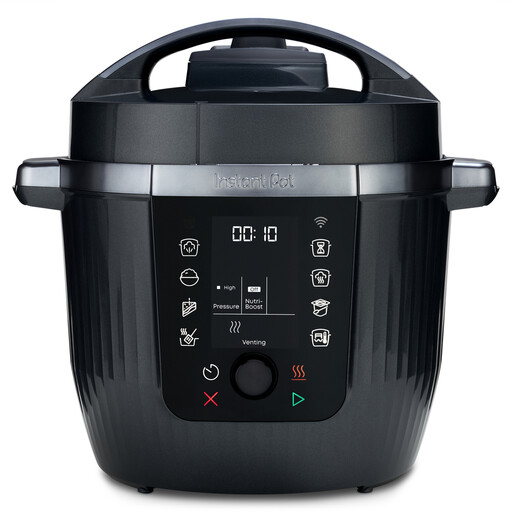
Consider this model if you want to sauté ingredients and pressure-cook a family stew using a cooker with adjustable programmes.
The listing states a 5.7L capacity and stainless-steel inner pot. This Pro model is distinct from the Duo 5.7L discussed above; check the Pro manual for its own bean-fill and minimum-liquid instructions.
A 5.7L to 6L bowl is a starting point: Instant Pot UK positions its Duo 5.7L for up to six people, while Tefal UK describes the 6L Cook4me+ CY851840 as making up to six servings. Those are manufacturer serving claims, so check how much of your stew fits below the exact cooker’s bean-fill limit.
Do not assume that the usual maximum applies to chickpeas. Sage Appliances UK advises filling no more than halfway for beans, grains or pasta; follow the instructions for the exact cooker you use if they set a stricter limit.
Read the manual for your exact model before cooking, particularly its lid, valve, minimum-liquid, fill-level and release instructions. The Instant Pot 5.7L manual also gives model-specific handling and care directions; do not assume they apply unchanged to another cooker.
Check the warranty coverage and return terms on the exact product listing, including who provides the warranty. Terms can differ between models and sellers, so a brand name alone is not enough to establish what is offered with a particular cooker.