Large-batch freezer cooks
If you make soup for several future meals, the usable pressure-cooking fill level matters more than the pot’s headline capacity. You also need space to store and handle a larger appliance.


Choose a cooker by the amount of soup you can pressure-cook below its maximum-fill line, not by its advertised litre capacity alone. A 5.6–6L model is a sensible starting point for routine family-size batches; consider an 8L model if you want larger batches and have room to store and handle it. Guided controls may appeal if you want on-screen prompts, but they do not replace the need to follow the appliance’s filling and release instructions.
If you make soup for several future meals, the usable pressure-cooking fill level matters more than the pot’s headline capacity. You also need space to store and handle a larger appliance.
If you regularly cook several portions, a cooker that can sauté and pressure-cook in one pot may suit your routine without moving to a larger appliance.
If you prefer prompts while learning to make batch-cooked soup, on-screen recipes and a model-specific pressure-release method may influence your choice.
Decide how much soup you want from one cooking cycle, then weigh the cooking controls against the work of cleaning, handling and storing each batch.
| Concern | Buying checks | Who this matters to |
|---|---|---|
| Usable batch size | Compare the pot’s maximum-fill marking with your intended batch, then check the appliance’s dimensions and weight. | If I want to freeze several meals from one cook, I need enough room below the pressure-cooking fill line. Around 34% of consumers put usable batch size first. |
| One-pot cooking | Look for both sauté or browning and pressure-cook modes; allow for heat-up and pressure release when planning your cooking time. | When I soften the soup ingredients before pressure cooking, I would rather use one appliance than move between pans. For around 22% of consumers, fewer active cooking steps are the priority. |
| Handling and cleanup | Check the appliance’s weight and removable-part cleaning instructions, and have containers ready for smaller portions. | A large batch still has to be handled, cleaned up and divided for storage. Manageable post-cooking work comes first for around 22% of consumers. |
| Cooking guidance | Check whether the exact model offers on-screen prompts, manual controls and a pressure-release method you are comfortable following. | If I am new to pressure cooking, I may value clear prompts more than extra capacity. Around 22% of consumers prioritise guidance when choosing. |
The full pot volume is not the amount of soup you can pressure-cook. Instant Pot’s Classic 5.7L instructions require contents to stay below the PC Max – 2/3 line.
Read the fill markings and instructions for the exact model before deciding whether one cycle will make enough portions.
The cited Instant Pot Duo 8L is larger and heavier than the cited Duo 5.7L, even before ingredients are added.
Measure its intended cupboard or worktop space and consider how you will handle the inner pot before choosing the larger size.
Keeping soup warm in a cooker is different from cooling and storing portions for later meals. GOV.UK advises dividing cooked food into smaller portions to help it cool more quickly.
Have suitable containers ready, then cool and refrigerate or freeze the portions in line with the food-storage guidance that applies where you live.
Its cited Duo models offer 5.7L and 8L routes for different batch sizes, with pressure cooking and sautéing among their functions.
The cited Cook4me+ CY851840 is a 6L multi-pressure cooker for cooks who prefer screen-led guidance alongside manual cooking modes.
The cited Express CSC051 is a 5.6L multi-cooker with pressure-cook, slow-cook, steam and brown/sauté modes.
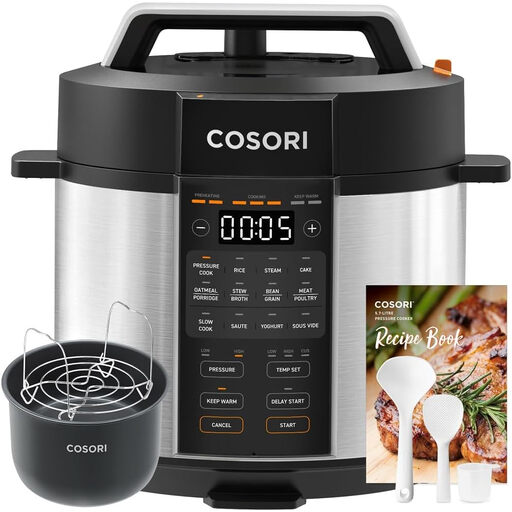
This 5.7L cooker is a choice to consider for routine family-size soup batches when you want to sauté ingredients before pressure cooking. Check its own fill markings to work out how much soup fits in one cycle.
 No image available
For routine soup batches, this 5.7L cooker offers pressure cooking and sautéing in one appliance.
Its product name identifies a ceramic non-stick coating. Check the pot marking and manual for the pressure-cooking fill limit before planning your batch; a separate suitable blending method may be needed if you want smooth soup.
It is a sensible size to consider for a family-size batch: Instant Pot UK positions its Duo 5.7L for up to six portions, while Tefal UK positions its 6L Cook4me+ for up to six servings or batch cooking. The amount you can pressure-cook depends on the exact appliance’s maximum-fill marking and your recipe.
Consider an 8L cooker if a larger batch in one cycle matters more to you than a smaller appliance to store and handle. Instant Pot UK positions its Duo 8L for up to eight people or large batch meal preparation; its usable pressure-cooking fill level still depends on that model’s instructions.
No: follow your cooker’s pressure-cooking fill marking and recipe instructions rather than using its full advertised capacity. For example, Instant Pot’s Classic 5.7L instructions say contents must remain below the PC Max – 2/3 line; check your own model instead of applying that marking to every cooker.
Not necessarily. A cooker with sauté and pressure-cook modes can cover those cooking stages, while a guided model such as Tefal Cook4me+ CY851840 adds on-screen prompts if you prefer help with settings and steps. In either case, follow the model’s filling and pressure-release instructions.
Divide the cooked soup into smaller portions so it can cool more quickly before refrigeration or freezing. For England, Northern Ireland and Wales, GOV.UK advises refrigerating cooked food within one to two hours and eating refrigerated leftovers within 48 hours or freezing them; check the applicable local guidance if you are in Scotland.