Shared-kitchen batch-broth makers
You make vegetable broth for several meals and need to clean the pot, lid and accessories before returning the cooker to shared storage. Plan where the portions will go before making a large batch.


For vegetable broth in a shared kitchen, choose a cooker whose pot and lid you can clean promptly, then match its usable capacity to the broth you can portion and refrigerate. A straightforward 5.7L model may suit routine batches; a Stock shortcut or hands-free steam-release setting is worth considering when you will use it regularly, provided the cooker also fits your worktop and storage space.
You make vegetable broth for several meals and need to clean the pot, lid and accessories before returning the cooker to shared storage. Plan where the portions will go before making a large batch.
You need a place to operate and store the cooker without taking over a shared worktop or relying on an unsuitable socket arrangement. Compare appliance dimensions as well as capacity.
You would use a dedicated Stock setting or a hands-free pressure-release mode, but still need a cooker whose size and cleaning routine work for everyone sharing the kitchen.
Plan how each broth batch will be cleaned and chilled, then check the available worktop, socket and usable cooking volume.
| Concern | What to check | Who this matters to |
|---|---|---|
| Cleaning and storage | Check care instructions for the pot, lid and seal, and make sure you have containers and fridge space for the broth. | I need to clear the cooker for the next housemate and chill the broth promptly after cooking. Around 42% of consumers would put cleaning and storage first. |
| Counter and socket space | Measure the cooker’s position and lid clearance; check its socket instructions and the space needed to release steam safely. | If worktop space and sockets are shared, I need somewhere the cooker can operate without getting in anyone’s way. Around 33% of consumers would make counter and socket space their primary concern. |
| Batch size and controls | Compare usable volume and manual fill limits, then consider whether a Stock programme or particular pressure-release mode suits your routine. | When I make broth often, I want the batch size and controls to match how I cook. For around 25% of consumers, those would be the deciding factors. |
A bowl’s stated size may exceed its usable cooking volume. Sage Appliances UK lists a 6L bowl but a 4L usable volume for the Fast Slow GO.
Plan your batch using the model’s usable volume and manual fill limits, then check that you can portion and refrigerate the broth.
Cleaning instructions differ by model and component. Instant Pot UK specifies a dishwasher-safe pot and lid for the Duo 5.7L, which does not establish how its other parts should be cleaned.
Check the instructions for the exact pot, lid, seal, valve and accessories before agreeing a shared cleaning routine.
Several appliances using the same extension can exceed its rating. Electrical Safety First warns against overloading extensions and adaptors.
Check the cooker’s instructions and use a suitable wall socket where possible. If its instructions permit an extension, check the combined load against the extension’s rating and do not daisy-chain it.
A large batch needs somewhere to cool and then be stored. GOV.UK advises cooling cooked food and putting it in the fridge within one to two hours.
Set aside containers and fridge space before cooking, and divide the broth into smaller portions so it cools more quickly.
Instant Pot UK describes the Duo 5.7L as a multi-cooker with pressure cooking and other cooking functions.
Sage’s Fast Slow GO is a 6L multi-cooker with a Stock shortcut and hands-free pressure-release settings.
COSORI UK presents a 5.7L electric pressure multi-cooker with programmed functions and a steam-release button.
Ninja UK identifies the Foodi OP300UK as a 7-in-1, 6L multi-cooker for uses beyond broth.
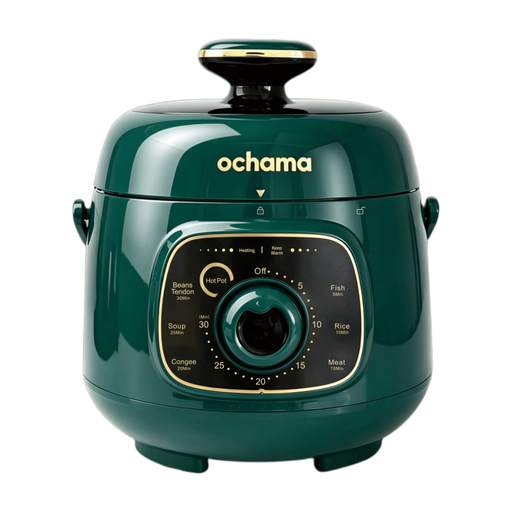
These two electric pressure cookers offer different stated capacities for shared-kitchen broth: consider the 5.7L COSORI for larger planned batches, or the 1.8L ochama when you expect to make less at a time. For either one, check the manual’s usable liquid limits before deciding how much broth to cook.
 No image available
Consider this 5.7L cooker if you plan broth batches for several meals. Its product name specifies a ceramic non-stick coating; check the manual’s liquid fill limit, component-by-component cleaning instructions and required socket arrangement before buying.
 No image available
Consider this 1.8L pressure cooker for smaller broth batches rather than assuming it will serve several housemates at once. Check its liquid fill limit, cleaning instructions and actual dimensions against your cooking and storage space.
Choose by the broth you can portion and refrigerate, the cooker’s usable volume and the space available—not its headline capacity alone. Instant Pot UK states 5.7L for the Duo, while Sage Appliances UK states a 4L usable volume for the Fast Slow GO despite its 6L bowl. Check the manual’s fill limits for your recipe.
Divide cooked broth into smaller portions so it cools more quickly, then refrigerate it promptly. GOV.UK home guidance advises cooling cooked food and placing it in the fridge within one to two hours; reserve enough fridge space before starting a large batch.
Use one only if the cooker’s instructions permit it and the extension is suitable for the combined load. Electrical Safety First warns against overloading or daisy-chaining extensions. The instructions described for the listed COSORI cooker call for a direct wall outlet rather than an extension, so follow that requirement for that product.
Not necessarily: sharing a domestic kitchen does not by itself establish that it is operating as a food business. GOV.UK states that keeping chilled food at 8°C or below is a legal requirement for food businesses in England, Wales and Northern Ireland. If the kitchen is used for commercial food production, check the applicable business requirements with the relevant local authority.