Hosts needing serving headroom
If you are making a substantial chickpea stew for several guests, compare your recipe volume with the cooker’s fill instructions rather than relying on its litre rating alone.


Choose an electric pressure cooker by comparing your stew recipe with its usable pressure-cooking fill level, not its stated capacity alone. If serving headroom is the priority, consider a larger vessel; if following recipe steps or browning ingredients in one pot matters more, check the exact model’s guidance and cooking modes before deciding.
If you are making a substantial chickpea stew for several guests, compare your recipe volume with the cooker’s fill instructions rather than relying on its litre rating alone.
If you are preparing other parts of dinner at the same time, on-device recipe steps and a clearly explained pressure-release method may matter more to you than additional capacity.
If you want to sauté onions and spices before pressure cooking, look for an appropriate mode on the exact model. A sauté mode may also let you reduce the stew after cooking.
Work out how much stew you intend to make and check the model’s fill instructions before weighing up guidance, timing controls and extra cooking modes.
| Concern | What to check | Who this matters to |
|---|---|---|
| Usable capacity | Compare recipe volume with the exact model’s pressure-cooking fill limit, particularly if cooking dried chickpeas. | I need enough stew for my guests without overfilling the cooker; around 36% of consumers put usable capacity first. |
| Dinner timing | Check the cooking stages your recipe requires and whether the model’s timing or keep-warm controls suit them. | Coordinating the stew with the rest of dinner is my main concern, rather than adding more cooking functions; roughly 29% of consumers prioritise timing. |
| Operating guidance | Check for on-device recipe steps and read the exact model’s pressure-release instructions. | I want clear steps for using pressure and opening the cooker while preparing a meal for guests; around 21% of consumers put operating guidance first. |
| One-pot cooking | Look for a brown/sauté mode if you plan to cook the aromatics or reduce the finished stew in the pot. | Avoiding a separate pan for preparation and finishing matters most to me; approximately 14% of consumers prioritise one-pot cooking. |
The vessel’s full volume is not necessarily its usable pressure-cooking volume. The Instant Pot Duo manual limits ordinary contents to two-thirds of capacity and expanding foods, such as dehydrated vegetables, to one-half.
Check your finished recipe yield against the exact cooker’s fill marks and manual before choosing a size.
Tefal describes automatic pressure release and on-device recipes for its Cook4me+ CY851840; those features should not be assumed for another cooker.
Check the model’s controls and release instructions, and follow its manual before opening the lid.
A dinner-party batch can leave a substantial amount of stew to cool. The Food Standards Agency advises dividing cooked food into smaller portions so it cools more quickly before refrigeration or freezing.
Set aside suitable containers and fridge space before serving rather than leaving leftovers in the cooker bowl for storage.
Instant Pot describes its Duo 5.7L and 8L pressure-cooking models as options for entertaining and batch cooking.
Tefal’s Cook4me+ CY851840 is a 6L pressure cooker with on-device recipe guidance and manual cooking modes.
Crock-Pot’s 5.6L Express CSC051 combines pressure cooking with other modes that may suit one-pot stew preparation.
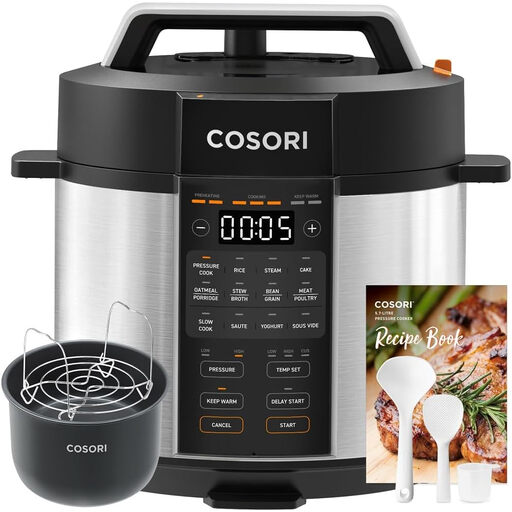
This multi-function pressure cooker is worth considering if you want to sauté ingredients and pressure-cook the stew in one appliance. Check its manual against your planned batch size before buying.
 No image available
A choice for hosts who want to sauté ingredients before pressure-cooking a chickpea stew.
Stated capacity: 5.7L. The product name lists a ceramic non-stick coating, slow-cook and steamer functions, and a recipe book.
Check the exact model’s fill limit for expanding ingredients and compare your recipe volume with the usable space; the 5.7L rating alone does not establish a dinner-party serving yield.
Choose a size that fits your recipe within the exact model’s pressure-cooking fill limit. Instant Pot describes its Duo 5.7L and 8L as six- and eight-portion models respectively, but its Duo manual limits ordinary contents to two-thirds of capacity and expanding foods to one-half; stated portions are only a starting point.
Yes, if the model has a suitable brown/sauté mode. Crock-Pot lists one for its Express CSC051, and Instant Pot lists sauté capability for the cited Duo model; follow the relevant cooker’s instructions when switching to pressure cooking.
Divide leftovers into smaller portions to help them cool before refrigeration or freezing, as the Food Standards Agency advises. Arrange containers and fridge space in advance rather than relying on the cooker bowl for storage.
Follow the exact model’s pressure-release instructions and wait until pressure has completely dropped before opening it. The Instant Pot Duo manual also calls for checking that valves are unobstructed before use; do not assume another model has the same release controls.