Regular curry batch cooks
If you make several portions for family meals, leftovers or freezing, usable pressure-cooking space matters more than the capacity printed on the box.


For regular family-sized lamb-curry batches, start by comparing 5.6–6L pressure multi-cookers with a browning or sauté function. Consider a 7.5–7.6L model if you routinely make larger batches, but check the exact cooker’s pressure-fill limit before deciding how much curry it can hold; extra programmes matter only if you will use them.
If you make several portions for family meals, leftovers or freezing, usable pressure-cooking space matters more than the capacity printed on the box.
If you want to brown lamb and soften onions before pressure cooking, a sauté function can keep those steps in the same pot.
If you are learning to use a sealed cooker, clear controls, release instructions and recipe guidance may matter more to you than a long programme list.
Start with the amount of curry you intend to make and the model’s pressure-fill rules, then decide whether one-pot browning and guided controls would improve your routine.
| Concern | What to check | Who this matters to |
|---|---|---|
| Usable batch capacity | Compare the rated capacity with the exact model’s pressure-fill mark after accounting for meat, sauce and other ingredients. | I want enough room for my usual curry batch without exceeding the pressure-fill limit; around 36% of consumers put usable batch capacity first. |
| One-pot workflow | Confirm that the exact model offers both pressure cooking and browning or sautéing. | When cooking after work, I would rather brown the lamb and cook the curry base without using another pan; around 29% of consumers prioritise that one-pot workflow. |
| Controls and clean-up | Read the manual for setup and steam release, and check which removable parts can be washed as you prefer. | If I am new to pressure cooking, I want to understand the controls and release process before making a full batch; around 21% of consumers make ease of use their primary concern. |
| Leftover handling | Plan how you will portion, cool, label, freeze and thoroughly reheat the curry. | When I cook ahead for later meals, I need portions I can store and reheat without repeatedly warming the whole batch; around 14% of consumers put leftover handling first. |
A cooker’s rated capacity is not its usable pressure-cooking volume. The Instant Pot Classic manual, for example, requires contents to stay below its PC Max 2/3 line.
Compare your recipe quantity with the pressure-fill limit in the manual for the model you intend to buy.
If the appliance lacks browning or sautéing, your preferred curry method may call for a separate pan before pressure cooking.
Check for both functions on the exact model if cooking the curry base in one pot matters to you.
The cut and size of the lamb pieces, recipe liquid, starting temperature and fill level can all affect your cooking plan. A programmed cooking time also leaves out heating and pressure release.
Follow the model’s manual and a suitable recipe, allowing for the full process rather than the programme time alone.
Making several portions is useful only if you can cool, store and reheat them appropriately. GOV.UK food-business guidance advises dividing food into smaller portions before freezing and reheating food until steaming hot throughout.
Portion and label the curry, and follow food-safety guidance appropriate to your setting when storing and reheating it.
You may also need freezer-safe containers and labels for the portions you intend to keep.
Its Classic 5.7L is a reference point for a family-sized cooker with pressure cooking and sautéing.
The Express CSC051 is a 5.6L example for cooks who want to brown ingredients and pressure cook in one appliance.
The range includes the guided 6L Cook4me+ and the larger 7.6L Turbo Cuisine & Fry.
The Foodi MAX OP500UK is a 7.5L option for cooks considering a larger multi-cooker.
These 5.7L choices fit the family-sized pressure-cooker route if you want to sauté the curry base before pressure cooking. For either model, use its own manual to decide how much curry can be cooked under pressure.
 No image available
Consider this model if you want to sauté ingredients before pressure cooking a family-sized curry batch.
The named variant has a 5.7L rated capacity and ceramic non-stick coating, and includes a recipe book. Check its manual for the pressure-fill and liquid requirements before setting your batch size.
 No image available
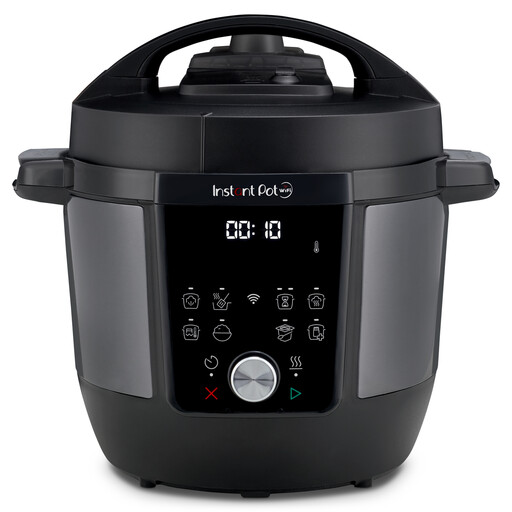
Consider this model for a curry workflow that starts with sautéing and continues with pressure cooking in the same appliance.
This Plus variant has a 5.7L rated capacity and a black finish. Check the Plus manual’s pressure-fill and liquid instructions rather than applying the Classic model’s figures to it.
Start with 5.6–6L models for regular family-sized batches, and compare 7.5–7.6L models if you routinely want larger batches or more portions to freeze. Instant Pot UK and Tefal UK position examples in the smaller range for family meals or batch cooking, but your recipe must still fit below the exact model’s pressure-fill limit.
No, but it lets you brown lamb and cook onions or spices in the cooker before pressure cooking if you want a one-pot method. Crock-Pot describes using the Express CSC051’s brown/sauté setting before pressure cooking; without that function, use a separate pan if your recipe calls for browning.
No: the rated capacity is not the permitted pressure-cooking fill volume. For the Instant Pot Classic 5.7L, the manual says contents must remain below the PC Max 2/3 line and gives liquid requirements; check the manual for your exact model before sizing a batch.
Plan to divide the cooked curry into smaller portions, cool and label portions intended for freezing, and reheat a stored portion thoroughly. GOV.UK food-business guidance advises smaller portions before freezing and says reheated food should be steaming hot throughout; follow guidance appropriate to your household or food-service setting rather than treating business rules as household law.