
24/7 Customer Support

Free returns

Same-day & Next-day Delivery

Quality Guaranteed

Unlock Your Welcome Offers: FREE Delivery | Up to 80% OFF | Free 30-day JoyPlus trial
Download the APP
Electric ride-on cars can make memorable birthday and Christmas gifts, but the product photographs do not always reveal what matters during everyday use. Parents and grandparents are usually comparing speed, battery life, remote control, realistic styling and price, while also trying to avoid a vehicle that is too large, difficult to charge or unsuitable for the child.
The right electric ride-on car for children should match the rider’s age, weight, height and typical play surface. It should also offer straightforward adult supervision and clearly stated specifications.
A 12V kids electric car is common for children aged approximately 3–6, but voltage alone does not tell you how the car will perform. Motor configuration, surface, rider weight and driving style also affect speed and battery duration.
For example, two 12V models may have different maximum loads, run times or suspension systems. A vehicle advertised as powerful may still be unsuitable if the seat is narrow or the car is too large for your available play area.
Battery duration is normally measured under particular conditions. Grass, slopes, frequent reversing, heavier loads and repeated stops can reduce play time. Many models in this category quote approximately 40–60 minutes per full charge, followed by 8–12 hours of charging.
Check whether the product includes a battery indicator. This practical feature helps prevent the car stopping unexpectedly during outdoor play. Also remember that remote controls commonly require separate AAA batteries, which may not be included.
A licensed ride-on car can recreate the appearance of a familiar vehicle, with details such as branded styling, butterfly doors or realistic lights. However, licensing relates to design and branding, not necessarily to extra battery capacity or stronger suspension.
Compare the objective specifications: maximum load, seat dimensions, wheel size, control range, speed settings and safety features. These are more relevant to everyday use than the badge on the bonnet.
Age guidance is a starting point rather than a substitute for checking fit. Several children’s electric car ages 3–6 models have a maximum load of 25–30kg, while some designs specify a recommended height range.
Measure the child’s seated height and compare it with the seat size. A one-seat model is intended for one rider only, even if the vehicle looks spacious. Avoid choosing solely by age if the child is particularly tall or close to the stated weight limit.
A kids ride-on car with remote control gives an adult the ability to manage direction and speed when required. This is particularly useful for younger or inexperienced riders. Remote ranges in the supplied models vary from approximately 15m to 25m, so check the exact listing.
Manual controls typically include a pedal, steering wheel and forward/reverse selection. Models with a soft-start function gradually build speed rather than moving abruptly. Maximum speeds around 3–5km/h are broadly comparable with walking pace, but children should still be supervised continuously and kept away from roads, driveways with moving vehicles, stairs and steep slopes.
Look for a combination of PP plastic and metal, wide wheels, a seat belt and suspension where outdoor use is expected. Suspension can help on flat grass, brick or firm gravel, but it does not turn a toy vehicle into an off-road vehicle. Follow the surface guidance supplied with the product.
Listings may refer to EN71-1-2-3 and EN62115, with some also mentioning EMC or other technical standards. These references relate to toy safety and electrically operated ride-on toy requirements. Always check the product instructions, warnings and supplied documentation, and inspect the vehicle after assembly before allowing a child to ride.
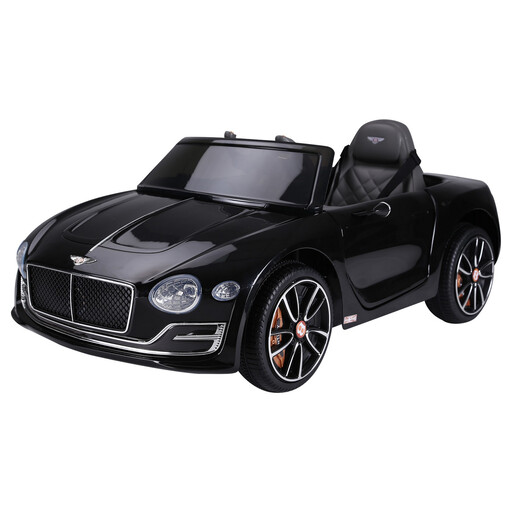
Why This Fits Their Persona: A relatively straightforward 12V battery-powered ride-on car for families seeking familiar controls and entertainment features without selecting a larger off-road design. It is listed for ages 3–5 and has a 30kg maximum load.
The listing states a 45-minute run time, charging guidance, battery display and remote control, making the core ownership details easier to assess.
Seat belt, rear-wheel suspension, LED lights, MP3 player, horn and a 2.4G remote control.
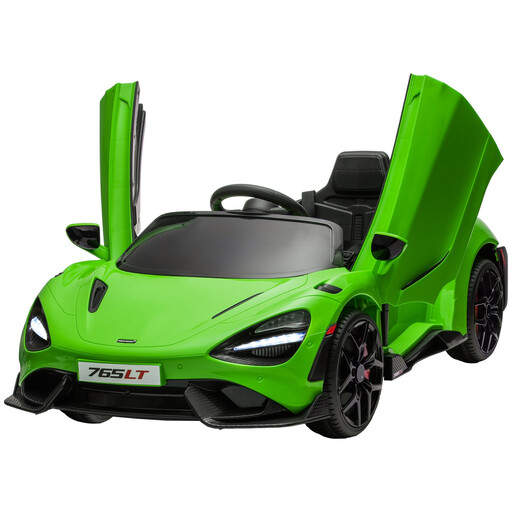
Why This Fits Their Persona: A realistic licensed ride-on for gift buyers who value styling alongside practical controls. It is specified for ages 3–6, with one seat, a 25kg maximum load and transport wheels.
The soft-start feature, stated 3–5km/h speed, 15m remote distance and battery indicator provide useful detail beyond the licensed appearance.
Butterfly doors, LED lights, music, horn, suspension and manual or parental remote control.
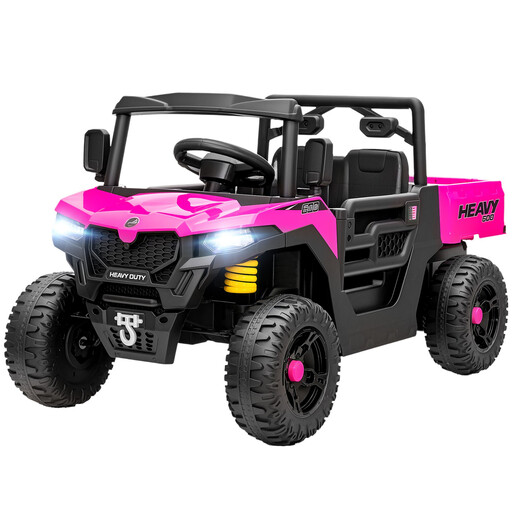
Why This Fits Their Persona: Designed for children who enjoy imaginative outdoor play, collecting toys or exploring larger garden spaces. It supports up to 30kg and is listed for ages 3–8.
Its speed is stated as 1.8–3.7km/h rather than relying on vague performance language, while soft start and four-wheel suspension address comfort and control.
Functional electric dump bed, dual 12V motors, four-wheel suspension, remote control, USB, TF card and MP3 inputs.
We have compiled a complete, real-time list of products that fully satisfy these strict selection criteria and UK safety regulations.
Assembly should be completed by an adult on a stable surface. Charge the battery fully according to the manual before the first ride, and unplug the charger before switching the vehicle on. Check that wheels, steering, seat belt, screws and electrical connectors are secure.
For regular use:
A ride-on car with lights and music may be entertaining, but these functions can draw additional battery power. If run time is important, prioritise battery capacity, charging instructions and the type of surface where the car will be used.
Some smaller models can be used indoors, provided there is enough clear space and the flooring is suitable. Larger 12V cars can measure more than one metre long, so check doorways, storage areas and turning space first. Never use them near stairs, glass doors or other hazards.
The electricity used for charging is generally modest, but the exact cost depends on the battery, charging frequency and household electricity tariff. The longer-term costs are more likely to involve replacement batteries, remote-control batteries and occasional parts. Follow the charging cycle in the manual to help preserve battery performance.
Service life depends on storage, usage, rider weight, terrain and maintenance. A model used on flat, dry surfaces and stored away from damp conditions may remain suitable for longer than one regularly used on rough ground. Check the stated age range and maximum load before buying, then reassess fit as the child grows.