
24/7 Customer Support

Free returns

Same-day & Next-day Delivery

Quality Guaranteed

Unlock Your Welcome Offers: FREE Delivery | Up to 80% OFF | Free 30-day JoyPlus trial
Download the APP
Electric ride-on cars for kids can provide imaginative outdoor play, but choosing one involves more than picking a colour or character. Parents and grandparents also need to consider battery voltage, rider capacity, charging time, terrain, supervision and available storage space.
A low price can be tempting, yet an unsuitable vehicle may become difficult to use if the seat is too small, the battery takes too long to recharge or the wheels are not suited to the garden surface. Use the guide below to compare children's electric cars based on practical features rather than marketing language.
A 12V ride-on car and a 24V ride-on car are designed for different types of use. Voltage can affect motor configuration and performance, but it does not by itself confirm that a vehicle is appropriate for your child or garden.
A lower-voltage vehicle may be more manageable for a younger or first-time rider. A 24V model may offer more power and a higher weight capacity, but it can also be larger, heavier and less suitable for very confined spaces. Always check the stated speed, recommended age, weight limit and surface guidance together.
A battery-powered ride-on car should be easy to start, stop and steer. Soft-start technology, adjustable speed settings and a parental remote control ride-on car function can be more useful than a higher maximum speed.
Remote controls are particularly helpful when a child is still learning. However, adult supervision remains necessary, and a remote should not be treated as a substitute for watching the child. Check the stated remote range too: one model below lists a range of up to 15 metres.
Product photographs can make a children's electric vehicle appear smaller than it is. Measure doorways, sheds, lifts and storage areas before ordering. Also check whether there is a suitable indoor, dry location for charging.
A listed run time is normally an approximate maximum and can vary with rider weight, surface, temperature and driving style. Charging may take several hours, so a vehicle used regularly may need to be charged after every outing.
A 6V ride-on can suit simple flat-surface play, while 12V models commonly provide a balance between control and outdoor capability. The Disney Cars Lightning McQueen model has a 6V battery, a maximum speed of 4 km/h and up to 40 minutes of continuous play per charge.
For more demanding outdoor use, look at motor count and wheel design as well as voltage. The 24V two-seater ride-on truck listed below uses four 24V, 35W motors and offers three speed settings between 5 and 7 km/h.
A two-seater ride-on car can be practical for siblings or friends, but it needs enough seat width and a suitable combined weight capacity. Do not assume that two seats mean two children of any size can ride comfortably. Check the maximum load and the individual product instructions.
Single-seat models can be easier to store and manoeuvre. The AIYAPLAY electric UTV with dump bed has a 30 kg maximum load and is specified for one rider, whereas the two-seater truck has a 50 kg maximum load.
A ride-on car for ages 3-8 may be used on patios, driveways, grass or compact gravel, but surface performance depends on wheel size, traction and suspension. Four-wheel suspension or spring suspension can help reduce jolts on suitable outdoor surfaces, while textured or traction-strip tyres can improve grip.
No toy ride-on vehicle should be used on public roads. Clear the riding area of steps, ponds, traffic, sharp edges and loose obstacles. Follow the manufacturer’s age, weight and surface instructions, and check fasteners regularly.
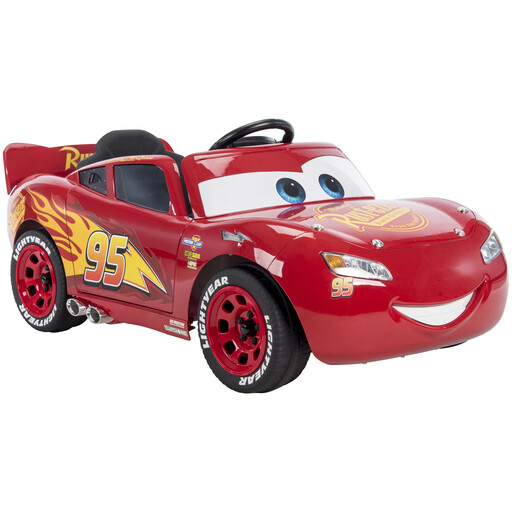
Why This Fits Their Persona: A straightforward option for a first ride-on, particularly when a child is attracted to character-themed play and will use it on flat pavements or driveways.
Its stated 4 km/h maximum speed and foot-pedal operation provide clear expectations, while traction-strip tyres are intended for suitable flat surfaces.
6V rechargeable battery, working headlights, character sounds and up to 40 minutes of listed play time.
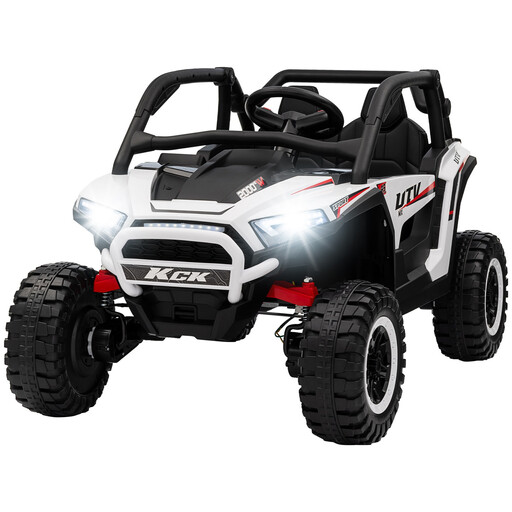
Why This Fits Their Persona: Suitable for households wanting a larger vehicle with adjustable speeds, spring suspension and room for siblings or friends.
The specification states two seats, seatbelts, a 50 kg maximum load and both manual and remote operation, helping buyers assess capacity before purchase.
24V 7Ah battery, four motors, spring suspension and up to 60 minutes of listed run time.
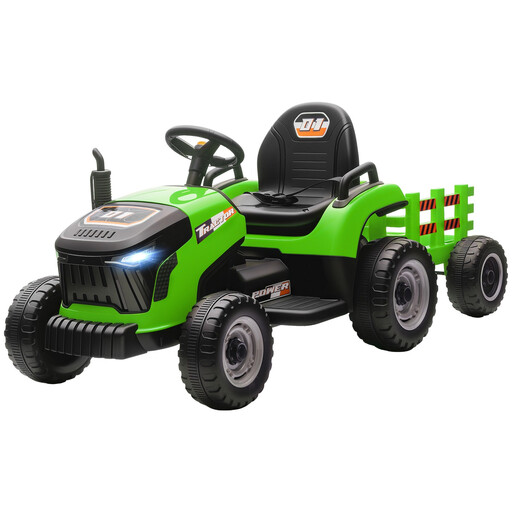
Why This Fits Their Persona: A practical match for children who prefer farm, gardening or construction-style role play in a garden or on suitable hard surfaces.
Its detachable trailer has a defined role-play purpose, while six wheels, soft start and a stated 3-5 km/h speed clarify how it is intended to be used.
Detachable trailer, six textured wheels, remote control and up to 60 minutes of listed riding time.
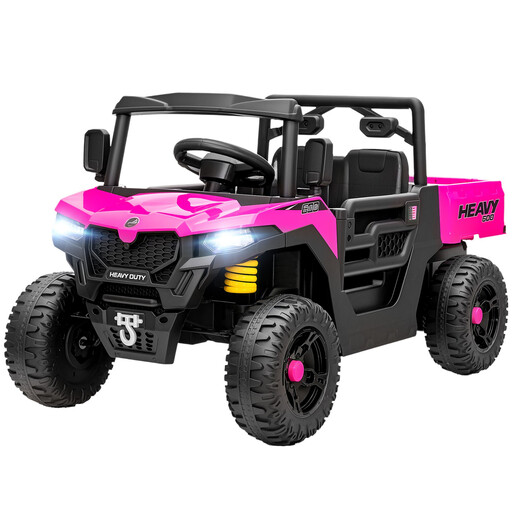
Why This Fits Their Persona: A single-rider choice for children who enjoy transporting toys, collecting leaves or creating their own outdoor missions.
The listing specifies a single rider, 30 kg maximum load, soft start, four-wheel suspension and a 1.8-3.7 km/h speed range.
Functional electric dump bed, parental remote control, USB/TF/MP3 ports and EN71-1-2-3 testing stated in the product information.
We have compiled a complete, real-time list of products that fully satisfy these strict selection criteria and UK safety regulations.
Before the first ride, assemble the vehicle according to the manual, charge the battery fully and check the steering, wheels, seatbelt, remote control and fasteners. Keep the charger dry and use only the supplied or specified charger.
Electricity use is usually modest because these vehicles use low-voltage rechargeable batteries, but the practical cost depends on charge frequency, battery capacity and local electricity tariffs. A 12V 4.5Ah battery stores less energy per full charge than a 24V 7Ah battery, although actual consumption also depends on motor load and charging losses.
Store the vehicle indoors or under suitable cover, avoid leaving the battery flat for extended periods and inspect it before each use. Replace damaged cables, cracked wheels or loose components before allowing a child to ride.
Some are specified for children from age three, but suitability depends on the individual child’s coordination, size and ability to follow instructions. Choose a low-speed model with soft start where possible, use the seatbelt if supplied and supervise directly.
The products above list approximately 40 to 60 minutes of use per charge. Real-world duration can be shorter on grass, gravel, slopes or with a heavier rider. Charging times commonly range from around 8 to 12 hours, so check the product details before planning frequent outings.
Some models are specified for grass and other suitable outdoor surfaces, particularly those with suspension and larger textured wheels. They should not be used on steep slopes, wet or slippery ground, public roads or areas with traffic. Always follow the product’s surface guidance and supervise the child.