
24/7 Customer Support

Free returns

Same-day & Next-day Delivery

Quality Guaranteed

Unlock Your Welcome Offers: FREE Delivery | Up to 80% OFF | Free 30-day JoyPlus trial
Download the APP
An electric sander can remove old paint, smooth timber, prepare furniture for finishing and clean up light rust far more quickly than hand sanding. However, buying based only on wattage or advertised speed can lead to poor results, excessive dust and a tool that is uncomfortable to use.
The most suitable model depends on the size of the surface, the level of detail required and the abrasive system. Before choosing, consider these common buying pitfalls.
A higher revolutions-per-minute or oscillations-per-minute figure does not automatically mean faster or cleaner sanding. Excessive speed can produce heat, remove too much material or damage softer wood. A variable speed sander gives more control when moving between rough stock removal and delicate finishing.
A 125mm random orbital sander covers broad, flat areas efficiently, but it is not designed for narrow corners. A detail or mouse sander has a pointed pad for edges and awkward spaces, yet its smaller surface makes it slower on large tabletops or doors.
Check the pad dimensions and replacement abrasive availability before buying. A tool that uses a common size, such as a 125mm sander, is generally easier to maintain.
Sanding dust can spread throughout a room and obscure the work surface. A small dust bag may be useful for occasional work, but an orbital sander with dust collection that accepts a vacuum adapter is more practical for longer projects. Dust extraction does not remove the need for suitable eye and respiratory protection.
A random orbital sander combines rotation with an orbital movement. This helps reduce visible swirl patterns when the tool is used correctly and is suitable for furniture, doors, panels and general woodwork. It can also be used on some metal and painted surfaces with the appropriate abrasive.
A detail sander or mouse sander uses a pointed base. It is more suitable for chair spindles, window frames, mouldings, corners and small restoration projects. For paint and rust removal, check that the product description specifically lists those applications and use a suitable grit rather than forcing the machine.
Wattage indicates electrical input, but it should be considered alongside the sanding action, pad size and speed range. For example:
Six speed settings, such as 6,000–13,000 rpm or up to 13,000 rpm, allow adjustment for different materials. Begin with a lower setting on softwood, veneer or painted surfaces and increase gradually if necessary.
Hook and loop sanding discs or sheets make abrasive changes quick, but the shape and hole pattern must match the backing plate. Aligning the holes is important because they help air and dust move towards the collection system.
Aluminium oxide is a widely used abrasive for wood, painted surfaces and some metal preparation. A practical selection of sanding sheets should include several grades:
Do not skip too many grit stages, as coarse scratches may remain visible. Replace paper when it becomes clogged or noticeably slower.
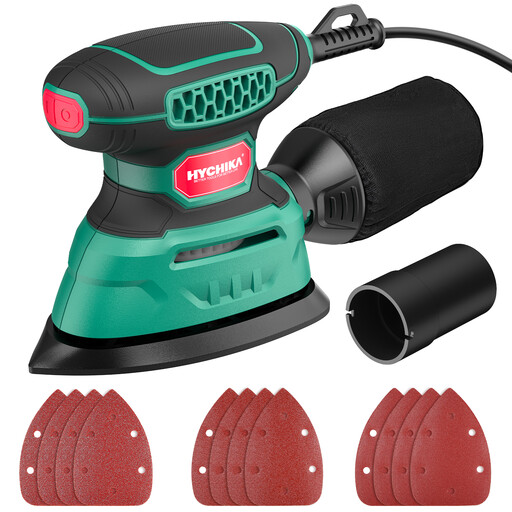
Why This Fits Their Persona: A compact option for occasional furniture touch-ups, small wooden projects and detail work around the home.
Its pointed detail base is more appropriate for tight spaces than a full-size orbital pad, while the dust bag and vacuum adapter provide two collection options.
140W motor, 13,000 OPM operation and 12 sheets in P80, P120 and P240 grades.
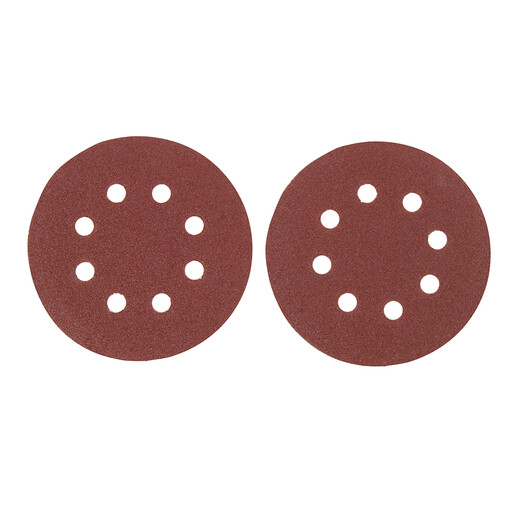
Why This Fits Their Persona: A 125mm format suits homeowners and furniture makers who need even coverage on panels, shelves and larger flat surfaces.
The integrated port and reusable dust bag address dust management, while the vibration-reduced grip is designed for more controlled use.
240W motor, 125mm sanding base, hook-and-loop attachment and two included sheets.
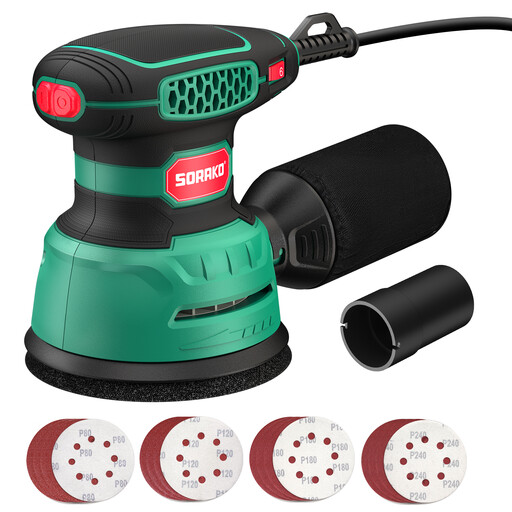
Why This Fits Their Persona: A corded 230V model with a 125mm pad and multiple speed settings is suited to frequent home improvement, furniture repair and larger sanding tasks.
Six adjustable speeds offer more control than a single-speed tool, and the dust bag or external collector helps limit loose debris.
350W motor, speeds up to 13,000 rpm, quick brake function and 16 abrasive sheets from P80 to P240.
We have compiled a complete, real-time list of products that fully satisfy these strict selection criteria and UK safety regulations.
Before operating any electric sander:
Avoid sanding unknown old coatings until you have considered the possibility of lead-based paint or asbestos-containing materials. Follow current UK safety guidance and the tool’s instructions, particularly when working indoors.
Yes. A random orbital sander is suitable for many wooden surfaces, including furniture, doors and boards. Use a coarse grit for removal and finer aluminium oxide sanding paper for surface preparation. Keep the tool moving to avoid uneven patches.
Both are compact sanders designed for corners and intricate areas. The terms are often used interchangeably, although individual models may differ in pad shape, power, dust extraction and included accessories. Check the replacement sheet shape and hole pattern before buying.
Running cost depends on the tool’s wattage and your electricity tariff. A 300W sander uses approximately 0.3 kilowatt-hours per hour of continuous operation, although actual use is usually intermittent. A lower-wattage detail sander may use less electricity, while a higher-powered model may complete a large task more quickly. Examine the wattage, expected working time and project size together rather than relying on motor power alone.