
24/7 Customer Support

Free returns

Same-day & Next-day Delivery

Quality Guaranteed

Unlock Your Welcome Offers: FREE Delivery | Up to 80% OFF | Free 30-day JoyPlus trial
Download the APP
Choosing an electric scooter for your child can be an exciting prospect, promising hours of outdoor fun. However, the market is filled with options that can be confusing for parents. It is easy to be swayed by flashy features and marketing claims, only to end up with a product that is unsuitable, unsafe or outgrown within a year.
As the Joybuy Product Recommendation Officer, my role is to help you navigate these choices with practical, objective advice. This guide will highlight the common purchasing pitfalls and focus on the core features that ensure you select a safe, durable and enjoyable scooter for your child.
Before looking at what to buy, it is crucial to understand what to avoid. Many parents find themselves disappointed by purchases that fall short of expectations due to these common issues.
To make an informed decision, focus on these essential parameters that directly impact safety, usability and longevity.
The motor is the heart of any children's electric scooter. For younger children (ages 6-8), a motor around 120W providing a top speed of 8-10 km/h is generally sufficient for learning and recreational fun. For older children (ages 9-14), a more powerful 200W motor offering speeds up to 16 km/h can provide a more engaging ride.
Always check for a non-zero start feature. This safety mechanism requires the rider to push the scooter to a slow walking pace (around 3-5 km/h) before the thumb or twist throttle will activate the motor, preventing abrupt and uncontrolled starts.
A scooter's frame should be made from sturdy materials like steel or aluminium to ensure it can handle regular use. Pay close attention to the maximum weight capacity. For added stability, especially for beginners, a 3 wheel electric scooter offers a more balanced platform.
Braking is a critical safety feature. Most kids' scooters use a rear foot brake, which is intuitive for children familiar with a traditional kids kick scooter. Some models for older children may feature an electronic handbrake, which can offer more responsive stopping power. Solid rubber or polyurethane (PU) wheels are common and have the advantage of being puncture-proof, though they offer a firmer ride than air-filled tyres.
To ensure the scooter grows with your child, look for an adjustable scooter for kids with multiple handlebar height settings. This not only extends the product's usable life but also ensures a comfortable and ergonomic riding posture.
If you plan to transport the scooter in a car or store it in a small space, a foldable kids scooter is a practical necessity. Check the folded dimensions and weight to ensure it is manageable to carry. Finally, features like a scooter with LED lights are not just for looks; they significantly improve visibility during overcast days or in the evening.
To help you match a product to your child's needs, here are a few recommendations based on different user profiles.
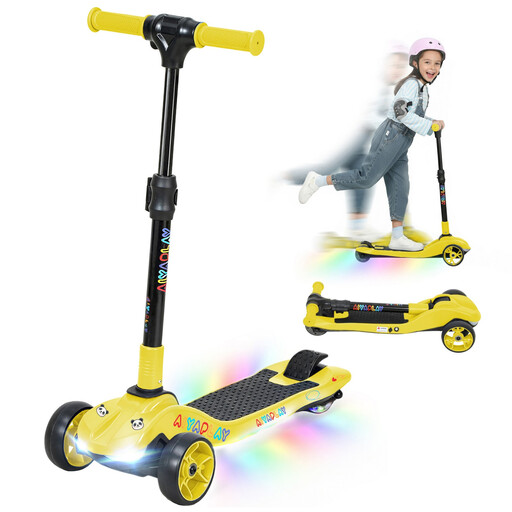
Why This Fits Their Persona: Ideal for younger children (6-10) who are new to scooters. The three-wheel design provides excellent stability, helping to build confidence and balance skills without the fear of toppling over. The gentle top speed is perfect for safe play on private property like a garden or driveway.
It avoids the "more power" trap with a sensible 8 km/h max speed. Its four-level adjustable handlebar directly counters the problem of a child outgrowing their scooter too quickly.
The primary advantage is its stability. It also features a simple push-button start suitable for its low speed, a lightweight foldable frame and fun LED lights for visibility.
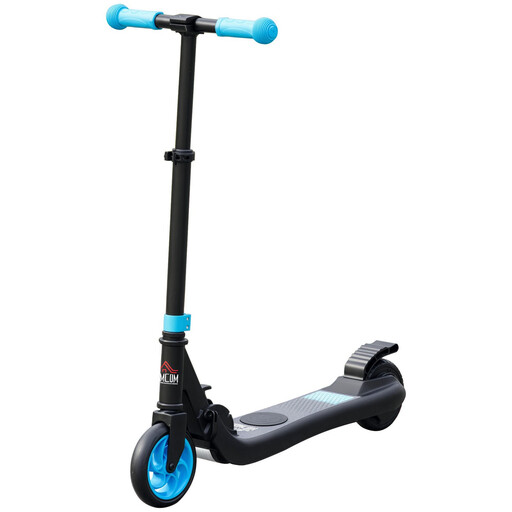
Why This Fits Their Persona: This is a great transitional scooter for children ready to move to two wheels. It maintains a safe top speed (8 km/h) while introducing the dynamics of a two-wheeled ride. Its very light weight (4.8 kg) makes it easy for a child to handle and for a parent to carry.
It directly addresses the start-up safety pitfall with its non-zero start system, preventing sudden acceleration. The adjustable handlebar also ensures it can adapt as your child grows.
Its key advantage is the combination of a lightweight, foldable design and the crucial non-zero start safety feature, making it both portable and secure for developing riders.
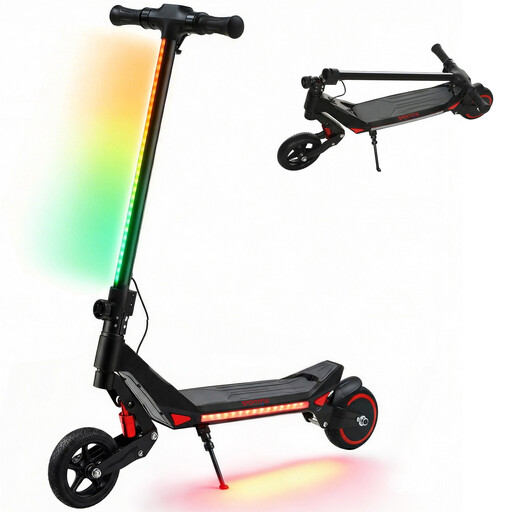
Why This Fits Their Persona: For the older, more experienced child (up to 14 years) seeking more of a thrill. The 200W motor delivers a higher top speed of 16 km/h, while features like dual suspension and an electronic handbrake provide the enhanced performance and control needed for a faster ride.
While powerful, it still incorporates the essential kick-to-start motor to prevent accidental launches. The robust frame and puncture-resistant tyres also address the pitfall of poor build quality.
Its front and rear spring suspension system provides a much smoother ride over bumpy ground. The combination of an electronic handbrake, LED display and vibrant RGB lights offers a premium feature set.
We have compiled a complete, real-time list of products that fully satisfy these strict selection criteria and UK safety regulations.
This is a critical point for all UK parents. It is illegal to ride a privately owned electric scooter on public roads, pavements, cycle paths or in public parks. They are only permitted for use on private land with the landowner's explicit permission. These rules apply to all riders, regardless of age.
The range of a rechargeable scooter depends on its battery capacity, the rider's weight and the terrain. Most kids' scooters offer a range of 6-12 km per charge, which typically takes 2-4 hours. To maintain battery health, always use the charger supplied by the manufacturer, avoid overcharging (unplug it once full) and do not charge it unattended or overnight. Store the scooter in a dry place, as extreme temperatures can affect battery performance.
Appropriate safety gear is non-negotiable. At a minimum, your child should always wear a correctly fitted helmet. Elbow and knee pads are also highly recommended to protect against scrapes and falls. Ensure your child is wearing sturdy, closed-toe shoes when riding.