
24/7 Customer Support

Free returns

Same-day & Next-day Delivery

Quality Guaranteed

Unlock Your Welcome Offers: FREE Delivery | Up to 80% OFF | Free 30-day JoyPlus trial
Download the APP
There are few things more frustrating for a DIY enthusiast than a stripped screw head on a new motherboard or a wobbly piece of flat-pack furniture that just won’t tighten properly. Manual screwdrivers have their place, but for speed, consistency and saving your wrists, a modern electric screwdriver set is a game-changer.
However, the market is filled with options, making it difficult to distinguish between a useful tool and a gadget that will end up at the back of a drawer. This guide is designed to help you understand the key features to look for, so you can choose a cordless power screwdriver that fits your specific needs, whether you're building a gaming PC, repairing a smartphone or simply tackling your weekend project list.
Before looking at specific models, it’s helpful to understand what separates a great tool from a mediocre one. Focus on these three areas to make an informed decision.
Torque, measured in Newton-metres (N.m), is the rotational force the screwdriver applies. This is arguably the most critical feature. A tool without adjustable torque is a one-size-fits-all solution that rarely fits anything perfectly.
An electric screwdriver with torque control gives you the versatility to handle both delicate electronics and tougher assembly jobs with confidence.
An electric screwdriver is only as good as its bits. A comprehensive kit should include a variety of bit types (Phillips, Flathead, Torx, Hex) to handle different projects. Look for bits made from S2 hardened steel, which offers superior durability and resistance to wear compared to standard chrome-vanadium steel.
Furthermore, a well-designed magnetic screwdriver set makes life much easier. A magnetic case keeps bits organised, while a magnetic chuck and bit tip ensure screws don't get dropped and lost—a lifesaver when working in tight spaces.
The convenience of a rechargeable screwdriver is lost if it’s constantly running out of power. Battery capacity is measured in milliamp-hours (mAh); a higher number generally means longer runtime. For reference, a battery around 350mAh might handle over 400 small screws, while a larger 2000mAh battery can drive hundreds of larger screws on a single charge.
Also, consider the charging method. The modern standard is USB Type-C, which allows you to charge your tool with the same cable you use for your phone or laptop, adding a layer of convenience.
Based on features, user-friendliness and overall design, here are our recommendations for those seeking a reliable electric screwdriver kit.
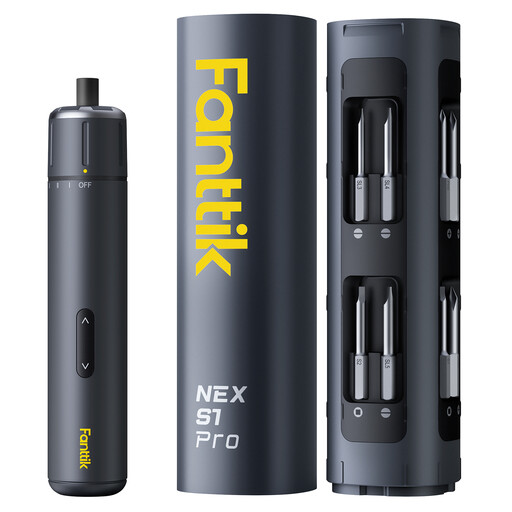
Why It Stands Out: The Fanttik S1 Pro is built for power and versatility. With three torque settings ranging from 1.5 N.m to 4.2 N.m (and a max hard torque of 6 N.m), it’s well-equipped for general household repairs, furniture assembly and PC building. The 2000mAh battery provides substantial runtime, and the 16 included S2 steel bits are housed in a satisfying pop-up magnetic aluminium case that keeps everything secure.
Pros:
Who is it for? This is an ideal tool for home DIYers, flat-pack furniture veterans and anyone building or upgrading a desktop computer who needs a reliable and powerful electric screwdriver for PC building.
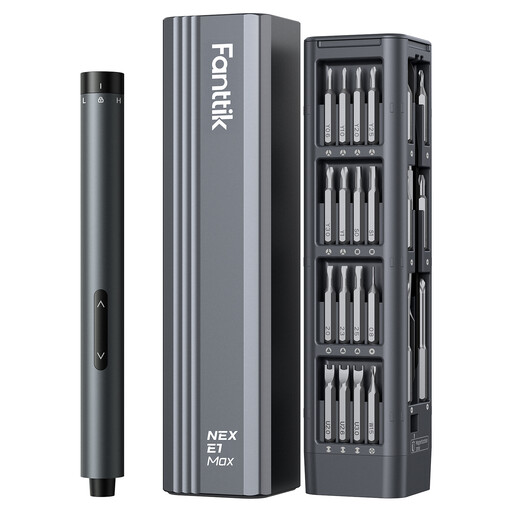
Why It Stands Out: When precision is paramount, the Fanttik E1 Max excels. This mini electric screwdriver is designed specifically for delicate tasks. It offers two low-torque settings (0.05 N.m and 0.2 N.m) to prevent damage to sensitive components. The standout feature is its comprehensive 50-bit electronics repair tool kit, all neatly organised in a sleek, award-winning magnetic case.
Pros:
Who is it for? Technicians, hobbyists and anyone who frequently works on small electronics like smartphones, tablets, watches, cameras or drones.
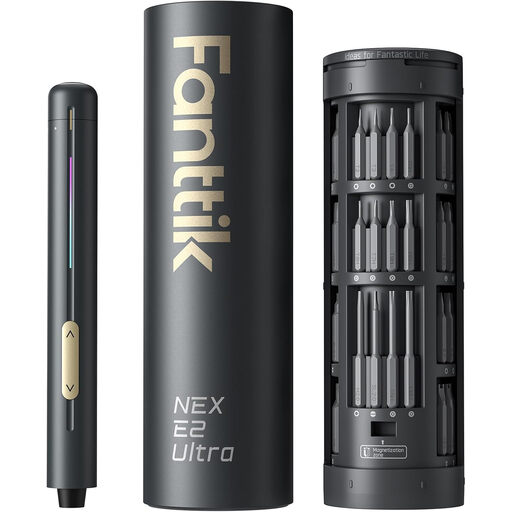
Why It Stands Out: The E2 Ultra takes the precision of the E1 Max and adds more power and control. It features five adjustable torque gears, ranging from a delicate 0.05 N.m up to 0.6 N.m, giving it a broader application range for intricate repairs. Its 800mAh battery offers over double the runtime of the E1 Max. An innovative gradient light bar provides intuitive visual feedback on the selected torque and direction and the kit includes a pry bar and tweezers.
Pros:
Who is it for? Serious electronics hobbyists and professional technicians who require a wider torque range, longer battery life and a complete electronics repair tool kit for their workbench.
While these kits offer a comprehensive selection of bits for most common tasks, some specialised projects may require a unique bit type or size. If you need to expand your collection or replace a specific bit, it's often more practical to purchase them individually.
For a wider selection of individual bits and accessories, explore our full range of screwdriver bits.
Yes, an electric screwdriver for PC building is an excellent tool that saves significant time and reduces wrist strain. The key is to use a model with adjustable torque control. Start on the lowest torque setting when fastening components to the motherboard or securing SSDs to avoid over-tightening and causing damage. You can use higher settings for case screws.
For delicate electronics like smartphones, watches or camera internals, a low torque setting is crucial. A good precision electric screwdriver should offer a range that starts at or below 0.05 N.m and goes up to around 0.4 N.m. This prevents you from stripping the tiny, delicate threads on small screws.
Absolutely. A magnetic screwdriver set provides a major quality-of-life improvement. A magnetic chuck holds the bit firmly in place, while a magnetised bit tip helps you guide screws into position and, more importantly, prevents them from falling into the depths of your device or PC case. This feature alone can save you a great deal of time and frustration.