For glazed wall tiles, choose a compact cordless brush when you need control around grout and fittings, or an extendable scrubber when reaching high tiles is the harder part of the job. Neither format makes a supplied head safe for every glaze: start with a gentle attachment, test a discreet area and check the tool’s wet-use and power instructions before cleaning.
Who needs which approach?
Careful glazed-tile cleaners
If the tiles are glossy, older or of uncertain condition, focus on the attachment that touches them. The Tiles & Architectural Ceramics Society warns that power-driven abrasives can permanently damage glaze; test a gentle head in a discreet spot before tackling the wall.
High-wall and shower-area cleaners
If reaching upper tile rows means stretching or repeatedly repositioning yourself, an extendable handle is worth considering. Check its usable length and whether you can control the head at the angles your wall requires.
Grout and detail-cleaning consumers
If dirt sits mainly in joints, corners and around fittings, a compact head offers a way to work on those areas without trying to fit a broad brush into them. Keep the attachment used on grout from scraping the glazed tile face.
What matters when choosing?
For a move-in clean, decide what can safely touch the glaze before weighing up reach, detail heads and cordless convenience.
| Concern |
What to check |
Who this matters to |
| Protecting the glaze |
Look for a soft or non-scratch head, then test it with your cleaner in a discreet area. Do not assume a supplied scour pad suits the finish. |
If I do not know how robust the tiles are, I want to lift the dirt without leaving marks. Roughly 36% of consumers put protecting the glaze first. |
| Reaching wall tiles |
Check the extension range and whether the controls and head angle work at the height you need. |
For tiles above comfortable arm height, I would rather keep the brush under control than repeatedly stretch towards the wall. Reaching awkward areas is the main need for around 29% of consumers. |
| Grout and corners |
Check for a narrow detail or cone head and whether you can obtain replacement heads. |
When grime is concentrated in joints and around fittings, I need a head that can reach those spaces without scouring the tile face. About 21% of consumers prioritise this detail work. |
| Power and upkeep |
Confirm the stated runtime, charging arrangement and whether the required battery and charger are included. |
If I am cleaning several areas after the move, I do not want to discover halfway through that the tool needs charging or a separate battery. For roughly 14% of consumers, power arrangements are the primary concern. |
Mistakes to avoid
-
Assuming a scour pad is safe because it comes in the box
A powered abrasive can damage glaze permanently, according to the Tiles & Architectural Ceramics Society. A stronger motor does not change whether the contact surface suits your tiles.
Identify the finish where possible, begin with a soft or non-scratch attachment and test an unobtrusive area before cleaning the full wall.
-
Expecting a bare tool to include its power components
Ryobi describes the R18CPS-0 as a bare tool. It is a different purchase decision if you do not already have a compatible ONE+ battery and charger.
Check exactly what is supplied and which battery and charger the tool requires before ordering.
Consumers new to the ONE+ system may need to obtain the compatible battery and charger separately.
-
Choosing reach without considering the detail work
An extension handle helps with high tiles, but a broad head may be awkward around taps, edges and narrow grout lines.
If the job includes both open wall areas and tight details, check the supplied head sizes or plan to use a compact tool for the smaller sections.
-
Treating a water-resistance rating as permission for any bathroom use
Bosch describes IPX5 as splash-water protection for its UniversalBrush, while HOTO states an IPX7 rating for its spin scrubber. Neither label replaces the wet-use and charging instructions for the exact tool.
Read those instructions before working near water, and use or charge the scrubber only as its manufacturer permits.
Relevant brands to consider
Bosch
The UniversalBrush is a compact cordless option for controlled work on tiles, joints and smaller areas.
- Bosch DIY UK lists interchangeable brushes and pads, including a non-scratch option, and describes the tool’s IPX5 rating as splash-water protection.
- Its compact format does not provide the reach of an extension-handle model; IPX5 is not permission to submerge the tool.
HOTO
The HFE0003GL is an extendable cordless scrubber to consider when high tiles and shower walls are difficult to reach.
- The model has a 37–51-inch extendable handle and two speeds; HOTO states that its spin scrubber has six heads and up to 110 minutes of runtime.
- Do not assume an included scour pad suits an unfamiliar glaze. Check the head that will touch the tile and patch-test it first.
Ryobi
The R18CPS-0 Compact Power Scrubber is a ONE+ option for consumers who already use that battery system and have repeated cleaning jobs.
- Ryobi Tools UK positions the model for stubborn surfaces, including shower enclosures.
- It is sold as a bare tool. Confirm that you have a compatible ONE+ battery and charger, and choose the attachment for the condition of your glaze rather than the force of the tool.
Beldray
The Antibac Turbo Scrubbing Brush is a small, battery-powered option for grout, corners and limited tile sections.
- Beldray lists five interchangeable heads, including a soft head and heads intended for tiles, grout and corners.
- The small format is less convenient for a broad high wall. Its instructions advise reducing pressure if too much force impairs cleaning, and its AA batteries need replacing when exhausted.
Lakeland
The Turbo Scrubber cordless kit is a long-reach option for accessing bathroom walls and other tiled areas.
- Lakeland lists four brushes, 112 cm of reach and up to one hour of cleaning per charge.
- Check which supplied brush is gentlest for your particular glaze before using the tool across the wall.
Joybuy product choices
These cordless spin scrubbers are options to consider for tiled areas after a move. Compare their heads and usable reach against your wall before choosing either one.
 No image available
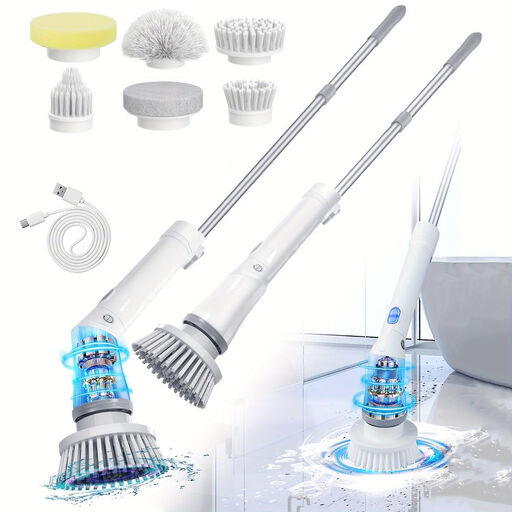
Leebein 2025 Electric Spin Scrubber, 7 Heads
Consider the extendable handle if reaching wall tiles is your main difficulty, but confirm that a supplied head suits your glaze and test it in a discreet spot.
The product title lists seven brush heads, two speeds and an IPX7 rating. Check the exact wet-use and charging instructions rather than treating the rating as permission for every type of bathroom use.
View on Joybuy
 No image available
Iagreea Electric Spin Scrubber, All White Version
For work on tiles and grout, check which head will contact the glazed face and patch-test it before cleaning a larger area.
If upper wall tiles are part of the job, confirm the tool’s usable reach. Read the exact wet-use instructions before using it around water.
View on Joybuy
Common questions
Can I use an electric scrubber on glazed wall tiles?
Only use an attachment and cleaning method that you have first tested on a discreet part of the particular tile. The Tiles & Architectural Ceramics Society warns that power-driven abrasives can permanently damage glaze; if the surface marks, stop rather than pressing harder. A pH-neutral cleaner and non-abrasive cloth are a gentler starting point for routine tile cleaning, as Wickes advises.
Should I use a soft brush or a scour pad?
Start with the least abrasive head suitable for the job, especially if the glazed finish is unfamiliar. Test it first, and use a smaller detail head for grout or crevices without dragging a hard or abrasive attachment across the glazed face.
How should I put the scrubber away after cleaning?
Clean the used head and store the tool as the exact model’s instructions direct. Beldray instructs users to store its brush clean and dry, while HOTO advises rinsing its tool after use; do not apply one model’s rinsing instructions to another scrubber.
Can I use or charge an electric scrubber in the bathroom?
Use and charge it only within the instructions for that exact model; an IP rating alone does not establish where charging or every form of wet use is permitted. Electrical Safety First identifies bathrooms as a higher-risk setting for electrical shock, so check the tool’s water-exposure limits and charging arrangement before starting.


