Detail-focused splashback owners
If your splashback has small tiles and visible grout joints, a controllable head and a gentle contact surface matter more than covering a broad area in one pass.


Start with a compact scrubber and a soft or non-scratch attachment if you need close control around small tiles and grout joints. Check the attachment and cleaner against your mosaic material first; choose an extendable handle chiefly when reaching the splashback or avoiding bending matters more than precise work.
If your splashback has small tiles and visible grout joints, a controllable head and a gentle contact surface matter more than covering a broad area in one pass.
For recurring kitchen marks, look for a manageable cordless tool and an attachment and cleaner appropriate to the tile material. Rotation does not remove the need for light pressure.
An extension handle may reduce stretching or bending at a high or wide splashback, provided you can still keep the head steady near grout joints.
Identify the tile material and check the grout condition before comparing attachments, head size and reach for a mosaic splashback.
| Concern | What to check | Who this matters to |
|---|---|---|
| Finish and grout protection | Confirm that an attachment and cleaner suit the particular mosaic material. Inspect the grout and any loose tiles before using a rotating head. | If I am unsure how my tiles or grout will react, I want to avoid abrasive contact; around 33% of consumers put finish and grout protection first. |
| Access to joints and edges | Compare head size and compatible detail attachments for narrow joints and confined sections. | Working around small tiles, sockets and worktop edges calls for a head I can position carefully. Detail access comes first for around 25% of consumers. |
| Routine kitchen grime | Check the available speed settings and whether a suitable soft attachment can be used with your chosen cleaner. | When grease film and splash marks keep returning, I want less manual scrubbing without pressing hard on the surface; around 25% of consumers prioritise routine grime removal. |
| Stretching and bending | Check the handle's reach and whether its head remains easy to control at the splashback. | A high or wide section is difficult for me to reach comfortably, so controlled access matters most. Around 17% of consumers put reduced stretching and bending first. |
Mosaics can be made from glass, ceramic, porcelain or natural stone. A pad or cleaning fluid suitable for one material may be unsuitable for another.
Identify the tile material and follow its care guidance before choosing an attachment or cleaner. If the material is uncertain, avoid abrasive treatment.
Tile Cleaning cautions that abrasive machinery is more likely to loosen a small tile. Motorised rotation does not make heavy pressure safe for the finish or joints.
Start with a soft or non-scratch attachment, use light pressure and test an inconspicuous area. Avoid powered scrubbing where tiles are loose.
Extra reach can help with access, but it can make pressure harder to control around small tiles, edges and narrow joints.
Choose a compact or detail format for close work; consider an extension when height, width or reduced mobility makes reach the greater concern.
Bosch lists IPX5 for the UniversalBrush, while Ryobi lists IPX7 for the RSCR4-120G. Neither designation replaces the individual instructions for the tool, charger and accessories.
Check the model's stated rating and follow its instructions for wet use, rinsing and charging.
The compact UniversalBrush is a route to consider when attachment choice and close control matter.
Ryobi has detail and telescopic scrubber formats, allowing buyers to distinguish joint access from extended reach.
The Scrub Buddi XL is a reach-focused option for buyers considering an extendable cleaning brush.
The extendable-handled scrubber below is a choice to consider when reaching the splashback is the main difficulty. Check its brush heads against your mosaic material and grout before use.
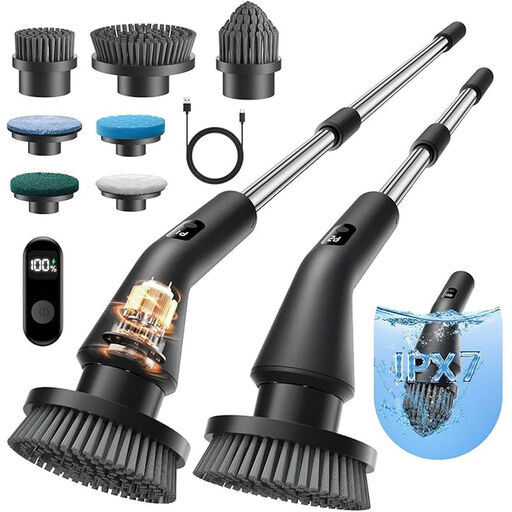 Image unavailable
The extendable handle makes this a choice to consider if reaching the splashback is more difficult than working close to its joints.
It is listed with seven brush heads, two speeds and an IPX7 rating. Check which head suits your tile and grout, and follow the instructions for wet use and charging.
No: choose the attachment and cleaner for the tile material and check that the grout and small tiles are secure. Mosaic Village advises cleaning according to material, while Tile Cleaning warns that abrasive machinery is more likely to loosen a small tile.
A small, controllable head helps with confined joints, provided its contact surface suits the mosaic. Ryobi specifies a 5 cm head for the RSCR4-120G; Bosch lists fine-brush and non-scratch-pad accessories for its cleaning-brush system. Check the actual attachment rather than relying on head size alone.
Choose an extendable handle when height, width or bending makes access the main problem. For close work around small tiles and grout, a compact tool may be easier to control; check that you can keep an extended head steady and its pressure light.
Only use vinegar if the care instructions for your particular tile permit it. Topps Tiles describes a diluted white-vinegar method for glass mosaic, but that is not a cleaning instruction for stone, marble or an unidentified mosaic material.