Whole-floor deep cleaners
If tracked-in grime covers much of the porcelain floor, look into a long handle and a flat head designed for broad tile areas, particularly if repeated bending is a concern.


Choose a long-handled cordless scrubber with a flat head if the main job is a large porcelain floor and you want to limit bending; a compact brush with a detail attachment makes more sense when grout lines and edges need most attention. Identify any suspected grout residue before scrubbing harder, and check that the head, cleaner and wet-use instructions suit the floor finish.
If tracked-in grime covers much of the porcelain floor, look into a long handle and a flat head designed for broad tile areas, particularly if repeated bending is a concern.
If the visible dirt is mainly in joints, corners, thresholds or along trim, prioritise a controllable detail attachment and check that its contact surface suits the tile finish.
If a cloudy film may be left from grouting or installation work, identify the deposit before choosing a brush or cleaner. A residue-specific cleaning method may matter more than scrubber speed.
Start with the job that would most influence your choice: reaching across the floor, cleaning narrow areas, identifying residue or protecting the finish while checking the powered tool.
| Concern | What to check | Who this matters to |
|---|---|---|
| Whole-floor reach | Check for an extension handle and a flat head intended for floor tiles. | If I have a large area of tracked-in grime to clean, I want to cover it without repeatedly kneeling. Around 29% of consumers would put floor reach first. |
| Grout and edges | Look for a dedicated corner or detail head and check its suitability for the finish. | When the dirt sits in joints and beside thresholds, I need control in narrow spaces more than broad coverage. Grout-and-edge access would come first for roughly 24% of consumers. |
| Unidentified residue | Identify the deposit before selecting a cleaner; check its instructions against the residue and surface. | A cloudy film left after grouting could need a different cleaning method from tracked-in dirt, so I would identify it before applying more pressure. For around 29% of consumers, residue identification would be the primary need. |
| Finish and powered-tool checks | Check head abrasiveness, wet-use and charging instructions, and applicable conformity information for the product. | With a polished or uncertain finish, I would rather check the head and cleaning method before tackling stubborn marks. Roughly 18% of consumers would prioritise surface and powered-tool checks. |
Cementitious grout residue may need a compatible residue cleaner rather than a stiffer head or more pressure. Mapei identifies porcelain-compatible products for this type of residue.
Identify the deposit first. If it is cementitious residue, follow a cleaner's instructions for that residue and the specific tile and adjacent materials.
A flat head covers open tile, but a separate detail head is more relevant to narrow joints, corners and thresholds.
Check which heads are included for the exact model, then choose according to where the dirt actually sits.
The Pink Stuff warns that its mildly abrasive paste and excessive pressure can scratch surfaces. A polished, glossy or unknown finish calls for particular care.
Check the cleaner and attachment against the finish, avoid unnecessary pressure and test an inconspicuous area where appropriate.
A water-resistance rating does not replace the exact model's charging and wet-use directions. Conformity marking also does not establish suitability for every tile finish or cleaner.
Read the supplied instructions and check the product and documentation for conformity information applicable to the market where it is sold. GOV.UK states that Great Britain recognises CE marking alongside or in place of UKCA marking where the relevant requirements are met.
Compact cordless brushes to consider when joints, edges and other small areas matter more than long-reach floor coverage.
A long-handle option to investigate when the main task is broad floor-tile coverage.
A compact scrubber-kit approach for smaller household cleaning tasks rather than long-reach floor coverage.
These cordless scrubbers have extendable handles for floor-cleaning tasks. Before choosing either for porcelain, check the included head shapes, brush stiffness and instructions for your floor finish.
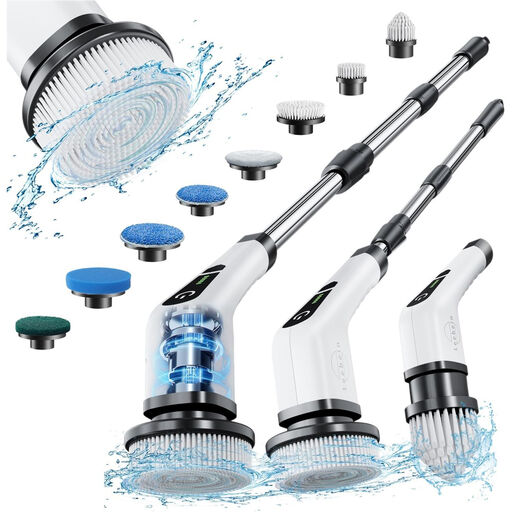 No image available
Consider this extendable-handle model if reaching across floor tiles without repeated bending is your priority.
 No image available
Consider this extendable-handle model for floor areas, while checking which supplied head fits the tiles and any grout work.
Scrubbing harder is not necessarily the answer if the haze is cementitious grout residue. Mapei identifies cleaners for that residue on porcelain and other acid-resistant surfaces; establish what the deposit is and follow the chosen cleaner's surface and safety instructions.
A flat head is the format to look for on broad tile areas, while a corner or detail head is more relevant to joints and edges. JML describes those separate uses for its Hurricane heads; check what the exact model includes and whether the contact surface suits your finish.
Do not assume an abrasive paste suits every porcelain finish. The Pink Stuff describes its paste as mildly abrasive and warns that excessive pressure may scratch surfaces; check the cleaner and attachment, particularly on polished or uncertain tiles, and test an inconspicuous area where appropriate.
UKCA is not the only marking recognised for relevant products in Great Britain: GOV.UK states that CE marking continues to be recognised alongside or in place of UKCA marking where applicable product requirements are met. Check the product and documentation for the appropriate conformity information; Northern Ireland follows different market processes.