Renters cleaning a small tiled threshold
You need to work around grout, edges and the door frame without making an existing problem with the finish worse. A controllable head matters more than covering a large area quickly.


Choose a compact cordless scrubber for a small tiled doorstep if you can work close to the surface; choose a telescopic model when reducing bending is the more important need. Whichever format you choose, match the brush head to the grout and edges, test it on an inconspicuous area and check the tool’s instructions against the doorway’s actual exposure to moisture.
You need to work around grout, edges and the door frame without making an existing problem with the finish worse. A controllable head matters more than covering a large area quickly.
If the threshold is difficult to reach comfortably, handle length and steady control may matter more to you than a compact tool.
A doorway that gets damp or opens directly outdoors makes the tool’s moisture instructions and the electrical setup part of the buying decision.
For a rented flat’s tiled doorstep, choose the tool format around your main difficulty, then check the brush and the conditions in which you will use it.
Consider it when: You can reach a small threshold easily and need close control around the grout, corners and door frame.
Trade-off: A small head covers less tile per pass and usually still requires you to bend or kneel.
Consider it when: Reaching a low or broader tiled area without kneeling is the main priority.
Trade-off: The longer format can feel bulky beside a door frame or narrow grout line, so check the supplied head sizes as well as the handle.
| Concern | What to check | Who this matters to |
|---|---|---|
| Reach and bending | Check the handle’s usable length and whether the head fits beside the door frame. Lakeland states a 112 cm reach for its Turbo Scrubber kit. | If I need to clean a low threshold without kneeling, being able to guide the brush from a comfortable position matters most. Around 40% of consumers put reduced bending first. |
| Moisture and outdoor use | Check the tool’s instructions against the doorway’s exposure to splashes or rain. Electrical Safety First advises using a residual current device (RCD) with outdoor electrical equipment. | When my doorstep gets damp or opens directly outdoors, I need a setup I can use within the tool’s stated conditions. Roughly 30% of consumers put moisture safety first. |
| Tile, grout and edge control | Check the included head shapes and follow the tile and cleaner instructions. Test the chosen brush and cleaner on an inconspicuous area before cleaning the visible threshold. | With narrow grout and an unknown finish, I would rather control the brush around each edge than use one head across everything. Around 30% of consumers prioritise surface control. |
A telescopic scrubber can reduce bending, but a bulky head may be harder to guide around narrow grout, corners and the threshold edge.
Look at the accessible tiled area and the supplied head shapes before deciding whether reach or close control matters more.
Bosch describes the UniversalBrush’s IPX5 rating as splash protection, while Ryobi states an IPX7 rating for its RSCR4-120G. Neither rating replaces the instructions for the particular tool or outdoor electrical precautions.
Do not operate electrical equipment in rain or standing water. For outdoor electrical equipment, follow Electrical Safety First’s advice to use an RCD.
Ryobi sells scrubbers within its ONE+ battery system, including the R18CPS-0 bare tool. A bare-tool listing should not be treated as a ready-to-use kit.
Check the exact listing for a compatible battery and charger before choosing a battery-system model.
If you do not already have compatible equipment, a bare tool may require a battery and charger separately.
A rented doorstep may have existing wear, loose grout or a finish that reacts poorly to the brush or cleaner you choose.
Record its existing condition, try a suitable head and cleaner on an inconspicuous area, and stop if the grout loosens or the finish changes. Do not power-clean loose tiles or cracked grout as though they were ground-in dirt.
The UniversalBrush is a compact cordless option for cleaning close to tile edges and other household surfaces.
Ryobi’s cordless scrubber range includes compact tools and longer-reach options, so the format depends on whether control or reduced bending matters more.
The Turbo Scrubber kit takes a longer-reach approach to domestic tile and floor cleaning.
The Antibac Turbo Scrubbing Brush is a handheld, multi-head option for smaller tiled areas and details.
These cordless scrubbers offer different handle and head arrangements to consider for a tiled doorstep. Choose by the reach you need, then check the supplied heads and the instructions for your doorway’s moisture conditions.
 No image available
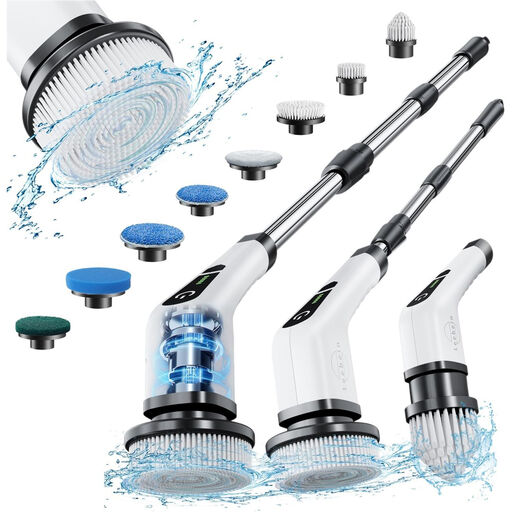
Consider the adjustable handle if reaching a low threshold without kneeling is your main concern. Check which of the eight interchangeable heads can be controlled around your grout and door frame. Test the brush on an inconspicuous area and follow the instructions for use near moisture.
 No image available
The adjustable extension handle makes this a model to consider when bending over the doorstep is difficult. Its title lists eight interchangeable heads and two rotation speeds; check the head shapes before relying on it for narrow grout. Follow the instructions for the doorway’s moisture conditions and test the brush on the finish first.
 No image available
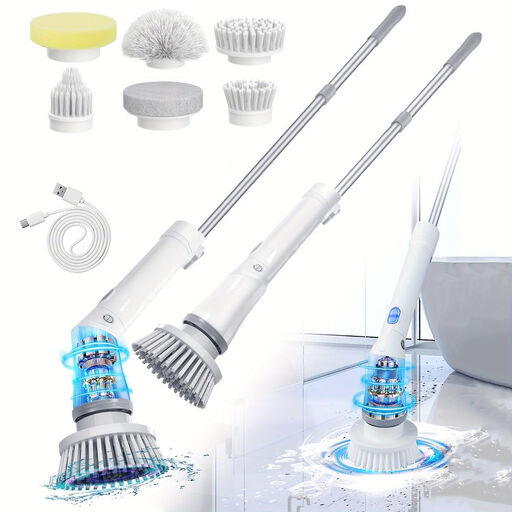
This is a cordless option to consider if you can work close to the tiled threshold. Check the handle reach and supplied heads against the grout and corners you need to clean. Before using it near an exposed doorway, check its moisture-use instructions and test the brush on an inconspicuous area.
 No image available
The extendable handle offers a reach option for a low doorway. The product title lists seven brush heads and two speeds; check whether the included heads suit tile edges and narrow grout. Its stated IPX7 rating is not permission to clean in wet weather, so follow the tool’s instructions and test the brush on the surface first.
Do not use an electric scrubber in rain or standing water simply because it has a water-resistance rating. Check the tool’s instructions for the conditions at your doorway; Electrical Safety First advises using an RCD with outdoor electrical equipment. If the conditions or electrical setup are unsafe, postpone the task or clean manually.
The ratings describe different stated levels of water protection, but neither alone determines whether a tool suits your doorway. Bosch describes IPX5 splash protection for its UniversalBrush, while Ryobi states IPX7 for the RSCR4-120G. Check the instructions for the exact model and its intended use before choosing.
Check your tenancy terms and the existing condition of the doorstep before using a powered brush on an unfamiliar finish. Photograph visible wear, test a suitable brush and cleaner discreetly, and report loose tiles or cracked grout rather than trying to scrub away a defect. The relevant arrangements can depend on your tenancy and where in the UK the flat is located.
It could matter where cleaning causes damage, but the outcome depends on the tenancy and evidence of the property’s condition. Under the Tenant Fees Act 2019, a deposit for a tenancy covered by the Act in England can serve as security for tenant obligations or liabilities connected with that tenancy; that does not determine the outcome for an individual doorstep or for a tenancy elsewhere in the UK. Record existing damage and stop cleaning if the surface begins to deteriorate.