Surface-care-first grout cleaners
For people cleaning sealed grout who want a compatible cleaner and controlled, gentle brushing before they consider cleaning speed.


Choose a compact cordless scrubber with a small head if narrow grout joints and close control are the main job; consider a multi-head brush if you also clean tiles and other household surfaces. For sealed grout, start with a compatible mild cleaner and a gentle nylon brush or non-scratch attachment, and check wet-use instructions separately from bathroom charging arrangements.
For people cleaning sealed grout who want a compatible cleaner and controlled, gentle brushing before they consider cleaning speed.
For people tackling several bathroom or kitchen surfaces who want to reduce bending or prolonged hand effort while still reaching grout joints.
For people whose main jobs are narrow joints, corners and tile edges rather than broad floors or walls.
Start with the cleaner and attachment your sealed grout can tolerate, then decide whether precise access, easier reach or wet-use practicalities matter most for your cleaning routine.
| Concern | What to check | Who this matters to |
|---|---|---|
| Surface care | Look for a nylon brush or suitable non-scratch pad. Follow the grout and cleaner instructions, and test a hidden area before continuing. | If I want to preserve the sealed grout and nearby tile finish, I would start gently rather than reach for a heavy-duty pad. Around 30% of consumers put surface care first. |
| Detail access | Check the supplied head’s size and shape for narrow joints, corners and edges; a broad head may be harder to guide precisely. | When short grout runs and shower corners are my main task, reaching the joint matters more than covering a large area quickly. Detail access is the primary need for around 30% of consumers. |
| Handling and reach | Consider grip, head angle and handle length for the surfaces you clean. A longer handle may help with posture but need not offer close joint control. | If repeated floor or wall cleaning means too much bending or kneeling, I would weigh easier reach against precision. Around 20% of consumers prioritise lower-strain handling. |
| Wet use and supplies | Check the exact tool’s water-resistance instructions, where it must be charged, and which batteries and heads come with it. | For bathroom cleaning, I need to know how to use and charge the tool safely and what is required before I can start. These practicalities come first for around 20% of consumers. |
A pad intended for tougher materials may be a poor match for sealed grout or the adjacent tile finish. LATICRETE’s grout-care guidance calls for gentle brushing with nylon or a suitable scrub pad.
Begin with a compatible mild cleaner and gentle attachment. Test an inconspicuous area and let it dry before cleaning the rest.
A water-resistance rating applies to the stated conditions for the tool; it does not establish where its charger or mains equipment can be used. Electrical Safety First advises against using extension leads to power appliances in a bathroom.
Follow the exact model’s wet-use and charging instructions, and keep charging equipment outside the bathroom unless the manufacturer gives an appropriate arrangement.
A long handle can make larger or awkwardly positioned surfaces easier to reach, but a broad brush offers less close control at individual grout joints. Ryobi UK lists a 5 cm head on its compact RSCR4-120G and a broader 15 cm head on its telescopic format.
Choose head size around the surface you will clean most often; retain a detail brush for tight joints even if a longer handle helps with posture.
Ryobi UK offers bare tools as well as kits, while Lakeland says its Electric Scrubber requires four AA batteries that are not included.
Check the exact package for its battery, charger or cable, brush heads and any separately required batteries.
A bare tool or the Lakeland AA-powered model may require items to be obtained separately before use.
Ryobi UK offers compact detail scrubbers alongside larger long-handle formats, making head size and working posture useful points of comparison.
A compact cordless household-brush option when grout is one of several indoor cleaning jobs.
A handheld, AA-powered scrubber to consider if a compact tool with interchangeable heads fits the job.
These multi-head household scrubbers suit buyers considering one cordless tool for bathroom cleaning alongside other surfaces. Before using any head on sealed grout, check its size, material and compatibility with the finish.
 No image available
Consider this model if the same cordless tool will be used for bathroom, floor and kitchen cleaning alongside grout.
The product name specifies seven brush heads, two speeds, an extendable handle and an IPX7 rating.
Check which head is small and gentle enough for your sealed grout, and follow the tool’s wet-use and charging instructions.
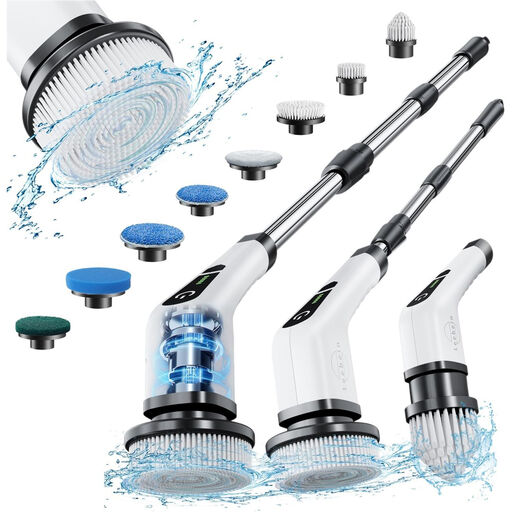 No image available
This multi-head option is relevant when tile and bathroom cleaning are regular jobs as well as grout cleaning.
Its product name specifies eight interchangeable heads and an adjustable handle listed at 137 cm.
Check the heads’ dimensions and materials against your sealed grout. The product information says not to submerge the unit, so follow that limitation despite its stated IPX7 rating.
 No image available
Consider this cordless model if your household cleaning includes tile joints and corners as well as larger bathroom or kitchen surfaces.
The product name specifies eight interchangeable heads, two rotation speeds and an adjustable extension handle.
Confirm which head suits narrow sealed grout. The product information says not to submerge the unit; follow that instruction when assessing its stated IPX7 rating.
You can consider one if its attachment and cleaner are compatible with your grout and adjacent tile finish. For routine grout care, LATICRETE advises a clear pH-neutral cleaner and gentle scrubbing with a nylon brush or suitable pad; test a small hidden area and let it dry before proceeding.
Do not make a heavy-duty pad your starting attachment for sealed grout. Bosch DIY describes the abrasive pad in its TAYDO Set for other tough cleaning jobs; begin instead with a compatible nylon brush or non-scratch attachment and assess the dried test area.
No: a tool’s IPX7 rating does not establish where its charger or mains equipment may be used. Electrical Safety First advises against powering bathroom appliances with extension leads; follow the scrubber’s charging instructions and charge outside the bathroom unless the manufacturer provides an appropriate arrangement.
A long handle is worth considering if bending or kneeling is the main difficulty, particularly when you also clean broad surfaces. For narrow joints, check whether its head can be guided precisely: Ryobi UK lists a 15 cm head for its telescopic format, compared with a 5 cm head on its compact RSCR4-120G.
Check the exact package for its battery, charger or cable and the heads needed for your surfaces. Lakeland says its Electric Scrubber needs four AA batteries that are not included, while Ryobi UK lists a 4V 2.0Ah battery and USB charging cable with the RSCR4-120G starter kit.