Shared-house detail cleaners
If grout lines, tile edges, basin joints and tap surrounds make up most of the job, look for a small head and a way to replace it. Reach across a room matters less than control around fittings.


For a tiled washstand top, start with a compact scrubber and a small or grout-capable head if the main jobs are tile joints, tap bases and basin edges. A broader handheld head makes more sense for open tile faces, while a multi-head or telescopic model is worth considering if the same tool will also clean larger or awkward bathroom surfaces. Check the supplied heads, battery and charger contents, and the exact model’s wet-use instructions before buying.
If grout lines, tile edges, basin joints and tap surrounds make up most of the job, look for a small head and a way to replace it. Reach across a room matters less than control around fittings.
If the same tool will clean the washstand, basin and occasionally the shower enclosure, a compact rotary head is worth considering. Check the exact model’s instructions for wet use rather than assuming every rechargeable scrubber can be used beside water.
If shower walls, tubs or other awkward surfaces are regular jobs too, several head shapes or an extension pole may be useful. Confirm that the supplied heads still cover close-up work around the washstand.
Choose it for: grout lines, basin joints and tight spaces around taps. Ryobi Tools UK lists point-grout and small bristle heads for its RDS4 detail-scrubber range.
Trade-off: a small head takes more passes across open tile faces; the RDS4-0 is also a bare tool.
Choose it for: open washstand tiles and a basin when close handheld control is more useful than extra reach. Ryobi Tools UK lists a 5 cm round head on the RSCR4.
Trade-off: a round head is less targeted than a point-grout head at the narrowest joins.
Choose it for: a washstand that is only one part of a larger bathroom-cleaning job, especially where walls or other surfaces are awkward to reach.
Trade-off: an extension adds bulk to close work, and it does not by itself provide a grout-capable head.
| Concern | What to check | Who this matters to |
|---|---|---|
| Grout and fittings | Look for a small or dedicated grout head, and check replacement-head compatibility for the exact model. | If I mainly clean narrow grout lines and the joins around a basin or taps, I need a head that can reach them. Around 42% of consumers would put detail access first. |
| Wet-area use | Check the exact model’s water-resistance statement and wet-use instructions; plan where it can charge and dry between users. | With several people using a washstand beside water, I want clear instructions for using and storing the tool safely. Wet-use practicality would come first for around 33% of consumers. |
| Wider coverage | Check which heads are supplied and whether an extension is useful for the other surfaces you intend to clean. | If I also clean shower walls or other awkward bathroom surfaces, I want one tool that can handle those jobs. Around 25% of consumers would prioritise wider coverage. |
An extension pole helps with distant surfaces, but it does not make a broad brush fit narrow grout or the space around a tap.
For a counter-height washstand, choose the head shape first. Add reach if shower walls or other awkward areas are also regular jobs.
Ryobi Tools UK identifies the RDS4-0 detail scrubber as a bare tool; its battery and charger are not included.
Check the box contents, charging equipment and battery platform for the exact version before ordering.
A bare tool may require a separate compatible battery and charger before its first use.
Ryobi Tools UK states an IPX7 rating for its RSCR4, but that rating does not describe every scrubber or its charger.
Follow the chosen model’s wet-use and charging instructions, and keep charging equipment away from the wet cleaning area.
GOV.UK warns that mixing sodium hypochlorite bleach with acidic or alkaline solutions can produce harmful gases.
Use one cleaner at a time, follow its label and ventilate the room. Rinse the surface as directed before changing products.
Ryobi Tools UK lists small-head and detail scrubbers alongside compact and telescopic options.
The compact Scrub Buddi XS and the longer-reach Scrub Buddi XL are two JML formats.
Rubbermaid describes a handheld Power Scrubber with an all-purpose head and a grout head for targeted household cleaning.
These cordless scrubbers are options for cleaning bathroom surfaces as well as a tiled washstand. For close grout and tap work, check the supplied head shapes before choosing either model.
 No image available
Consider this format if you also need to reach bathroom surfaces beyond the washstand. Its product title lists seven brush heads, two speeds and an extendable handle, and advertises an IPX7 rating. Check the individual head shapes for grout work and follow the exact model’s wet-use instructions beside a basin.
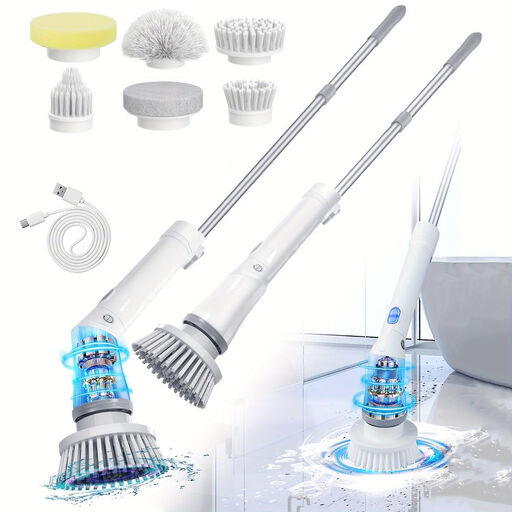 No image available
Consider this cordless option if the tool will clean bathroom tiles as well as the washstand. Check the supplied brush shapes before relying on it for narrow grout and tap surrounds, and consult its wet-use instructions before working beside water.
Start with a small or grout-capable head if the difficult spots are grout lines, tap bases and the basin-to-tile joint. A wider round head covers open tile faces, but check whether the chosen kit also has a head that fits its narrow joins.
Not for a counter-height washstand alone. An extension becomes relevant if you will also clean high, low or otherwise awkward bathroom surfaces; choose the brush heads for close-up work separately.
No. Ryobi Tools UK states IPX7 protection for its RSCR4 scrubber, with the stated limit of up to 30 minutes in up to 1 metre of water; that specification cannot be transferred to another model or its charging equipment. Follow the instructions for each part of the kit.
No. GOV.UK warns that sodium hypochlorite bleach mixed with acidic solutions can produce harmful gases. Follow each cleaner’s label, ventilate the room and rinse as directed before changing products.