Detail-edge cleaners
If the main job is the thin junction between the tray and wall or sealant, look for a pointed, small flat or corner head rather than judging a scrubber by its broad brush alone.


For grime in narrow shower-tray edges, choose the supplied brush heads before comparing stated motor speeds: a pointed or small flat head is intended for gaps, while a corner head can help at curved sections. An extendable cordless handle may reduce bending, but check that the brush suits your tray’s finish and charge the device outside the bathroom.
If the main job is the thin junction between the tray and wall or sealant, look for a pointed, small flat or corner head rather than judging a scrubber by its broad brush alone.
An adjustable handle can make a low or wall-side edge easier to reach. Check whether you can also shorten it enough to control the brush near the sealant.
For a stone-resin, acrylic or unidentified tray, establish the material and follow its maker’s care instructions before selecting a brush. Merlyn Showering, for example, warns against abrasive tools on its stone-resin trays.
Start with the head that can reach the edge, then decide how much handle length you need; the tray’s care instructions can rule out an otherwise convenient brush.
| Concern | What to check | Who this matters to |
|---|---|---|
| Narrow gaps and corners | Check whether a pointed, small flat or corner head is included, and whether replacement heads are available. | If grime collects in the narrow junction, I need a head that can reach it without pressing a broad brush against the sealant. Roughly 42% of consumers put detail access first. |
| Reach and control | Check the handle’s adjustment range and whether the shorter setting permits controlled edge work. | When the perimeter is low or against a wall, I want to reach it with less kneeling but still guide the brush accurately. Around 33% of consumers chiefly prioritise reach and comfort. |
| Tray finish | Identify the tray material, consult its care instructions and check the brush type before use. | If I am unsure what the finish tolerates, protecting it matters more than scrubbing harder. Approximately 25% of consumers place surface protection first. |
A broad head may miss the junction and make it harder to avoid pressure against the sealant.
Confirm the exact heads supplied, particularly if edge cleaning is your main reason for buying.
A product’s stated IPX7 rating does not address the risks from sockets, chargers or extension leads in a bathroom.
Follow the device instructions and charge it outside the bathroom. Electrical Safety First advises against using extension leads to power appliances there.
Surface-care rules vary. Merlyn Showering warns against scourers and abrasive cloths for its stone-resin shower trays.
Identify your tray, follow its maker’s instructions and test a suitable gentle brush on an inconspicuous area first.
Stated speeds and runtimes do not establish how well a particular head will clean your tray edge.
Compare the included heads and charging contents, then check whether the handle gives you the control you need.
A TUYU cordless scrubber listed on Amazon includes pointed, small flat and corner heads, making its stated head set relevant to gap and corner work.
The HOTO model examined combines an extension pole, six heads and two stated speeds for broader bathroom cleaning as well as low-edge reach.
The Leebein model examined has a stated adjustable handle intended to help reach low cleaning areas.
The examined PUFTEM PFCB01 listing describes six replaceable heads and a battery-level display for consumers who prefer a shorter-format scrubber.
These cordless scrubbers have extendable handles relevant to reaching low shower-tray edges. Before choosing one for the narrow perimeter, check its included detail heads and your tray’s care instructions.
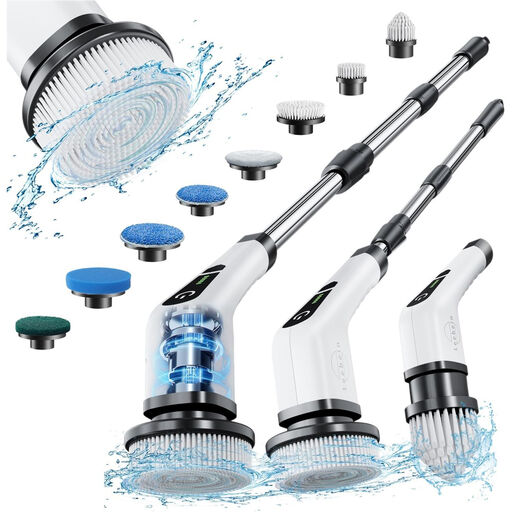 Image unavailable
The adjustable handle may suit cleaning a low tray perimeter with less bending.
The product name specifies eight interchangeable heads and a 137 cm adjustable handle. Check which head shapes are supplied and whether the brush suits your tray finish.
 Image unavailable
The extendable handle makes this a model to consider if reaching the low edge is the main difficulty.
The product name states seven brush heads, two speeds and an IPX7 rating. Confirm the head shapes, tray-finish suitability and charging arrangement before buying.
 Image unavailable
The adjustable extension handle may help with low edges, provided you can still control the brush beside the sealant.
The product name specifies eight interchangeable heads and two rotation speeds. Confirm that a suitable detail head is included and check the tray maker’s brush guidance.
For a narrow junction, start by checking for a pointed, small flat or corner head rather than relying on a broad flat brush. Choose only a brush type permitted by your tray’s care instructions.
Do not assume every brush suits every tray finish. Check the tray maker’s guidance first; Merlyn Showering warns against abrasive cleaning tools on its stone-resin trays. Test a suitable gentle head in an inconspicuous area before cleaning the visible edge.
Charge it outside the bathroom and follow the device’s charging instructions. Electrical Safety First advises against using extension leads to power appliances in bathrooms; a scrubber’s waterproofing claim does not make its charger or an extension lead safe beside the shower.
A higher stated rotation speed alone does not establish better cleaning at a narrow tray edge. Compare the supplied head shapes, your ability to control the brush and its suitability for the tray finish before using RPM to distinguish models.