What matters when buying?
For a tiled sink surround, check access around fittings and the tool’s wet-use instructions before weighing up attachments and storage.
| Concern |
What to check |
Who this matters to |
| Narrow joints and tap-side gaps |
Check the brush-head diameter and whether the body can be positioned beside the taps. |
If I need to reach between fittings and tile edges, I want control without the head striking the tap; around 36% of consumers put detail access first. |
| Wet cleaning |
Check the exact model’s water rating, permitted use conditions and charging instructions. |
When I clean beside a wet sink, I need to know how the tool can be used around splashes; wet-use confidence comes first for around 29% of consumers. |
| Surface-appropriate attachments |
Check tile and sink care instructions, then identify the supplied brush or pad and its intended surfaces. |
If my sink surround includes a finish or sealant that needs care, I do not want to assume a heavy-duty pad is suitable; around 21% of consumers prioritise attachment choice. |
| Storage and charging |
Check stored dimensions, kit contents and whether a separate battery or charger is needed. |
With little cupboard space and only occasional cleaning to do, I want equipment I can store and keep ready; for around 14% of consumers, that is the primary concern. |
Joybuy scrubber options
These cordless scrubbers are relevant to sink and tile cleaning, but their included heads and handle designs need checking against tight tap-side gaps and your storage space.
 No image available
Leebein electric spin scrubber, 8 heads and adjustable extension handle
Consider this for cordless sink and tile cleaning if a supplied head fits the joints and gaps you need to reach.
The product name specifies eight interchangeable brush heads, an adjustable extension handle and two rotation speeds. Check head sizes, surface suitability and the handle’s stored length before buying.
Joybuy
 No image available
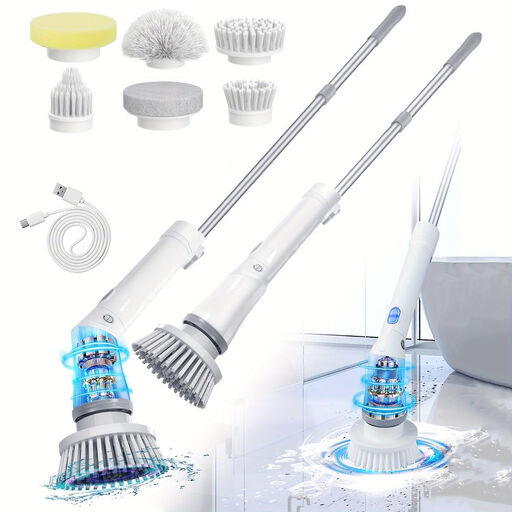
Leebein 2025 spin scrubber, 7 heads and extendable handle
This cordless option may suit bathroom and kitchen cleaning if its supplied heads can reach the sink surround without an awkward handle position.
The product name specifies seven brush heads, two speeds and IPX7 water resistance. Check the heads’ dimensions and surface uses, the stored length and the model’s wet-use and charging instructions.
Joybuy
 No image available
Iagreea electric spin scrubber, lightweight all-white version
Consider this model for grout and corner cleaning if its supplied heads fit your sink surround and suit its surfaces.
Before using it near water or cleaning fluids, check the exact wet-use conditions and charging instructions; also confirm the head dimensions and intended surfaces.
Joybuy
Frequently asked questions
What type of electric scrubber suits a tiled sink surround?
A compact handheld scrubber with a small detail head is a sensible starting point when grout lines and gaps beside taps are the main job. Bosch DIY positions the UniversalBrush for tiles and narrow tap-side areas, while RYOBI UK specifies a 5 cm head for its RSCR4-0; check that the particular head and body fit your sink layout.
Does an IPX5 or IPX7 rating settle whether I can clean beside a sink?
No: use the rating within the exact model’s stated conditions. Bosch DIY describes IPX5 splash protection for the UniversalBrush, and RYOBI UK specifies IPX7 for the RSCR4-0. Follow the tool’s wet-use and charging instructions rather than treating either rating as permission for every kind of water exposure.
Should I use a heavy-duty pad on grout and nearby tiles?
Only if the pad is suitable for the particular grout, tile finish and surrounding materials. Dremel distinguishes non-scratch from heavy-duty pads, so check surface-care instructions instead of assuming that the more abrasive option is appropriate everywhere.
What should I check before adding a cleaning product?
Read both the cleaner label and the scrubber instructions, limit splashes and use protection where the cleaner’s hazards call for it. The Health and Safety Executive warns that some cleaning products can cause skin burns and eye damage.
Does an electric scrubber for Great Britain have to carry a UKCA mark?
Not necessarily: Department for Business and Trade guidance updated in August 2026 says CE marking continues to be recognised in Great Britain alongside or in place of UKCA marking where the relevant regulatory requirements are met. This Great Britain guidance should not be assumed to cover Northern Ireland unchanged.


