Washstand-detail cleaners
If grout lines, tile edges and spaces around taps are the main job, a handheld brush with a small or shaped head deserves attention. Check that you can manoeuvre the head without its body obstructing narrow areas.


For a tiled washstand top dominated by grout, edges and corners around taps, start with a compact brush and a head shaped for detail work. A larger rotating scrubber makes more sense if you also plan to clean broader bathroom surfaces; check its supplied heads, water-protection instructions and charging arrangement before choosing.
If grout lines, tile edges and spaces around taps are the main job, a handheld brush with a small or shaped head deserves attention. Check that you can manoeuvre the head without its body obstructing narrow areas.
If the same tool will also tackle shower walls, baths or floor tiles, a flat head and extended reach may matter more than the smallest possible brush body. Check the supplied attachments and stated runtime for the surfaces you intend to clean.
If you already own compatible batteries, a platform scrubber may fit your existing setup. Confirm the exact battery compatibility and whether the tool is supplied with a battery and charger.
Choose the head shape for the washstand first. Consider a broader head or extending handle only if other bathroom surfaces are part of the job.
| Concern | What to check | Who this matters to |
|---|---|---|
| Control around taps and grout | Check the body size and whether a supplied small or cone-shaped head reaches the corners you need to clean. | If taps interrupt most of the tiled area, I want to guide the brush along joints without fighting a broad head. Around 42% of consumers put precise washstand control first. |
| Coverage and reach | Check for a flat tile head and, if needed, an extending handle; compare the stated runtime with your intended cleaning routine. | When the washstand is only one stop in a bathroom clean, I need a tool that also reaches larger tiled surfaces. Wider coverage is the primary concern for around 33% of consumers. |
| Wet-area use and power setup | Check the exact scope of the model's water-protection rating and whether its battery and charger are included. | If I will use the brush near splashes, I need clear use and charging instructions; a bare tool also needs a compatible power setup. Around 25% of consumers prioritise these checks. |
A flat tile head does not take the place of a small or cone-shaped head beside taps and along tight edges.
For a washstand-first purchase, check the detail heads supplied with the tool. Give greater weight to a broad head or extension if you will also clean larger surfaces.
A product's stated splash or water protection describes particular parts and use conditions; it does not make its charger suitable for a wet area. Electrical Safety First warns that wet conditions increase electric-shock risk.
Follow the tool and charger instructions, keep charging equipment away from wet areas and do not run an extension lead into the bathroom.
RYOBI describes the R18CPS-0 as a bare tool: its battery and charger are not included.
Before choosing a platform scrubber, confirm that you have a compatible battery and charger, then check which brush heads are supplied.
Without compatible ONE+ equipment already to hand, the R18CPS-0 needs a battery and charger separately.
A small oscillating detail brush and a rotating brush with an extension have different head shapes and handling demands, even when both are described as bathroom scrubbers.
Match the supplied head and tool format to the area you clean most often, rather than relying on the category name alone.
Lakeland's Turbo Scrubber kit is a reference point for cleaning washstand tiles as part of a wider bathroom routine.
The UniversalBrush is a compact rechargeable option to examine for tiles, joints and confined areas.
The R18CPS-0 is relevant if you want a larger cordless scrubber and use the ONE+ battery system.
SonicScrubber's detail-brush format is relevant to grout, tight corners and areas close to taps.
These rotating scrubbers are options to examine if washstand cleaning is part of a broader bathroom routine. For a washstand dominated by tap bases and narrow grout lines, check the included heads before choosing either tool.
 No image available
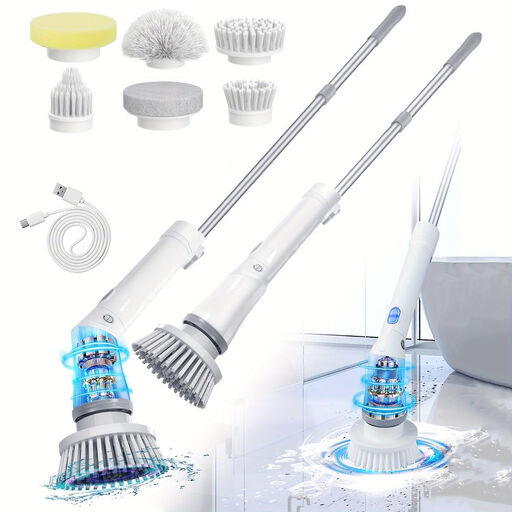
Consider this rotating format if you also clean bathroom tile faces; check that a supplied head fits the grout and spaces around your taps.
Check the instructions for wet-area use and your tile maker's surface-care guidance before cleaning.
 No image available
Consider the extendable handle if you also clean larger bathroom surfaces; check whether one of the seven supplied heads fits washstand grout and corners.
The product name states two speeds and an IPX7 rating. Follow the model's instructions for the rating's scope, wet-area use and charging.
Choose a compact detail brush if most of the work is beside taps, in corners and along grout. A long-handle rotating scrubber is more relevant when the same tool will also clean shower walls, baths or floor tiles, but check that it has a head suited to the washstand.
No: check what the rating applies to on the exact model and follow its use instructions. Bosch describes IPX5 splash protection for the UniversalBrush, while RYOBI specifies an IPX7-rated battery compartment on the R18CPS-0; neither statement makes charging in a wet area safe.
Charge it away from wet areas where practical, following the charger and scrubber instructions, and do not run an extension lead into the bathroom. Electrical Safety First warns that wet conditions increase the risk and severity of electric shock.
It means you need to check which parts are supplied before you can use the tool. RYOBI states that the R18CPS-0 does not include a battery or charger, so confirm that you already have compatible ONE+ equipment or can obtain it separately.