Grout-and-edge cleaners
If dirt in joints, corners and small patches is the main problem, a compact or detail brush gives you a more targeted tool than a broad floor pad. Ryobi and The Pink Stuff both offer small-head scrubber formats.


Choose a compact or telescopic spin scrubber if grout lines, edges and small patches are the main job; an upright floor cleaner or polisher is better suited to repeated cleaning across a larger area of sealed ceramic flooring. Check the attachment against your tile finish before using it, and weigh reach, floor coverage, power arrangements and wet-area safety against the work you actually need to do.
If dirt in joints, corners and small patches is the main problem, a compact or detail brush gives you a more targeted tool than a broad floor pad. Ryobi and The Pink Stuff both offer small-head scrubber formats.
If you regularly clean an open area of sealed ceramic flooring, an upright machine offers broad pad coverage and a standing handle. Ewbank lists floor-cleaning models in this format, though narrow joints may still need a separate brush.
If reaching floor-level tiles is the difficulty, compare handle adjustment, head angle, tool weight and where the controls sit. A longer handle does not, by itself, establish how comfortable a scrubber will be to use.
Choose it when: grout, edges and isolated marks matter more than covering the whole floor.
Trade-off: a small head takes more passes across an open room.
Choose it when: you need to reach floor-level joints while standing.
Trade-off: the longer tool may give you less close control at a delicate edge.
Choose it when: regular cleaning of a broad, sealed tile floor is the priority.
Trade-off: its wide pad will not replace a narrow grout brush.
| Concern | What to check | Who this matters to |
|---|---|---|
| Grout and edges | Check head shape and whether its bristles suit your tile finish; consider replacement-head availability. | If joints and perimeter dirt are the main job, I need a head that can reach them without scrubbing the tile face aggressively. Around 33% of consumers put targeted grout-and-edge cleaning first. |
| Open-floor coverage | Check cleaning-path width, suitability for sealed hard floors and the supplied pads; compare cord length or stated runtime. | For a larger open floor, I want to cover the tiles without working across the room with a small brush. Broad-floor coverage comes first for around 25% of consumers. |
| Less bending | Check the handle's adjustment range, head angles, tool weight and whether you can reach the controls while standing. | When repeated kneeling is the obstacle, I need to reach low tiles with a tool I can control. Around 25% of consumers prioritise reduced bending. |
| Wet-area and tile care | Check the exact tool's water-use and charging instructions, then test the chosen attachment and cleaner on an inconspicuous tile. | If I clean near water or have a scratch-sensitive finish, safe electrical use and surface care shape my choice. These are the primary concerns for around 17% of consumers. |
A broad pad covers open tiles but has limited access to joints and corners; a small head solves a different task.
Identify whether most of your work is on tile faces or in the joints before choosing a format.
Regular grout cleaning may still call for a separate detail or manual brush.
The Pink Stuff describes its included paste as mildly abrasive and warns that excessive pressure can scratch surfaces. Tile finish and attachment material matter alongside the motor.
Remove loose grit first, follow your tile maker's care advice and test the brush, pad and cleaner in an inconspicuous area before broader use.
A product-specific ingress rating does not remove electrical hazards around a bathroom or wet floor.
Follow the exact tool's wet-use and charging instructions, inspect cables and plugs, and heed Electrical Safety First's advice not to bring an extension lead into a bathroom to make up for a lack of sockets.
Scrubber ranges can include both bare tools and kits, so the heads, battery and charger need checking for the exact item.
Confirm the supplied equipment and compatible replacement heads before checkout. Plan a suitable recycling route for the electrical tool and batteries when they reach the end of use.
Upright floor cleaners and polishers to consider when the main job is an open area of sealed hard flooring.
Compact and telescopic cordless scrubbers for consumers comparing detail access, reach and battery arrangements.
A small scrubber kit aimed at detailed cleaning rather than wide floor coverage.
A telescopic spin-scrubber option for consumers who place particular value on adjustable reach.
These choices focus on cordless spin scrubbers for floor-level reach or targeted tile and grout cleaning. Compare their attachments with your tile finish; they are not substitutes for a wide-pad upright cleaner when open-floor coverage is your main priority.
 No image available
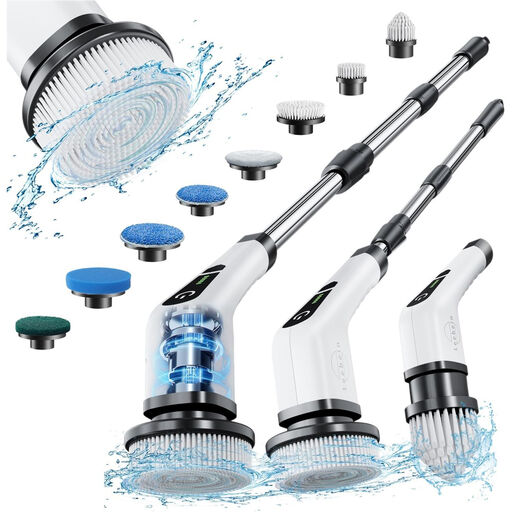
Consider this telescopic format if reaching floor-level tiles and joints while standing matters to you.
The product name specifies eight interchangeable heads, an adjustable extension handle and two rotation speeds. Check the head material against your tile finish and follow the exact charging instructions.
 No image available
This adjustable-handle option is relevant if you want to reach floor tiles without relying on a short handheld tool.
The product name specifies eight interchangeable heads and a handle described as adjustable to 137 cm. Check which head suits your tiles and what charging equipment is supplied.
 No image available
Consider the extendable handle for floor-level tile cleaning when standing reach is a priority.
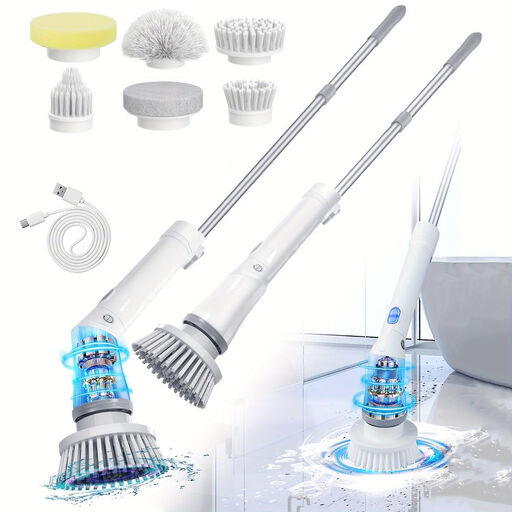
The product name lists seven brush heads, two speeds and an IPX7 water-resistance rating. Check the rating's conditions, head suitability and charging instructions; the stated rating does not make charging beside water safe.
 No image available
This choice is geared towards targeted work on tiles and grout rather than broad floor coverage.
Check the supplied head shapes and materials against the joints and tile finish you intend to clean. Follow the exact wet-use and charging instructions rather than assuming the tool can be used or charged beside water.
Yes, provided the attachment and cleaner suit the particular tile finish and you follow its care instructions. Johnson Tiles advises removing loose grit and describes warm water with a neutral or nearly neutral detergent for routine care of unglazed porcelain; for your installed ceramic tile, check the maker's guidance and test an inconspicuous area before using a powered brush more widely.
Choose a compact or telescopic brush scrubber for joints, edges and small patches; choose an upright machine for repeated cleaning across a larger open area of sealed hard flooring. Ewbank lists a 43.5 cm cleaning path for its FP90, whereas Ryobi lists a 5 cm head for a compact scrubber, illustrating why one format may not cover both jobs.
A water-resistance rating is not permission to charge a scrubber near a bath or shower. Keep charging away from water, follow the tool's instructions and heed Electrical Safety First's warning against using an extension lead in a bathroom where there are no socket outlets.
Use an appropriate electrical or battery collection route rather than household rubbish. GOV.UK advises keeping unwanted electrical products and batteries out of household waste; check the applicable collection instructions for the tool and its battery type.