For sound glazed wall tiles and close work around fittings, choose a compact cordless scrubber only if you can use a suitable gentle head. A telescopic model is worth considering for high walls and repeated bathroom changeovers, while older, damaged or uncertain glaze may call for a soft cloth instead. Test an inconspicuous area before powered cleaning: reach and speed do not outweigh the risk of marking the finish.
Who is choosing the tool?
Holiday-let operators with frequent bathroom changeovers
Repeated cleaning of larger tiled areas makes reach, manageable handling, storage and access to replacement heads relevant. A long pole may help with high wall sections, but it does not remove the need to choose a head that suits the glaze.
Cleaners working around taps and shower corners
Close control and smaller attachments matter more than maximum reach when cleaning around fittings, grout edges and narrow sections of tiled wall.
Owners caring for older or uncertain glazed tiles
Preserving the finish takes priority over powered scrubbing. The Tiles & Architectural Ceramics Society advises testing glazed surfaces discreetly and switching to a soft cloth if scratching appears.
What matters when choosing?
Decide whether the glaze can tolerate the proposed head before comparing reach, bathroom-use instructions and the equipment included.
Compact cordless scrubber
Choose when: You need close control around taps, grout edges and shower fittings on tiles suitable for the selected head.
Trade-off: A hand-held tool offers less reach on high walls, so larger areas may require more repositioning.
Telescopic cordless scrubber
Choose when: Repeated changeovers involve high or broad tiled wall sections where an extended handle would help you reach.
Trade-off: A longer tool and broader head can be harder to control around small fittings; it still needs a suitable gentle head.
Soft-cloth cleaning
Choose when: The glaze is old, damaged or uncertain, or a discreet test shows marking.
Trade-off: Cleaning by hand takes more effort, but lets you control contact with a vulnerable finish.
| Concern |
What to check |
Who this matters to |
| Protecting the glaze |
Check tile-care guidance and the supplied heads; test the gentlest suitable option in a hidden area. |
If the glaze is older or unfamiliar, I would rather clean by hand than leave permanent marks; around 36% of consumers put protecting the finish first. |
| Reach and changeovers |
Check extended handle length and whether the head angle works for the wall sections you clean. |
When I repeatedly clean tiles above a bath or shower, reaching them without awkward stretching matters most; roughly 29% of consumers prioritise reach. |
| Wet-area use and maintenance |
Check what any water-resistance rating covers and follow the tool's cleaning, charging and inspection instructions. |
I need to use and maintain an electrical tool around bathroom moisture without treating its charger as water-resistant; about 21% of consumers make wet-area handling their primary concern. |
| Storage and kit contents |
Check the tool's storage size, included heads and whether a compatible battery and charger are needed. |
With limited storage and occasional cleaning sessions, I want to know what equipment I need to keep together; approximately 14% of consumers put storage and kit completeness first. |
Mistakes to avoid
-
Using a scouring head because the dirt looks stubborn
The Tiles & Architectural Ceramics Society warns that power-driven abrasives may permanently damage glaze. A brush being sold for tile cleaning does not establish that every supplied head suits your tiles.
Start with the gentlest compatible head, test a hidden area and switch to a soft cloth if marking appears.
-
Assuming a bare tool is a complete cleaning kit
Ryobi describes the R18TPS-0 as a bare tool: its battery and charger are not included.
Check whether you already have compatible ONE+ equipment, and identify every item needed to use the tool.
-
Treating water-resistance ratings as interchangeable
Bosch specifies IPX5 splash-water protection for its brushes, while Ryobi's stated IPX7 protection applies to the R18TPS-0 battery compartment. Neither statement describes every part of a tool or its charger.
Check the exact model instructions, including which component the rating covers, and keep charging equipment away from wet cleaning.
-
Relying on an annual electrical test alone
The Health and Safety Executive says portable electrical equipment should be maintained according to the risks of its use; it does not prescribe annual portable appliance testing for every item. Visual checks can identify damage between inspections.
Check the tool and charging equipment for visible damage, and arrange competent inspection or testing when the equipment and working conditions call for it.
Relevant brands for reference
Bosch
Bosch's UniversalBrush and TAYDO lines are compact cordless options for work around tiles, joints and fittings.
- Bosch specifies interchangeable accessories and IPX5 splash-water protection; the TAYDO set includes microfibre pads as well as heavier-duty pads.
- Choose the attachment for the installed glaze rather than assuming every pad is gentle enough. A compact tool also offers less reach on high wall sections.
Ryobi
The Ryobi R18TPS-0 is a telescopic ONE+ option for reaching larger or higher tiled sections.
- Ryobi specifies a pole extending to 1.4 m, a pivoting head and a 15 cm brush for this model.
- The R18TPS-0 is sold without a battery or charger, and its broad head may be less convenient around detailed tilework.
Lakeland
Lakeland offers both compact cordless cleaning brushes and a longer-reach Turbo Scrubber bathroom kit.
- Lakeland lists a 112 cm reach and four brushes for the Turbo Scrubber, giving buyers different head shapes to assess for the task.
- Confirm which attachment suits the particular glazed finish; a scouring attachment should not be treated as suitable for every tile.
Joybuy scrubbers for tiled bathrooms
These cordless options cover extendable-handle cleaning for higher tiled sections and a hand-held option for closer work. For each one, check the supplied head against your tile's finish before using powered scrubbing.
 No image available
Leebein 2025 Spin Scrubber, 7 Heads, Extendable Handle
Consider the extendable handle for higher tiled sections, provided a supplied head suits the glaze.
The product name lists seven brush heads, two speeds and IPX7 water resistance. Check what the rating covers in the instructions, and test a gentle head in an inconspicuous area.
View on Joybuy
 No image available
Leebein Spin Scrubber, 8 Heads, Adjustable Extension Handle
The adjustable extension handle may suit repeated cleaning of tiled wall sections at different heights; check that the chosen head is appropriate for your glaze.
The product name specifies eight interchangeable heads and two rotation speeds. Test a gentle head discreetly and follow the tool's water-use and charging instructions.
View on Joybuy
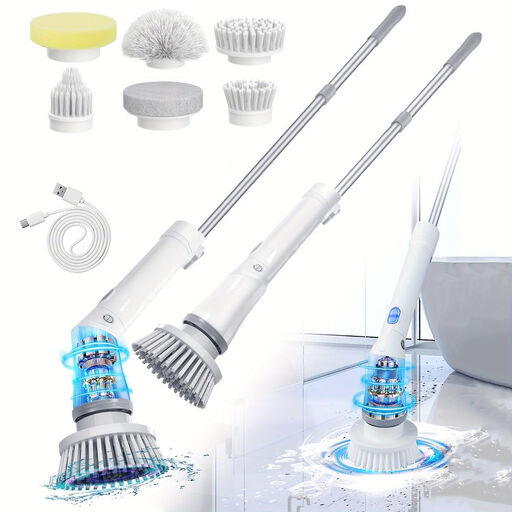 No image available
Iagreea Electric Spin Scrubber, All White Version
For close work around fittings, check whether a supplied head is suitable for the glazed tile before choosing this hand-held option.
Test in an inconspicuous area and follow the tool's instructions for bathroom use and charging.
View on Joybuy
Common questions
Can I use an electric scrubber on glazed wall tiles?
Only if the selected head and cleaning method suit the tile, and a discreet test shows no marking. The Tiles & Architectural Ceramics Society warns against power-driven abrasives on glazed surfaces and advises switching to a soft cloth if scratching appears.
Does IPX5 mean I can submerge a scrubber?
No. Bosch describes IPX5 on its brushes as splash-water protection. Check the instructions for the exact model and component rather than treating a wet-area rating as permission to submerge the tool or charger.
Does every holiday-let scrubber need an annual PAT test?
Not automatically. The Health and Safety Executive says equipment that could cause injury must be maintained safely, but it does not prescribe annual portable appliance testing for every item. Base visual checks, inspection and any testing on the equipment, its use and its working environment.
Does England's holiday-let guidance cover the whole UK?
No. GOV.UK's guidance on self-catering holiday homes applies to England; check the applicable guidance for the nation where the property is located. For portable electrical equipment, the Health and Safety Executive advises maintenance appropriate to its use and environment.


