Who needs which scrubber?

Routine cleaners protecting an existing sealer

If your main job is lifting everyday grime from sealed grout and nearby tile, start with gentle contact rather than the stiffest brush. Tile Doctor recommends pH-neutral cleaning and a soft-bristle brush for sealed surfaces; check that the cleaner also suits your particular sealer.

Cleaners working on narrow details

For tight grout lines, corners and joins, a handheld tool with an appropriately gentle detail head may be easier to position than a broad spinning head. Bosch offers interchangeable attachments, while SonicScrubber lists heads shaped for grooves and confined areas.

Cleaners trying to bend less

Floor grout and shower walls can make kneeling or stretching the harder part of the job. A telescopic handle can extend your reach; Tower’s Whiziwand XL also detaches for handheld use. Check the tool’s weight and the suitability of its brush head as well as its handle length.

What matters when choosing?

For sealed grout, settle on a compatible head and cleaner first. Then decide whether control in small joints or easier reach across a larger area matters more to you.

Concern What to check Who this matters to
Protecting the sealer Check for a soft or non-scratch head and a cleaner compatible with the tile, grout and existing sealer. If I clean sealed surfaces regularly, I want to lift grime without making abrasive contact my default. Around 42% of consumers put sealer-compatible, gentle cleaning first.
Reaching narrow joints Look at the supplied head shapes and whether you can hold a suitable detail head close to the grout line. When corners and thin joints are the main job, I need to place the brush accurately rather than sweep across the tile face. Grout-line precision comes first for around 33% of consumers.
Reducing bending Check handle extension, handheld use and whether a suitable head is available for the sealed surface. For a floor or shower wall, I would rather extend the tool than kneel or stretch through the whole job. Reach and reduced effort are the primary concern for around 25% of consumers.

Mistakes to avoid with sealed grout

  • Choosing by motor speed alone

    Higher speed does not establish that a brush or cleaner suits your sealer. Tile Doctor advises pH-neutral cleaning for sealed surfaces and warns that some cleaners intended for ceramic tile can degrade a sealer.

    Choose a compatible cleaner and soft or non-scratch contact for routine work. Try a more vigorous setting only after checking the surface guidance and testing a small, inconspicuous area.

  • Assuming every kit head is gentle

    A kit can contain heads for different surfaces and tasks. A low-speed setting or a large attachment count does not mean each included brush is suitable for sealed grout.

    Check the material and intended use of the exact head you plan to fit, including any replacement head.

  • Using a broad head for tiny details

    A telescopic handle helps with reach, but a broad spinning head may be difficult to place within a narrow joint or corner.

    Prioritise a controllable handheld arrangement and a suitable detail head when precision matters most; choose a longer handle when floor or wall reach is the bigger obstacle.

  • Putting an old tool or batteries in household rubbish

    UK Government guidance says electrical products and batteries should be taken to an appropriate collection point rather than placed in household rubbish.

    Use an appropriate electrical-recycling route for the tool and a battery collection route for removable batteries.

Brands to consider for sealed-grout cleaning

Bosch

Bosch’s UniversalBrush is a compact cordless brush intended for tasks including tiles and joints.

  • Bosch lists interchangeable brushes and pads, including a non-scratch pad option, and a 215 rpm operating speed.
  • Check which attachment comes with the particular set and whether it suits your grout and sealer.

Tower

Tower’s Whiziwand XL takes a long-handled approach to grout, tile and larger cleaning areas.

  • Tower lists a telescopic handle, detachable handheld section, seven attachments and 350 rpm and 450 rpm settings.
  • Its lower setting is described for delicate glass and tiles, but brush material still needs checking before use on sealed grout.

SonicScrubber

SonicScrubber’s Household System is a compact, AA-battery-powered tool aimed at grooves and tight household areas.

  • The brand lists a cone brush for grooves and a separate soft, non-scratch head for surfaces needing gentler contact.
  • The cone brush is described as rigid, so do not assume it is the right head for your sealer. The compact tool also lacks the reach of a telescopic handle.

A long-handled Joybuy option

This extendable-handle scrubber is relevant if reaching floor or wall grout is your main difficulty. For sealed grout, check the supplied head and your cleaner against the surface before using it.
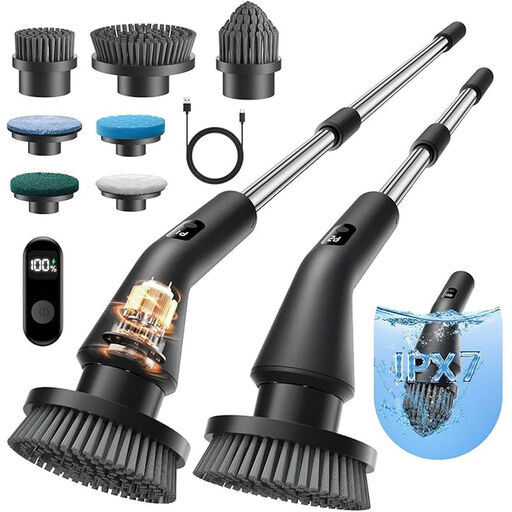
Leebein 2025 Electric Spin Scrubber with extendable handle

Leebein 2025 Electric Spin Scrubber with Extendable Handle

The long-handled format is suited to shoppers who want more reach when cleaning floor or wall grout.

  • Listed with seven brush heads, two speeds and an IPX7 rating.
  • For narrow joints, check the included head shapes; for any sealed surface, confirm that the head and cleaner suit the existing sealer.
Joybuy

Questions about sealed-grout cleaning

Can I use an electric scrubber on sealed grout?

Yes, if its fitted head and your cleaner suit the grout, adjacent surface and existing sealer. Tile Doctor recommends pH-neutral cleaning and soft-bristle agitation for sealed surfaces; test your chosen combination in an inconspicuous area first.

Should I use the highest speed on dirty grout?

Not by default on sealed grout. Begin with a suitable gentle head and a lower practical setting, then consider more vigorous cleaning only if the surface guidance and a small-area test support it. Tower describes its Whiziwand XL’s 350 rpm setting for delicate glass and tiles, not as a guarantee for every sealer.

Which head should I look for in narrow grout lines?

Look for a head you can position accurately within the joint, while checking that its material suits the sealed surface. SonicScrubber lists a cone brush for grooves, but describes it as rigid; its soft, non-scratch head serves a different need.

How should I dispose of an old electric scrubber in the UK?

Take the electrical tool and any removable batteries to appropriate collection routes rather than putting them in household rubbish. UK Government guidance directs electrical products and batteries to suitable recycling collection points.