Holiday-let turnover cleaners
If you clean the washstand between guest stays, a tool needs to be manageable around the basin and straightforward to clean, store and recharge between changeovers.


For a tiled washstand, start with a hand-sized cordless scrubber rather than a larger model unless cleaning broad surfaces is also a substantial part of the job. A compact rotating head suits routine tile faces; a detail head is the more targeted choice when grout and tap bases take most of the work. Check the supplied heads, battery and charger, and wet-use instructions before buying; water resistance does not make every bathroom use or charging location safe.
If you clean the washstand between guest stays, a tool needs to be manageable around the basin and straightforward to clean, store and recharge between changeovers.
If narrow joints, tap bases and edges take most of your time, head shape and control matter more than covering a large tile face in one pass.
If a scrubber will move between rooms or properties, check what comes with each kit and plan for replacement heads, charging equipment and condition checks during repeated use.
Choose when: Routine cleaning centres on the tiled top and basin surround, with some space to work around the fittings.
Trade-off: A small round head takes more passes over a broad surface and may not reach the tightest joints.
Choose when: Grout lines, tap bases and confined edges are the main cleaning task.
Trade-off: Detail heads take more passes across open tile; some models are sold without a battery or charger.
Choose when: The washstand is one part of a wider cleaning round and you can accommodate the larger head and compatible battery system.
Trade-off: A larger head is less targeted around tap clearances, while a bare tool needs separate compatible power equipment.
| Concern | What to check | Who this matters to |
|---|---|---|
| Access to grout and fittings | Check the supplied head shapes and their stated uses; confirm that one fits the narrow joints and tap clearances. | If grout lines and tap bases slow me down, I need a head I can guide into those spaces. Around 33% of consumers would put detail access first. |
| Repeated changeovers | Compare head size with the open tiled area, then check the stated runtime and the battery capacity on which it depends. | When several bathrooms need resetting, I want to cover the tile faces without making every pass by hand. Roughly 25% of consumers would prioritise the pace of routine cleaning. |
| Wet-area handling | Read the tool’s water-use instructions and ingress-protection rating; plan to charge outside the bathroom. | I need to work near water without treating a water-resistance claim as permission to charge beside the basin. Around 25% of consumers would make safe wet-area handling their primary concern. |
| Ongoing equipment needs | Confirm battery and charger inclusion, replacement-head availability and a suitable condition-check routine. | If the tool will be used repeatedly across properties, I need the kit and replacement parts to remain practical to manage. Roughly 17% of consumers would put ongoing equipment needs first. |
A broad head may suit open tile but can be awkward around taps and narrow edges. Ryobi UK lists a 5 cm head for its RSCR4-0 compact model and a 15 cm head for its R18CPS-0.
Look at the smallest spaces you must clean before choosing head size. Reserve a larger head for work that genuinely includes substantial open surfaces.
Ryobi UK identifies the RDS4-0 detail scrubber and R18CPS-0 as bare tools; the R18CPS-0 runtime claim also depends on the battery used.
Check the exact contents for heads, a compatible battery, charger and charging cable before choosing a kit.
A separately obtained battery and charger add equipment to buy, store and maintain.
An IP rating describes resistance to water ingress under stated conditions, not a safe charging arrangement. Electrical Safety First warns against using an extension lead to power an appliance in a bathroom when no socket-outlets are available.
Follow the scrubber’s wet-use instructions, charge outside the bathroom and stop using equipment that shows damage or electrical faults.
For self-catering holiday homes in England, GOV.UK directs owners to Health and Safety Executive electrical-safety guidance. HSE says the type and frequency of equipment checks depend on the equipment, its environment and previous results.
Set a routine for checking the tool, switch and charging lead, and review it as use and conditions change.
Ryobi UK offers compact rotating, detail oscillating and larger 18V ONE+ scrubber formats relevant to different parts of this task.
The Bosch UniversalBrush is a compact cordless option with interchangeable accessories.
The Deep Clean Scrubber Turbo Brush is a multi-head option for choosing different brushes around tile, grout and fittings.
SonicScrubber’s rechargeable system is aimed at detail cleaning with interchangeable heads.
Lakeland’s Electric Cordless Scrubber is a multi-head household option described for bathroom tiles and fittings.
These cordless, multi-head scrubbers are options to assess for tiled washstand cleaning. Check whether their supplied heads fit your grout and tap clearances rather than assuming that a bathroom-use description settles the choice.
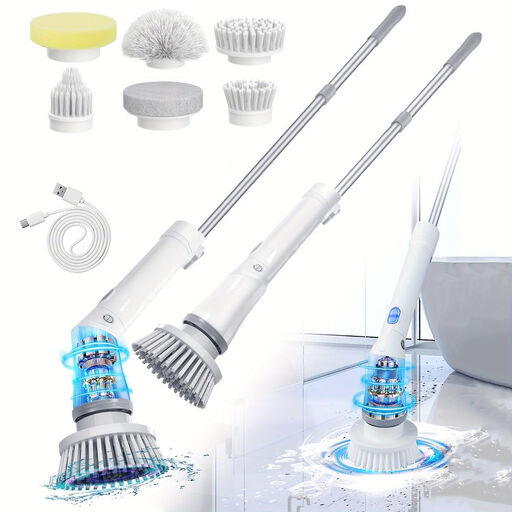 No image available
Consider this for tiled surfaces and grout, but check the supplied heads against narrow joints and tap bases before choosing it.
Confirm the wet-use and charging instructions for your cleaning routine.
 No image available
Consider this when washstand cleaning is part of a wider bathroom round; check whether its extendable handle is comfortable around taps.
The product name states seven brush heads, two speed settings and IPX7 water resistance. Check the heads’ intended uses and follow the manufacturer’s use and charging instructions.
Do not use an extension lead to power an appliance in the bathroom when no socket-outlets are available, as Electrical Safety First advises. Charge a cordless scrubber outside the bathroom and follow its manufacturer’s instructions.
No. IPX7 concerns water ingress into the rated product under specified conditions; it does not settle where an appliance may safely be used or charged. Follow the exact model’s instructions and keep charging separate from wet cleaning.
An annual test is not the automatic interval for every appliance: the Health and Safety Executive says the type and frequency of checks depend on the equipment, environment and previous results. For self-catering holiday homes in England, GOV.UK directs owners to HSE electrical-safety guidance; check requirements applicable to the property’s UK nation.
Clean and store each head as its manufacturer instructs, and check for wear before reuse. If you need separate heads for tile faces, grout and fittings, confirm their intended uses and replacement availability for the exact model.