Tenants cleaning narrow grout and recesses
If the brush cannot enter the opening or reach a corner, its reach elsewhere will not solve the main task. You need a head you can position and control inside the recess.


For a narrow tiled recess, start by checking whether a small detail brush can reach the grout and corners; a wider rotary head is more useful when there is room to clean the surrounding tiles. Choose a telescopic scrubber if awkward reach is the main problem and the head fits the area. In a rented flat, test unfamiliar brushes and cleaners gently, and report recurring damp or extensive mould rather than relying on scrubbing alone.
If the brush cannot enter the opening or reach a corner, its reach elsewhere will not solve the main task. You need a head you can position and control inside the recess.
If you also clean open tiles above or below the recess, handle length and brush angle may matter more than they would for grout alone.
If the glaze or sealant is unfamiliar, you need to consider the brush, cleaning compound and pressure together. Recurring damp calls for attention beyond a cleaning tool.
Choose when: The recess is narrow and access to grout and corners is the main task.
Trade-off: A small head takes more passes across broad tiles; the SonicScrubber Household System uses AA batteries.
Choose when: The opening accommodates a wider head and you also clean adjacent flat tiles.
Trade-off: Ryobi Tools UK lists a 15 cm head on the R18CPS-0, which may be awkward in a tight recess.
Choose when: Reaching open tiles above or below the recess is the harder part of the job.
Trade-off: The larger format still needs enough clearance for its brush head inside the recess.
| Concern | What to check | Who this matters to |
|---|---|---|
| Access to grout and corners | Measure the narrowest opening and internal clearance, then compare them with the head’s dimensions and the space needed to manoeuvre it. | If I cannot get a brush into the recess, cleaning the surrounding wall will not finish the job. Around 50% of consumers put precise access first. |
| Reach and handling | Check handle length, brush angle and whether the head still fits where the tiles are hard to reach. | High or low tiles make me want to avoid awkward stretching or kneeling; around 30% of consumers prioritise easier reach. |
| Setup and surface care | Confirm the required battery, charger and brush heads, and check cleaner directions before testing an unfamiliar finish. | I want a usable setup without overlooking what it needs, while taking care with the flat’s tiled finish. Around 20% of consumers make this their primary concern. |
A head that works across open tiles may not enter the recess or turn towards its back corners.
Measure the opening and usable space inside it before choosing a brush. Prioritise a detail head if grout and corners are the main job.
Ryobi Tools UK lists the R18CPS-0 and R18TPS-0 as bare tools.
Check whether you already have a compatible ONE+ battery and charger, or need them to use the tool.
A compatible battery and charger may be needed separately.
The Pink Stuff describes the paste in its Scrubber Kit as mildly abrasive and warns that too much pressure can scratch surfaces.
Start gently and test the brush-and-cleaner combination on an inconspicuous area when compatibility with the tile, glaze or sealant is uncertain.
Wandsworth Borough Council notes that damaged pipework and failed seals can cause damp. Cleaning the visible area does not address those causes.
Photograph and report damp or mould that returns, particularly if a leak or failed seal is suspected. Croydon Council advises tenants to contact their landlord about large areas of black mould.
Its battery-powered Household System is aimed at detail cleaning, including grout.
Its ONE+ range includes compact and telescopic rotary scrubbers for more open cleaning areas.
Its Miracle Scrubber Kit combines a battery-powered tool, interchangeable heads and cleaning paste.
An extendable spin-scrubber format for bathroom and tile cleaning appears in an Amazon.co.uk listing for a Leebein model.
These spin scrubbers are choices to consider for bathroom tiles, grout or awkward reach. For a narrow wall recess, check the dimensions and shape of an included head against the space you need to clean before choosing a model.
 No image available
Consider this model if reaching the tiles is difficult and you can identify a supplied head that fits the recess.
The product name specifies eight interchangeable brush heads, an adjustable extension handle and two rotation speeds. Check head dimensions before choosing it for narrow grout or corners.
 No image available
Consider this extendable model for bathroom tiles that are awkward to reach, provided an included head suits the recess.
The product name specifies seven brush heads, two speeds and an IPX7 rating. Confirm head shapes and dimensions, and follow the instructions for wet-area use.
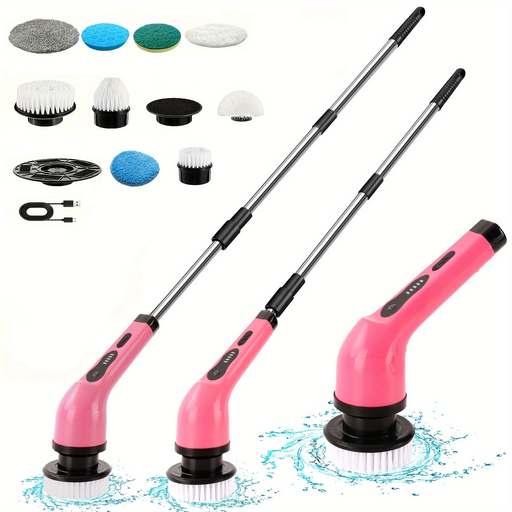 No image available
Consider this cordless option for tiled areas if one of its supplied heads can enter and move within the recess.
The product name specifies two speeds and nine replacement heads. Check the head shapes and dimensions, as well as the instructions for use around water.
 No image available
Consider this model for grout and tiled areas if its detailed head is small enough for your recess.
Check the detailed head’s dimensions before choosing it for a confined opening, and follow the product instructions for wet-area use.
Only if its brush head and body have enough clearance. Ryobi Tools UK lists 15 cm heads for its R18CPS-0 and R18TPS-0, so measure both the opening and the space inside before choosing either for a narrow recess.
Follow the instructions for the exact tool rather than assuming that a water-resistance rating applies to every part or model. Check the directions for cleaning, charging and use near water before starting.
Ryobi Tools UK lists the R18CPS-0 and R18TPS-0 as bare tools, so you need access to a compatible ONE+ battery and charger to use them. Check what you already own and what is supplied with the particular product.
Report recurring damp or mould to your landlord or managing agent, especially if you suspect a leak or failed seal. Wandsworth Borough Council identifies damaged pipework and failed seals as possible damp causes, while Croydon Council advises landlord contact for large areas of black mould; this is local England guidance, not a UK-wide tenancy-law conclusion.