Cleaners covering long skirting runs
If you clean several rooms between guest stays, a handle that lets you work from standing height may matter more than precision at every corner. Compare the tool’s reach and handling weight together.


Choose a long-handled cordless scrubber if repeated cleaning along low skirting makes bending the main problem; choose a compact detail scrubber if narrow grout and trim edges take most of the work. More interchangeable heads are useful only if the included brushes fit those profiles and the tile finish. For an unknown or delicate glaze, check the tile-care instructions and test a non-abrasive approach before using a powered brush.
If you clean several rooms between guest stays, a handle that lets you work from standing height may matter more than precision at every corner. Compare the tool’s reach and handling weight together.
For narrow joints, corners and irregular skirting profiles, a small or shaped brush is easier to position than a broad head. A compact tool is less suited to covering a long, low perimeter from standing height.
If the material, glaze or sealant condition is unclear, establish the appropriate cleaner and attachment before prioritising speed. The Tiles & Architectural Ceramics Society advises testing an unobtrusive area and warns against power-driven abrasives on glazed surfaces.
For recurring cleaning of tiled skirting in a holiday let, decide whether standing reach, access to narrow details or protection of the finish is your primary concern.
Choose it when: long runs of low skirting make repeated bending the main difficulty.
Trade-off: a larger head can be awkward around tight trim, and handle length does not establish comfort in use.
Choose it when: the work is concentrated in narrow grout, corners and shaped edges.
Trade-off: without a long handle, cleaning an entire low perimeter can involve more crouching.
| Concern | What to check | Who this matters to |
|---|---|---|
| Reach and handling | Compare the stated handle range, included pole and tool weight; check whether the head can meet the floor-to-skirting junction. | If I clean long runs between stays, I want to work without repeatedly kneeling, but still need a tool I can handle comfortably. Around 45% of consumers put standing reach and repeated cleaning first. |
| Grout and edge access | Check the exact kit for a small or pointed brush, and whether compatible replacement heads are available. | Narrow grout and trim corners are my main task, so control in those spaces matters more than covering a broad tile face. For around 36% of consumers, precise access is the primary concern. |
| Tile-finish protection | Identify the tile and cleaner requirements; check brush firmness and test an unobtrusive area before powered cleaning. | When the glaze or sealant condition is uncertain, I would rather establish a suitable method than risk marking the skirting. Protecting the finish comes first for around 19% of consumers. |
An attachment being included does not make it suitable for a particular glaze or sealant. The Tiles & Architectural Ceramics Society warns that power-driven abrasives may permanently damage glazed surfaces; Verona Group also advises against scouring pads on glazed tiles.
Identify the finish, start with a suitable non-abrasive brush and cleaner, and test an unobtrusive patch.
Several broad heads will not necessarily reach a recessed grout line or tight trim corner. The Hurricane and SonicScrubber product descriptions distinguish shaped or small brushes for detail work.
Check which heads come with the exact kit and whether compatible detail and replacement brushes are available.
If none fits the profile, finishing those edges may require a separate detail tool.
Cordless operation does not remove electrical precautions for the charger. Electrical Safety First warns against using extension leads to power appliances in bathrooms.
Charge away from the wet cleaning area, inspect the charger and cable between turnovers, and take damaged equipment out of use.
A telescopic handle can reduce bending, but the tool still has to be manoeuvred along the skirting. The HOTO HFE0003GL is listed at 1.9 kg; that figure alone cannot establish whether it will feel comfortable during a full turnover.
Compare weight, collapsed length, handle adjustment and storage space alongside reach.
The HFE0003GL is a long-handled cordless option for low skirting and other tiled areas. This model has a 37–51 inch handle range, two speeds, six heads and up to 110 minutes of runtime.
The Hurricane Spin Scrubber combines an extension pole with interchangeable heads. Robert Dyas describes its pointed corner brush for corners, tracks and trim.
The Household System is a compact detail-cleaning option. SonicScrubber lists a 212 g tool and a separate 0.75 inch medium brush for grout and general detail work.
These cordless, extendable scrubbers suit shoppers considering a long-handled tool for repeated low-level cleaning. Check the included brush shapes and tile-care instructions before using any head on the skirting.
 No image available
Consider this extendable model if standing reach is your main priority when cleaning low skirting.
The product title lists eight interchangeable heads and two rotation speeds. Check which supplied brush fits narrow edges and whether its bristles suit the tile finish.
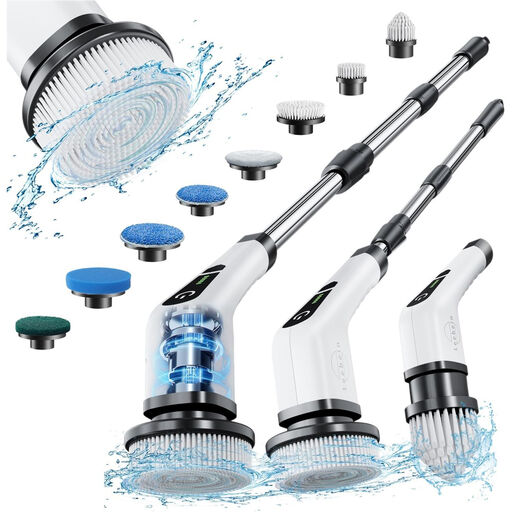 No image available
Consider this cordless model if you need an extendable handle for low skirting and a choice of heads for other cleaning areas.
The product title specifies eight interchangeable heads and a 137 cm adjustable handle. Confirm the brush shapes for grout and trim; follow the product instructions around water and charge away from wet areas.
 No image available
Consider this extendable model for repeated cleaning along low tiled skirting where working from standing height is important.
The product title lists seven heads, two speeds and IPX7 water resistance. That rating does not establish brush suitability for glazed tile: check the attachments and test an unobtrusive area.
Charge the scrubber away from the wet cleaning area rather than running an extension lead into the bathroom. Electrical Safety First warns against using extension leads to power appliances in bathrooms; follow the scrubber’s charging instructions as well.
No: water resistance does not establish whether a brush or pad suits the tile finish. The Tiles & Architectural Ceramics Society warns that power-driven abrasives may permanently damage glaze, so check the surface guidance and test a suitable non-abrasive attachment in an unobtrusive area.
Choose a cleaner for the confirmed tile and grout type, rather than assuming one bathroom product suits every finish. Verona Group advises against abrasive creams and scouring pads on glazed tiles and calls for stone-safe products on natural stone.
Do not assume that every portable appliance needs an annual PAT test. The Health and Safety Executive says blanket annual PAT testing in low-risk environments is a myth and emphasises maintaining equipment so it does not cause danger; set inspection and maintenance arrangements for the tool’s actual use and check requirements applicable to the property.
For a self-catering holiday home in England, GOV.UK guidance says operators must follow Health and Safety Executive electrical-safety guidance. Choose a tool that can be inspected and maintained, keep charging away from damp cleaning areas, and check any other requirements that apply to the property; England-specific guidance should not be assumed to cover a let elsewhere in the UK.