Shared-house cleaning rota users
If you regularly clean broad tiled sections, standing reach and a larger head may matter more than precision around grout.


Choose a telescopic scrubber if the regular job is cleaning broad, high or low sections of tiled wall; check its reach, head angle, battery bundle and wet-use instructions. A compact scrubber better suits grout and corners, while a rechargeable long-handle model may suit occasional wall cleaning if its supplied heads meet your needs.
If you regularly clean broad tiled sections, standing reach and a larger head may matter more than precision around grout.
If most of the work is around tile joins, narrow edges or fittings, a compact tool with suitable small heads is more relevant than maximum reach.
A scrubber may help clean a suitable surface, but recurring marks call for attention to the underlying moisture problem as well.
Consider it when: You regularly clean broad tiled sections above or below comfortable hand reach.
Trade-off: A broad head is less suited to narrow grout lines, and a bare tool may require a separate compatible battery and charger.
Consider it when: You want a supplied long handle and interchangeable heads for occasional wall cleaning without a separate power-tool battery platform.
Trade-off: Confirm which replacement heads are available and whether the handle and attachments suit the areas you clean.
Consider it when: Grout, corners and fittings make up most of the job.
Trade-off: A small head takes more passes across a broad wall and requires you to work closer to the tiles.
| Concern | What to check | Who this matters to |
|---|---|---|
| Reach and wall coverage | Check the extended handle length and whether the head angle and size suit your wall. | I need to clean high tiles and broad panels without repeatedly stretching or moving closer. Around 50% of consumers put reach and coverage first. |
| Grout and corners | Check the included head shapes and whether the brushes are suitable for your tile finish. | My main job is cleaning joins, edges and tight corners rather than whole panels; roughly 30% of consumers prioritise that detailed work. |
| Wet use and shared upkeep | Check which parts any water-resistance rating covers, the charging instructions, battery inclusion and replacement heads. | Several residents will use and care for the tool, so I need clear wet-use instructions and a workable charging arrangement. About 20% of consumers place wet use and upkeep first. |
Ryobi UK lists the R18TPS-0 as a bare tool, whereas its RSCR4-120G kit includes a battery and USB charging cable. Those bundles do not contain the same equipment.
Check the tool, compatible battery, charger and brush heads included with the exact variant.
A bare tool can require a separate battery and charger before use.
Ryobi UK specifies a 5 cm head for its compact RSCR4-120G and a 15 cm head for the telescopic R18TPS-0. The smaller head means more passes over broad panels.
Base your choice on the largest job you do regularly; prioritise a detail head when joins and corners are the main task.
Removing marks from suitable tiles does not address condensation, poor ventilation or a leak. GOV.UK guidance for rented housing in England says the underlying damp issue should be tackled.
Report recurring damp or mould to the landlord or managing agent and ask for the moisture source to be investigated.
Water-resistance claims are specific to the model and may describe a particular part of the tool rather than every component.
Check what the exact model's rating covers and follow its cleaning, battery and charging instructions.
Ryobi UK lists both a telescopic 18V ONE+ wall-cleaning format and a compact 4V detail scrubber.
JML offers the Hurricane Spin Scrubber as a rechargeable long-handle option with interchangeable heads.
The SonicScrubber Rechargeable System is oriented towards grout, corners and other small areas rather than broad wall coverage.
These adjustable-handle cordless scrubbers are options to consider when reach matters for tiled utility walls. Compare their included heads and wet-use instructions with the specific areas your household cleans.
 No image available
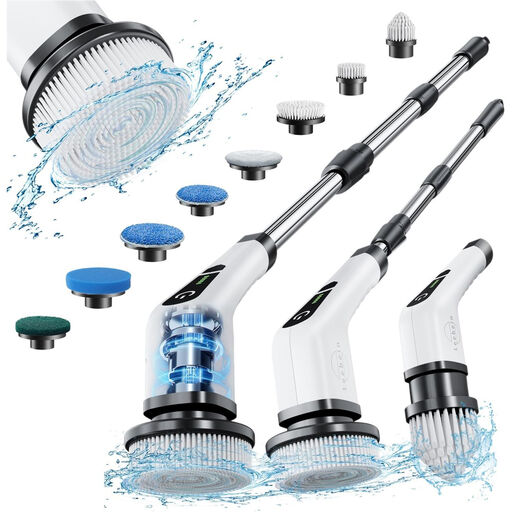
Consider this adjustable-handle option for cleaning tiled wall sections and changing heads for smaller areas.
The product name specifies a 137 cm adjustable handle and eight interchangeable heads. Check the head sizes for your tiles and follow the model's wet-use and charging instructions.
 No image available
Consider this model if an extension handle and a choice of heads suit your tiled-wall cleaning routine.
Its product name specifies eight interchangeable heads and two rotation speeds. Check the extended length and head sizes against your working height and tile details.
 No image available
Consider this extendable-handle version if you need to move between tiled sections and smaller cleaning tasks.
The product name specifies seven heads, two speeds and an IPX7 rating. Confirm what that rating covers, whether a battery is included and which heads suit your tiles; follow the exact model's care instructions.
Choose a long-handle model when broad wall sections and reach are the main job; choose a compact model when grout, corners and fittings take priority. Compare the actual head sizes and attachments, since a small detail head needs more passes across a full panel.
No. A rating applies to the stated model and components, not to every scrubber or every cleaning method. Confirm what it covers on the exact variant and follow its battery, charging and cleaning instructions.
Treat repeated damp or mould marks as a reason to investigate moisture, not simply to scrub again. GOV.UK guidance for rented housing in England says landlords should tackle the underlying damp issue; report recurring marks to your landlord or managing agent so possible causes such as leaks, condensation or ventilation can be considered.