Washstand detail cleaners
If grout lines, tap bases and basin edges are your main jobs, a small or cone-shaped attachment matters more than a long handle.


For a tiled washstand top, start with a compact scrubber that has a small or cone-shaped head for grout, tap bases and tile edges. A larger rotary head makes more sense if you also plan to clean broad shower or wall-tile areas, but may be awkward around fittings. Whichever format you choose, check that its attachments suit your surfaces and follow the model-specific water and charging instructions.
If grout lines, tap bases and basin edges are your main jobs, a small or cone-shaped attachment matters more than a long handle.
If you clean several bathroom surfaces regularly, look for a grip you can manage, heads that are easy to change and a stated runtime that suits the length of your cleaning sessions.
If the washstand is only one job alongside shower screens or larger tile areas, consider head size, reach and what batteries or accessories the tool requires.
Choose the head that can reach your main cleaning area before deciding how much reach or versatility you need elsewhere in the bathroom.
| Concern | Buying checks | Who it matters to |
|---|---|---|
| Grout, taps and edges | Look for a supplied small or cone head. Check which attachments the maker permits on glazed tile, sealant and tap finishes. | I need to reach the grout beside the basin and clean around taps without using a broad head against the fittings; around 36% of consumers put precise access first. |
| Routine cleaning effort | Compare grip, weight, speed settings and stated runtime for the length of your usual cleaning session. | When the family bathroom needs frequent attention, I want a tool that is straightforward to hold and set up. Around 29% of consumers make easier routine cleaning their primary concern. |
| Use beyond the washstand | Check head sizes and reach for larger surfaces, while keeping a suitable head for work around the basin. | If I also clean shower walls or other broad surfaces, I want those jobs to shape my choice of tool; roughly 21% of consumers prioritise wider household use. |
| Water and battery care | Read the exact model's water-exposure instructions and check its charging method and included batteries or charger. | Because I will use the tool near a basin, I want to know how to handle water exposure and charging safely. For around 14% of consumers, that is the first consideration. |
A large rotary head may suit wider tile areas but can be awkward beside taps and along narrow washstand edges.
Prioritise a small or cone head if fittings and short grout runs make up most of the job. Consider a larger head when you also intend to clean broad surfaces.
Water claims differ by model and by the part being protected: Bosch specifies IPX5 splash-water protection for its UniversalBrush, while Ryobi's IPX7 claim concerns the R18CPS-0 battery compartment. Beldray's manual says not to immerse its Antibac Turbo Scrubbing Brush.
Follow the selected model's instructions for cleaning and water exposure rather than treating a rating as permission to immerse the complete appliance.
A tool may need additional items before it is ready for regular use. Ryobi specifies that its R18CPS-0 is a bare tool, while AA-powered detail scrubbers need replacement batteries.
Check what is included and which batteries, charger and replacement heads are compatible with the exact model.
London Fire Brigade warns that damaged, submerged, short-circuited or overcharged batteries can present a fire risk.
Use the supplied or manufacturer-approved charger in a dry location and stop using a battery that is damaged or swelling. Electrical Safety First advises against using extension leads to power appliances in a bathroom.
Its Electric Cordless Scrubber is a handheld option for close-range bathroom cleaning.
The Household System focuses on detailed work around grout, taps and sinks.
Its Antibac Turbo Scrubbing Brush offers different head shapes for tile, grout and tighter areas.
The UniversalBrush is a compact rechargeable option with accessories for tiles, joints, shower glass and taps.
The R18CPS-0 is a larger-head option to consider when the washstand is one of several cleaning jobs.
These electric scrubbers are choices for bathroom tile cleaning. For a tiled washstand, check the supplied head shapes and the instructions for use near the basin before deciding which one fits the detailed work.
 No image available
Consider this electric scrubber for bathroom tile cleaning if its supplied heads suit the grout and fittings on your washstand.
Check the head shapes and the instructions for water exposure before using it near the basin.
 No image available
Consider the extendable handle if you also need to reach beyond the washstand; check that one of the seven heads is suitable for tap bases and narrow grout.
The product name specifies two speeds and claims IPX7 protection. Follow the exact model instructions to establish what water exposure they permit.
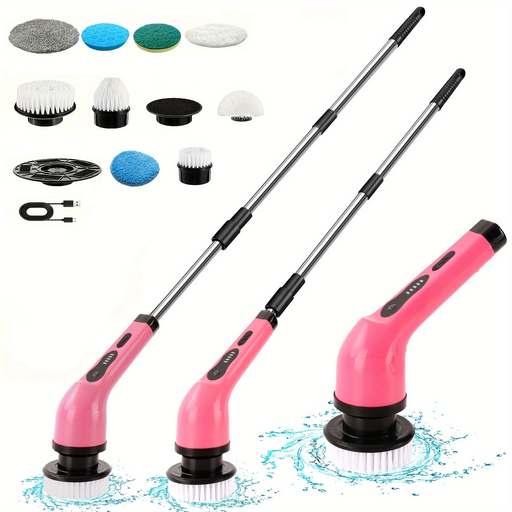 No image available
For washstand cleaning, check whether the supplied heads include one suited to grout and the space around taps.
This rechargeable variant is described as having two speeds and nine replacement heads. Read its water-use instructions before working near the basin.
Not usually for a worktop-height washstand: a compact tool with a small or cone head is more relevant to grout, corners and the spaces around taps. Consider a longer handle if you also need to reach wall tiles, shower areas or floors.
Yes, if the maker specifies those uses and you choose an attachment suitable for the particular surface. Bosch lists tiles and joints for its UniversalBrush, while Beldray specifies a large tile-and-grout head; check the instructions before using an abrasive head on glaze, sealant or fittings.
Charge it away from the wet area, using the supplied or manufacturer-approved charger and following the tool's instructions. Electrical Safety First advises against using extension leads to power appliances in a bathroom, and London Fire Brigade warns of the risks associated with damaged or submerged batteries.