Detail-first window-ledge cleaner
If the main job is a narrow ledge, grout joints and right-angle corners, you need a head you can position precisely more than a long handle.


For a narrow tiled window ledge, start with a compact handheld scrubber and a small or cone-shaped brush that can reach grout and right-angle corners. An extendable scrubber makes more sense if you also clean larger or awkward-to-reach tiled areas; consider a larger battery-platform tool for wider surfaces, but check whether its head will fit the ledge and whether a battery and charger are included.
If the main job is a narrow ledge, grout joints and right-angle corners, you need a head you can position precisely more than a long handle.
If you also clean tiled walls, floors or shower edges, extra reach may help you work on high and low surfaces without repeatedly bending or stretching.
If you regularly tackle stubborn dirt across larger household or outdoor surfaces, a battery-platform tool may be worth considering, particularly if you already have compatible equipment. Its brush still needs to fit the ledge.
Choose it when: grout, corners and the ledge itself are the main jobs.
Trade-off: a small brush takes more passes over a broad tiled surface; some detail systems use replaceable batteries.
Choose it when: the ledge is part of a wider cleaning routine involving high, low or larger tiled areas.
Trade-off: the longer handle and larger brush arrangement can be awkward to position on a shallow ledge.
Choose it when: wider surfaces and recurring stubborn dirt justify a larger tool, especially if you own a compatible battery.
Trade-off: a broad head may not reach tight grout or corners, and a bare tool needs a compatible battery and charger.
| Concern | What to check | Who this matters to |
|---|---|---|
| Access to grout and corners | Check the usable ledge depth and whether a supplied small, cone or side brush fits the joints and right-angle edges. | If I mainly clean a shallow ledge, I need to guide the brush into its grout and corners without a broad head catching on the edges. Around 42% of consumers would put that precise access first. |
| Effort and reach | Check whether an extension reaches your other tiled areas and whether the tool remains manageable when held horizontally. | When the ledge is one of several high or low areas I clean regularly, I want to avoid repeated bending and stretching. Roughly 33% of consumers would make easier reach their primary concern. |
| Wider household use | Check brush-head size against each surface, then confirm the battery format and what comes with the tool. | If stubborn dirt across broader surfaces is my main task, I need a tool that suits those areas without assuming its brush will fit a narrow ledge. About 25% of consumers would prioritise that wider use. |
A broad brush can miss grout and right-angle edges even when its motor speed looks suitable for bigger surfaces. RYOBI specifies a 15 cm round head for the R18CPS-0, while SonicScrubber describes cone and smaller brushes for grooves and tight gaps.
Measure the ledge and inspect its corners before comparing motors; check the dimensions and shape of the brush you would actually use there.
Power arrangements differ. SonicScrubber lists AA batteries for its Household System, while RYOBI identifies the R18CPS-0 as a bare tool without a battery or charger.
Check the contents of the exact variant, including its battery, charger, charging cable and replacement-head options.
Bosch lists IPX5 for the UniversalBrush; RYOBI describes an IPX7-rated battery compartment on the R18CPS-0. The compartment rating is not a claim that every part of the tool has the same protection.
Follow the exact model instructions for wet use, and keep chargers, charging ports and any components not rated for water exposure dry.
Electrical Safety First advises against charging battery packs overnight or while out of the house.
If your scrubber uses a rechargeable pack, follow its charging instructions and charge it where it can be supervised, away from water and damaged cables.
Lakeland lists both a handheld cordless scrubber for close-up work and an extendable Turbo Scrubber for reaching other bathroom surfaces.
The UniversalBrush is a compact cordless option Bosch describes for edges, corners and narrow spaces.
The Household System focuses on small surfaces, joins and grooves where brush shape matters.
The R18CPS-0 is an 18V ONE+ platform tool to assess if cleaning extends beyond the window ledge.
These cordless scrubbers are relevant if you want to clean a tiled ledge alongside other tile or household surfaces. Check the included brush dimensions before choosing one for narrow grout and corners.
 No image available
Consider this format if ledge cleaning is part of a wider tile-cleaning routine, but check that a supplied head fits the grout and corners. The product name specifies eight interchangeable heads, an adjustable extension handle and two rotation speeds.
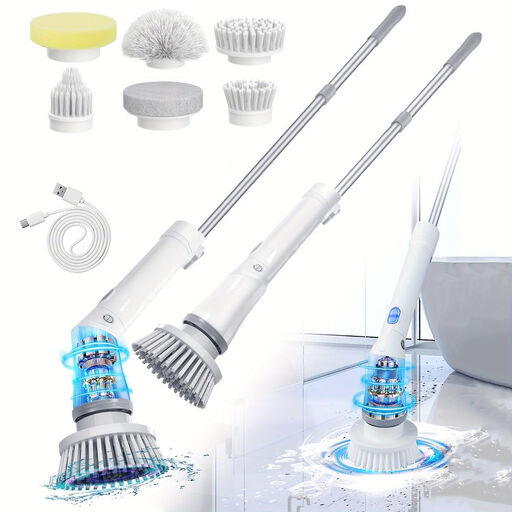 No image available
If grout and corners are your priority, check that this variant includes a brush narrow enough for your ledge. Read its instructions before using it around water.
 No image available
The extendable format is worth considering if you also clean larger bathroom, floor or kitchen surfaces; confirm that an included head fits the window ledge. The product name specifies seven brush heads, two speeds and an IPX7 water-resistance claim; follow the model instructions for wet use.
Start by checking whether a small or cone-shaped head fits the grout and right-angle edges; SonicScrubber describes its cone brush for grooves and its medium brush for tight gaps. For a finish or sealant that might mark, choose an appropriate gentler attachment and test it on an inconspicuous area.
Usually not for an easily reached, narrow ledge: a compact head is the more important fit check. Consider an extendable model if you also need to reach high tiles, low surfaces or other areas beyond the ledge.
Check the power source, supplied battery and charger, and availability of replacement heads for the exact model. RYOBI sells the R18CPS-0 as a bare tool without a battery or charger, while SonicScrubber lists four AA batteries for its Household System.
Follow the scrubber maker's charging instructions and do not leave a removable battery pack charging overnight or while you are out; Electrical Safety First gives that advice for battery packs. Stop using a damaged battery or charger and contact the maker for guidance.
Check your council or retailer's electrical-waste collection route and any separate instructions for its battery. GOV.UK explains that UK waste electrical and electronic equipment rules aim to reduce electrical waste sent to landfill or incineration; the collection route available to you depends on local arrangements.