
24/7 Customer Support

Free returns

Same-day & Next-day Delivery

Quality Guaranteed

Unlock Your Welcome Offers: FREE Delivery | Up to 80% OFF | Free 30-day JoyPlus trial
Download the APP
Choosing an electric stand mixer for baking can make bread, cakes, biscuits, pastry and whipped cream easier to prepare. However, product listings often highlight headline figures while leaving out details that affect everyday use. A high wattage number, large bowl or “quiet” label does not automatically mean the mixer will suit your kitchen.
The following guide explains the specifications worth checking, common buying traps and three practical options for different types of UK home baker.
A listing may advertise a 1000W stand mixer, but this can refer to peak power rather than continuous rated power. For example, the Monsga SM100 lists 1000W peak power alongside 600W rated power. These are different measurements, so compare like with like when assessing a mixer for bread dough or other demanding recipes.
Power is only one factor. The motor design, gearing, mixing action and recommended dough quantity also influence performance. Always follow the manufacturer’s capacity guidance rather than assuming a larger wattage permits unlimited heavy mixing.
A bowl described as 6 litres may not be suitable for filling to the rim. The Monsga SM100 has a maximum 6-litre capacity but recommends 5 litres of usable capacity. Leaving room allows ingredients to circulate and reduces splashing, especially when mixing flour, cream or batter.
For a family that regularly prepares large batches, a 5-litre stainless steel bowl or larger can be useful. Smaller households may prefer a compact bowl that is easier to lift, clean and store.
Noise ratings are useful only when the measurement and operating conditions are clear. The Monsga SM100 lists a noise level of under 75 dB, while the Honinst model lists less than 60 dB. These figures should be treated as product information rather than a guarantee of silent operation. Dough kneading can sound different from whisking at high speed, and the worktop can amplify vibration.
A stable surface, non-slip feet and a properly locked bowl can help reduce movement and unnecessary noise.
For everyday recipes, look for a mixer with a range of controlled speeds rather than focusing only on the maximum setting. An 8-speed stand mixer can offer gradual adjustment for folding and kneading, while a 10-speed stand mixer may provide more incremental control for whisking, creaming and mixing.
A planetary mixing system moves the attachment around the bowl while it rotates, helping it reach more of the mixture than a single fixed spinning point. This is particularly useful for cake batter and buttercream, although scraping the bowl may still be necessary during some recipes.
Use the dough hook at low or medium speed for yeast dough, the flat beater for cakes and biscuits, and the whisk for cream and egg whites. Do not exceed the recommended operating time or quantity.
A stainless steel bowl is durable, resistant to odours and generally straightforward to clean. Check whether it has a handle, whether it locks securely into the base and whether the attachments reach close enough to the bottom for smaller mixtures.
A tilt-head mixer makes it easier to change the bowl and attachments. Confirm that the head locks in position before starting, and check that there is enough overhead clearance if the mixer will sit beneath a wall cupboard.
Useful features include overload protection, overheating protection, a head-lock mechanism and stable suction or non-slip feet. These features support safer domestic use but do not replace supervision.
Before buying, check which components are dishwasher-safe. On the Monsga SM100, the bowl and accessories can be cleaned in a dishwasher according to the product listing, while the motor housing should be wiped with a damp cloth and kept away from water. Avoid abrasive cleaners and check attachment care instructions, particularly for coated tools.
For the UK, also verify the supplied plug, instruction manual, responsible seller information, delivery terms and returns process. A CE marking may appear on a product listing, but consumers should still review the specific compliance information supplied with the appliance and ensure it is suitable for use in the UK.
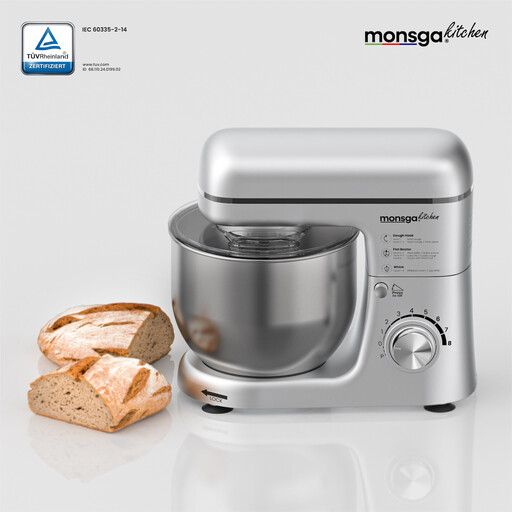
Why This Fits Their Persona: A practical choice for beginners and families wanting one food mixer for cakes, biscuits, cream and occasional bread dough.
Its listing separates 1000W peak power from 600W rated power and states a recommended usable capacity of 5.0 litres.
8 speeds, a tilt-head design, stainless steel bowl, dough hook, whisk, beater and splash guard.
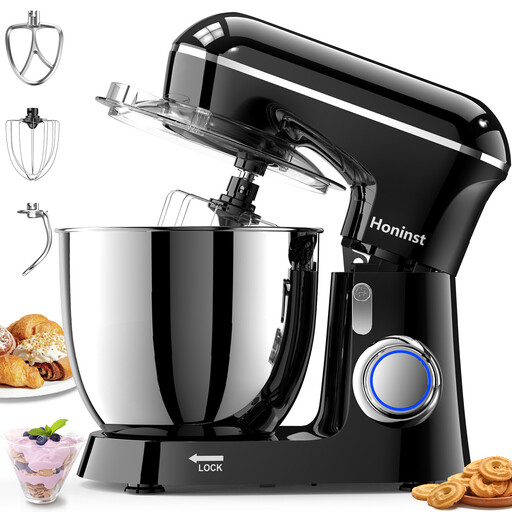
Why This Fits Their Persona: Suitable for bakers who value more speed control, a larger bowl and a quieter listed operating figure for regular home use.
The specification gives a 6.2-litre bowl, 10 speeds plus pulse, and identifies the power rating as model-dependent rather than presenting one universal figure.
Planetary mixing action, tilt-head lock, overheating protection and listed noise below 60 dB.
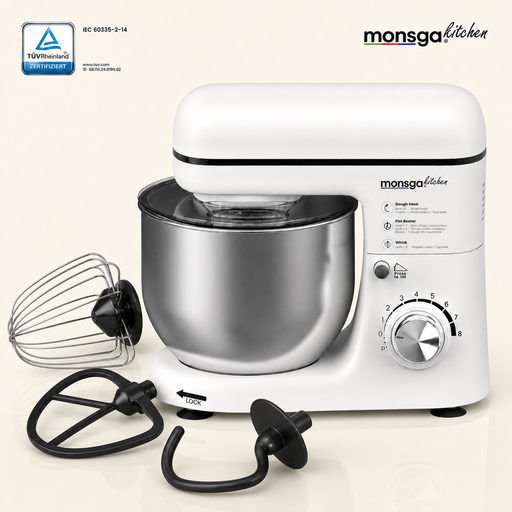
Why This Fits Their Persona: A useful match for households preparing family-sized portions of bread, cakes, biscuits or mashed potato.
The product information distinguishes its 6-litre maximum bowl from the 5-litre recommended working capacity, helping set realistic expectations.
360-degree planetary mixing, overload protection, suction feet and dishwasher-compatible accessories listed by the seller.
We have compiled a complete, real-time list of products that fully satisfy these strict selection criteria and UK safety regulations.
It can be worthwhile if you make bread, cakes, pastry or whipped cream regularly and want hands-free mixing. For occasional small batches, consider the appliance’s minimum mixing quantity, storage space and cleaning requirements before choosing a larger model.
Running cost depends on the appliance’s actual power draw and how long it operates. A mixer rated at 600W does not necessarily consume 600W continuously in every task. To estimate cost, multiply the appliance’s kilowatt usage by your electricity tariff and operating time. Short mixing cycles generally use less electricity than prolonged kneading.
Lifespan depends on workload, maintenance, attachment care and whether the motor is used within the manufacturer’s limits. Avoid overloading the bowl, allow the motor to cool when instructed, and keep the appliance dry. Check the warranty, spare attachment availability and seller support before purchase.