Space-limited shared-kitchen users
If the worktop needs to be cleared after cooking, consider how the bowls and lid store as well as how easily everyone can wash and dry them.


Choose a compact, stackable steamer if it must be put away after each use, and check that its removable parts suit your cleaning routine. A multi-tier model makes more sense when you regularly steam asparagus alongside other foods. Neither litre capacity nor tier count shows whether whole spears will fit, so check the usable basket dimensions or plan to cut them.
If the worktop needs to be cleared after cooking, consider how the bowls and lid store as well as how easily everyone can wash and dry them.
If asparagus is often part of a meal with other foods, separate tiers and total capacity matter. Check the usable space in each basket too: a capacity figure cannot tell you whether whole spears fit.
A timer and visible water level can make a shared cooking routine easier to follow. Users still need to stay nearby while the appliance operates and take care with hot steam.
Start with storage and wash-up arrangements, then check the basket space needed for asparagus and the controls everyone will use.
| Concern | What to check | Who this matters to |
|---|---|---|
| Storage and wash-up | Check how the parts stack for storage and which removable parts are dishwasher-safe. | If I have to clear a shared worktop and clean up before the next person cooks, easy-to-store, washable parts matter most; around 40% of consumers put storage and wash-up first. |
| Room for asparagus and other food | Check each basket’s usable length and width, and whether cutting spears is acceptable; litres alone do not establish the fit. | When I cook asparagus with the rest of a shared meal, I need space to keep foods in separate tiers; around 30% of consumers make meal capacity and separation their primary concern. |
| Timing and shared use | Check the timer, water-level display or refill method, and where the appliance can operate safely. | I want a cooking routine other users can follow without guessing about water or timing, while still staying nearby; around 30% of consumers prioritise routine control and safe shared use. |
Those figures describe total volume, not the internal length of an individual basket. A steamer can have ample volume without the footprint needed for uncut asparagus.
Ask the retailer or manufacturer for usable basket dimensions, or buy only if cutting the spears works for you.
A timer marks an endpoint; it does not remove the risks from hot water, lids and escaping steam. Tefal’s appliance guidance says small electrical appliances should not be left unattended during operation.
Stay nearby, follow the model’s instructions and open the lid away from your face. Let the steamer cool before cleaning or storing it.
Steam needs room to disperse. Breville’s food-steamer manual specifies a stable, dry, level, heat-resistant surface with adequate ventilation and warns against use beneath cupboards or near steam-sensitive surfaces.
Agree on a clear operating position in the shared kitchen before buying, rather than assuming any available stretch of worktop will do.
Dishwasher-safe parts can reduce hand-washing, but users still need to empty, wash and dry the appliance after use. A food business has additional cleaning obligations: GOV.UK advises cleaning and disinfecting equipment after contact with raw food.
Agree who cleans the bowls and drip tray before they are stored. If the kitchen is part of a food business, follow its food-safety cleaning procedures.
Russell Hobbs UK documents conventional three-tier steamers with 7L and 9L total-capacity options.
Morphy Richards UK describes both a basic three-tier steamer and Intellisteam models with additional cooking controls.
Tefal’s VC204865 is a three-bowl, 9L steamer worth considering when storage and water monitoring shape the choice.
These choices cover two ways to approach the task: a dedicated two-tier food steamer for cooking foods together, and a pressure multi-cooker whose listed functions include steaming. For either appliance, confirm the usable steaming space before relying on it for whole asparagus spears.
 No image available
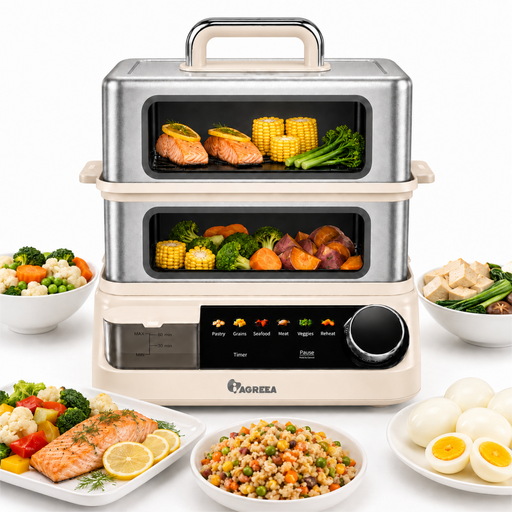
Consider this dedicated steamer if you want to cook asparagus alongside another food in separate tiers, provided the trays have enough usable room for the spears.
The product name specifies 2000W, two stainless-steel trays, a 2.5L external water tank, six presets and a timer. Confirm the trays’ internal dimensions, how the parts are cleaned and how much storage space the appliance needs before buying.
 No image available
Consider this multi-cooker if you want an appliance with a steam function as well as other cooking functions, rather than a dedicated tiered steamer.
Its product name specifies 5.7L capacity and lists rice cooking, slow cooking and sautéing among its functions. Confirm what steaming equipment is included and whether its usable dimensions suit your asparagus. Follow the product instructions when handling pressure release and hot steam.
Capacity alone cannot tell you. It describes total volume rather than a basket’s usable length and width, so ask for the internal dimensions or plan to cut the spears.
No: use the timer as a cooking prompt, not a substitute for staying nearby. Tefal’s steamer guidance says small electrical appliances should not be left unattended while operating; follow the instructions for your model as well.
Choose a stable, dry, level and heat-resistant spot with room for ventilation. Breville’s food-steamer manual warns against positioning its appliance beneath cupboards or near surfaces that steam could damage.
Agree who empties, washes and dries the removable parts after each use, following the appliance instructions. If the kitchen operates as a food business, GOV.UK’s food-hygiene guidance also calls for cleaning and disinfecting equipment after contact with raw food; that business guidance is not a domestic shared-kitchen rule.
Check your model’s instructions if steam production slows or cooking takes longer. Morphy Richards advises descaling its steamers when those signs appear; use the procedure specified for the appliance rather than assuming any descaler or method is suitable.