Space-limited cottage cooks
You need room to position and put away a steamer in an unfamiliar kitchen. Compact or stackable designs are worth considering alongside the timer, cleaning and safety features you need.


For a smaller household in a holiday cottage, start with a compact steamer if worktop and cupboard space are tight; consider a three-tier 9L model if baby potatoes will share the appliance with other foods. Synchronised cooking controls are more relevant when you regularly prepare foods with different timings. In every case, check the assembled dimensions, water controls and a safe place to use the appliance.
You need room to position and put away a steamer in an unfamiliar kitchen. Compact or stackable designs are worth considering alongside the timer, cleaning and safety features you need.
You want to steam baby potatoes alongside other foods. Basket layout and total food capacity matter, as do the arrangements for checking and refilling water.
You often prepare foods with different cooking times and would use preset timings or synchronised finishing, rather than a manual timer alone.
Decide where the steamer can stand and be stored before comparing basket space. Then consider whether you need straightforward controls for potatoes or coordinated timing for a larger meal.
| Concern | What to check | Who this matters to |
|---|---|---|
| Setup and storage | Check assembled dimensions, whether the bowls nest for storage, and whether there is a dry, level position away from the sink. | In a small cottage kitchen, I need a steamer I can set down safely and put away afterwards; around 38% of consumers put space and storage first. |
| Timing and water | Look at the timer, shut-off function and how you check or refill the water; inspect the socket and lead before use. | With an unfamiliar kitchen, I want to manage a simple cooking cycle without losing track of the water; roughly 37% of consumers primarily value straightforward controls and safe use. |
| Food capacity | Compare usable basket shape and tier layout as well as stated total food capacity; treat water-tank capacity separately. | When potatoes are part of a shared meal, I need room for other foods without overcrowding the baskets; about 25% of consumers make multi-food capacity their main concern. |
A stated total food capacity does not tell you how baby potatoes will fit in a particular basket. The water tank is a separate measurement.
Compare basket shape and tier layout with the portion you intend to cook. Do not use tier count or wattage alone to judge potato capacity.
Shut-off does not remove the risks associated with hot surfaces, water and electrical equipment. Electrical Safety First advises against leaving electrical appliances on and unattended.
Stay nearby, use a stable heat-resistant surface and follow the appliance instructions for filling, opening and cooling.
Electrical Safety First warns that overloaded extension devices can overheat. Damage, scorch marks or a hot plug are reasons to stop using the setup.
Check the appliance instructions first. If they permit an extension, keep within its marked rating, avoid daisy-chaining and keep the lead dry and visible.
Synchronised finishing and keep-warm controls address a different need from steaming potatoes on their own.
Consider those controls if you regularly coordinate several foods; otherwise, compare manual models' timer, water-level and cleaning arrangements.
Its cited manual three-tier models offer a choice between a compact 7L format and a stated 9L total capacity.
Its cited range includes a basic 9L manual steamer and an Intellisteam model for coordinating several foods.
The VC204865 is relevant where putting away a three-bowl steamer is a priority.
The FS1400-GS is a basic three-tier option for shoppers comparing manual controls.
These choices cover different ways to steam baby potatoes: a dedicated two-tier steamer, a compact cooking pot with a steam basket, and a multi-cooker with a steaming function. Check the usable steaming space and the cottage setup before choosing between them.
 No image available
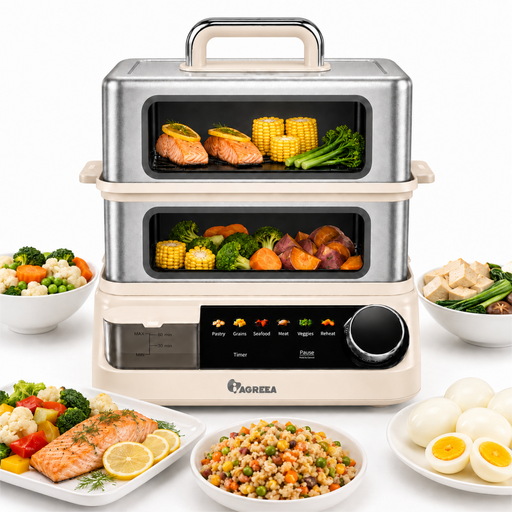
Consider this dedicated steamer if you want separate trays for potatoes and another food. Its stated features include two stainless-steel trays, a 2.5L external water tank, six presets and a timer.
The 14L figure does not establish how many potatoes fit. Check usable tray space, overall dimensions and UK plug and voltage compatibility for the cottage.
 No image available
This compact cooking pot is an option for a small potato portion when you also want a pot for other cooking tasks. It has a detachable steam basket and glass lid rather than separate steamer tiers.
Check the basket's usable dimensions and the pot's capacity against your intended portion. The pot and lid become hot during use.
 No image available
Consider this multi-cooker if you want a steaming function alongside its other cooking modes, rather than a dedicated tiered steamer. The stated 5.7L capacity is for the pot, not a specified potato-steaming basket.
Confirm the included steaming accessory and its usable space, plus UK plug and voltage compatibility. Its instructions call for a direct wall outlet, not an extension lead.
Choose a compact 7L model when space and a smaller household are the priorities; consider a 9L three-tier model when potatoes will share the steamer with other foods. Russell Hobbs lists models at both capacities, but litres do not tell you an exact potato portion, so check the basket shape and avoid overfilling it.
A timer and an accessible way to monitor water are useful for a straightforward cooking cycle; compare shut-off and cleaning arrangements too. Check how each specific model works, and do not treat automatic shut-off as a reason to leave it unattended.
Follow the appliance instructions first: some appliances call for a direct wall outlet. Where an extension is permitted, Electrical Safety First advises keeping within its marked rating, avoiding overload and daisy-chaining, and checking it for damage.
Check the cottage's appliance rules and find a dry, stable position with a suitable socket before switching on. Inspect the appliance, plug and cable, keep hands dry, and stop using the equipment if you notice damage or signs of overheating.