Small-batch bao makers
If you usually steam one or two portions and need to put the appliance away promptly, a compact format is worth considering. Salter lists a 3L, three-tier model, but check its basket space against the size of your bao.


Choose a compact three-tier steamer when cupboard and worktop space matter most; consider a larger 7.5–9L three-tier model when several people need to cook in one session. Total capacity does not tell you whether proofed bao and their liners will fit, so check the individual baskets before buying. In a shared kitchen, water-level visibility, controls and the cleaning routine matter alongside capacity.
If you usually steam one or two portions and need to put the appliance away promptly, a compact format is worth considering. Salter lists a 3L, three-tier model, but check its basket space against the size of your bao.
If several people cook in one session, separate tiers may help organise buns and other foods. Salter lists a 7.5L three-tier model, while Morphy Richards lists a 9L three-tier model; neither total capacity establishes how many of your buns will fit.
If the next person needs a clean, ready-to-use appliance, look at the controls and removable parts of the particular model. Morphy Richards lists a visible water gauge and timer on its 48755; Salter lists dishwasher-safe baskets and automatic shut-off on its EK2726Z.
Start with the size of your proofed bao and the space available for an assembled steamer. Then decide how much batch space and post-cooking clean-up your shared kitchen needs.
| Concern | What to check | Who this matters to |
|---|---|---|
| Usable batch space | Compare the internal basket dimensions and lid clearance with proofed bao and liners; total litres are not a bun count. | When several people want buns in one session, I need room for portions without crowding the baskets. Around 30% of consumers would put usable batch space first. |
| Worktop and cupboard space | Measure the assembled footprint and clearance above the lid, as well as the space needed to store the appliance. | If cupboard space is tight, I need an appliance I can put away without taking over the shared worktop. Roughly 40% of consumers would make its footprint their primary concern. |
| Hand-off between users | Check water-level visibility, timer or shut-off features, and the instructions for cleaning removable parts. | Before the next person cooks, I want straightforward controls and a manageable clean-up. Around 30% of consumers would prioritise that hand-off. |
A stated capacity can be divided across tiers. It cannot establish whether each basket has enough width and height for your bao after proofing.
Measure the buns and liners you intend to use, then compare them with the internal basket dimensions and lid clearance before ordering.
Bowls that nest away can save cupboard space, but the assembled steamer still needs worktop space while it runs and a suitable place to cool.
Check assembled dimensions and the clearance needed around and above the appliance, not just its stored size.
Even where baskets are dishwasher safe, users still need to deal with the lid, remaining water and any food residue. Dishwasher suitability also varies by model and component.
Agree who will let the appliance cool, unplug it, empty it and clean each part according to its instructions before the next use.
These model-specific examples show how capacity, storage and cleaning features can differ. Check the exact model rather than assuming a feature applies across a brand.
Tefal’s VC204865 is a three-bowl option for shared batches when storage space also matters.
The 48755 is a 9L, three-tier option for buyers who want a larger format with straightforward controls.
Salter offers a choice between the compact 3L EK5885 and the larger 7.5L EK2726Z, both with three tiers.
The 21140 is a 9L, three-tier model to compare with other larger-format steamers.
These choices include a two-tier food steamer and two electric cooking pots with steaming attachments. Compare the space available for your bao and the appliance’s cleaning requirements; the pots are not three-tier food steamers.
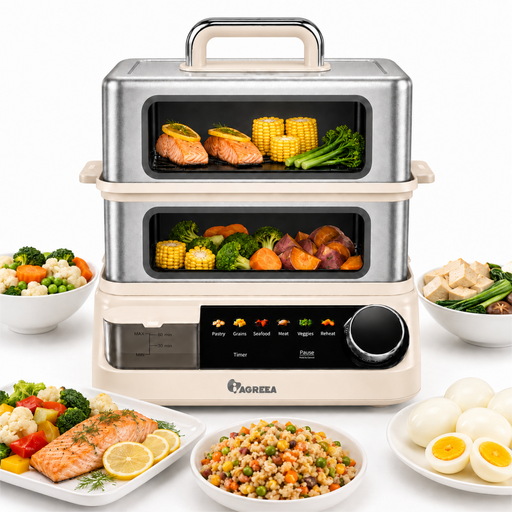 No image available
Consider its two tiers when you need separate trays for several portions, provided your proofed bao and liners fit.
The product name specifies 14L total capacity, 2000W, two stainless steel trays, a 2.5L external water tank, six presets and a timer. Check the trays’ internal dimensions, vertical clearance and cleaning instructions before buying.
 No image available
Consider this cooking-pot format for a small bao batch if you also want a pot rather than separate steaming tiers.
The product name specifies 600W and a glass lid. Its capacity is described as both 1.2L and 1.1L, so confirm the applicable figure and check the steam basket’s internal dimensions against your bao.
 No image available
Consider the hot-pot-and-steamer format if you want to prepare steamed food alongside a shared meal and its steamer fits your buns.
The product name specifies 1200W and dual power control. Its 5L figure describes the hot pot’s volume, not the usable space in the steamer; check the steamer’s dimensions and cleaning instructions.
Compare basket dimensions to decide whether your bao will fit; use total litres only as a broad indication of appliance size. Check internal width, basket height, lid clearance and room around proofed buns and liners, especially if you plan to use several tiers at once.
No: a timer or automatic shut-off is a model feature, not a reason to ignore the appliance while it runs. Follow its water-fill and placement instructions and allow hot parts to cool before moving or cleaning them. The Russell Hobbs 21140 instructions warn that its steam, lid, baskets and water can become very hot, and advise opening the lid away from your face.
Let the steamer cool, then empty and clean its food-contact parts according to the model’s instructions before handing it over. For a kitchen operated as a food business, GOV.UK says cooking equipment must be cleaned regularly and food areas and equipment cleaned and disinfected after contact with raw food; those business requirements should not be assumed to apply to an ordinary shared household kitchen.
If an electric steamer is supplied or controlled in a workplace, the Health and Safety Executive says electrical equipment must be maintained to prevent danger. The appropriate checks depend on the equipment, its environment and previous results, so confirm the premises’ appliance-safety arrangements rather than assuming a fixed annual testing interval.