Occasional corn steamers
If you cook a few corn pieces at a time, cupboard space and cleaning the baskets after use may matter more to you than a large stated capacity. Compare how the bowls store as well as how much food they hold.


For occasional corn pieces, start with a compact steamer whose baskets are easy to clean and store, provided they will hold the portions you cook. If several people regularly steam full meals, consider a larger capacity instead; in either case, check the appliance’s footprint and any shared-kitchen rules before buying.
If you cook a few corn pieces at a time, cupboard space and cleaning the baskets after use may matter more to you than a large stated capacity. Compare how the bowls store as well as how much food they hold.
If corn is one part of a meal for several people, look at the basket arrangement and total capacity. A visible water level can also be useful when the appliance is used for longer cooking sessions.
If the kitchen is managed by a workplace, accommodation provider or another organisation, confirm that a personal steamer is permitted and suitable for the electrical supply and place of use before bringing one in.
For corn pieces in a shared kitchen, decide how much food you normally steam at once, then check whether the appliance can be stored, cleaned and used safely in that space.
| Concern | What to check | Who this matters to |
|---|---|---|
| Shared clean-up | Check which baskets, lid and drip-tray parts can be removed and washed in a dishwasher; follow separate instructions for the electrical base. | If I need to leave the steamer ready for the next person, cleaning the food-contact parts promptly is my priority. Roughly 30% of consumers put shared clean-up first. |
| Storage space | Check assembled and stored dimensions, including whether bowls nest or sit upside down on the base. | With a crowded cupboard or worktop, I need somewhere to put the appliance between uses. For around 30% of consumers, storage is the primary concern. |
| Cooking capacity | Compare total capacity with basket layout and the number of foods cooked together; avoid crowding the baskets. | When several of us prepare a meal, I need room for corn alongside other food rather than another batch. Capacity comes first for roughly 20% of consumers. |
| Safe, permitted use | Read the steam-handling instructions and, in a managed kitchen, confirm appliance permission and electrical suitability. | If the kitchen has an operator, I need to know I can use my steamer there and remain nearby while it runs. Around 20% of consumers prioritise safe, permitted use. |
A timer or automatic shut-off does not remove the risk from hot water, surfaces and escaping steam. Tefal advises against leaving a small electrical appliance unattended while it operates.
Stay nearby, use a stable heat-resistant surface, open the lid away from your face and let the appliance cool before taking it apart.
A larger stated capacity can accommodate more food, but it does not tell you whether the steamer will fit the shared cupboard or whether its baskets suit your corn pieces.
Match capacity to the portions cooked together, then check basket layout and both assembled and stored dimensions.
A dishwasher-safe basket or lid does not make the electrical base dishwasher safe.
Follow the cleaning instructions for each part, keeping the base, plug and cord out of water.
Permission and electrical-safety procedures may affect whether a personal appliance can be used. For workplace equipment, the Health and Safety Executive says it must be maintained to prevent danger and be suitable for its intended use.
Ask the kitchen operator about its rules before purchase or use, and check the appliance, plug and cable for visible damage before switching it on.
These examples show different capacities and storage or cleaning features in specific steamer models; they are not whole-brand assessments.
The Food Collection 14453 is a three-tier steamer with a stated 7 L capacity, a 60-minute timer and dishwasher-safe parts.
The Mini Compact VC130115 has bowls that Tefal says can be stored upside down on the base.
The 48755 three-tier steamer has a stated 9 L capacity, a visible water gauge and a 60-minute timer with a bell.
The EK2726Z is a three-tier 7.5 L steamer with dishwasher-safe baskets, a water-level window and a 60-minute timer.
These choices cover two different ways to steam corn: a larger, two-tier electric steamer for shared batches and a compact electric cooking pot with a steam basket for smaller portions. Check basket fit and storage space rather than comparing their stated capacities alone.
 No image available
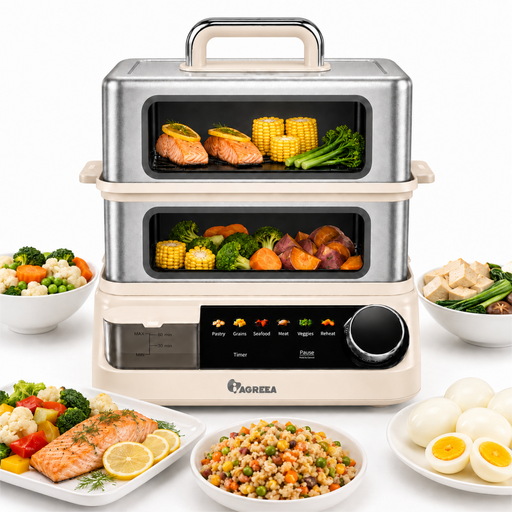
Consider this larger steamer if several people will cook corn alongside other foods. Its listed features include two stainless steel trays, a 2000 W rating, a 2.5 L external water tank, viewing windows, six presets and a timer.
Check its assembled dimensions and whether the trays are dishwasher safe before choosing it for a shared cupboard and cleaning routine.
 No image available
This 600 W electric cooking pot includes a glass lid and steam basket, making it an alternative for smaller corn portions rather than a multi-tier steamer. The lid and steam basket are described as dishwasher safe; the electrical base must be cleaned according to its own instructions.
Check that the basket fits your corn pieces and confirm capacity before buying: the product information gives both 1.2 L and 1.1 L.
For occasional portions where storage matters, a compact model around 6.5–7.5 L is a starting point; around 9 L is worth considering if several people regularly steam different foods together. Check basket space and appliance dimensions as well as total capacity.
Follow your model’s instructions for the load. For mixed foods, Tefal advises placing larger pieces and foods needing longer cooking in the lowest basket and avoiding overloaded baskets; piece size and the rest of the load affect cooking time.
Stay nearby while it operates. Tefal advises against leaving a small electrical appliance unattended; a timer does not replace supervision or careful handling of steam and hot water.
Do not assume the same testing procedure applies to every shared kitchen. For workplace equipment, the Health and Safety Executive says it must be maintained to prevent danger, with checks and testing determined by the equipment and its use; ask the operator of a workplace or other managed kitchen what its appliance policy requires.