A 61-key touch-sensitive keyboard with lesson functions suits someone focused on learning a festive tune. If moving and storing the instrument matter more, consider a compact portable model; if the tune marks the start of continuing piano study, consider an 88-key weighted digital piano and its greater space requirements. Check how you will learn the particular tune, since onboard songs and lesson functions do not necessarily cover it.
Who is the keyboard for?
First-time tune learner
If practising the melody and then coordinating both hands is the immediate goal, look at the lesson workflow rather than the number of sounds alone. Yamaha documents hand-by-hand and both-hands lessons on the PSR-E383; check how you would use them for your chosen tune.
Seasonal player with limited space
If the keyboard will be carried to a gathering or put away afterwards, its dimensions, weight and power options matter. Casio lists a carry handle and battery operation for the CT-S300.
Learner continuing into piano
If this tune is the beginning of regular piano study, consider whether you want a full 88-key weighted format and have room to keep it set up. Korg lists that key format for the B2.
What matters when choosing?
Decide how you will learn the tune, where the instrument will live and whether you expect to continue studying piano; those decisions point to different features.
| Concern |
What to check |
Who this matters to |
| Guided practice |
Check the exact model's lessons and touch response, then whether your chosen tune works with its teaching method. |
If I am learning my first melody, I want a way to practise each hand before playing them together. Around 42% of consumers put guided practice first. |
| Moving and storage |
Check dimensions, weight and power options, including whether an adaptor is supplied. |
When the keyboard needs to move between rooms or be stored after the celebration, I need a manageable setup. Roughly 33% of consumers prioritise portability. |
| Continuing piano study |
Confirm the key range and action, plus space and provision for a pedal and stand. |
If the festive tune is my starting point for regular piano study, I care more about a full weighted keyboard than occasional portability. About 25% of consumers place piano progression first. |
What should you check before buying?
-
Assuming every keyboard has piano-style keys
Yamaha lists the PSR-E383 as a 61-key touch-sensitive keyboard, while Korg lists 88 weighted keys for the B2. Those formats answer different playing and space needs.
Decide whether learning this tune is a short-term goal or the beginning of regular piano study before choosing a key range and action.
-
Assuming a mains adaptor comes in the box
Casio lists six-AA battery operation for the CT-S300 and says its AD-E95100L adaptor is optional and not included.
Check the package contents and the exact compatible power supply if you plan to practise from a mains socket.
-
Overlooking the space an 88-key instrument needs
Korg lists the B2 at 1,312 mm wide and 11.4 kg; Casio lists the CT-S300 at 3.3 kg. The intended place to play and store the instrument can therefore change the choice.
Measure the available space and decide whether you will need to carry or put away the keyboard regularly.
-
Putting an unwanted keyboard in general waste
Electrical equipment and batteries need appropriate end-of-life handling. Recycle Your Electricals advises using reuse or electrical-recycling routes for items with a plug, battery or cable.
Look for a suitable reuse or electrical-recycling point, and follow the local collection guidance for removable batteries.
Relevant brands for reference
Yamaha
Yamaha's PSR-E383 is a reference point for a 61-key portable keyboard with structured lessons.
- Yamaha documents three-step lessons, feedback and practice for either hand or both hands on this model.
- Check whether its songs and lesson workflow fit the festive tune you intend to learn; the features are model-specific.
Casio
Casio's CT-S300 illustrates a compact 61-note keyboard for a setup that needs to move or be stored.
- Casio lists touch-sensitive keys, a carry handle and six-AA battery operation.
- Casio says the compatible AD-E95100L mains adaptor is optional and not included.
Korg
Korg's B2 represents the 88-key weighted digital-piano format for someone intending to continue piano study.
- Korg lists a metronome and an included damper pedal alongside its Natural Weighted Hammer Action keyboard.
- At 1,312 mm wide and 11.4 kg, the B2 needs more room and is less convenient to move; a stand and three-pedal unit are optional.
Roland
Roland's GO:KEYS documentation is relevant if playing along with a recording or accompaniment is part of the plan.
- Roland describes Bluetooth audio playback, auto-accompaniment and chord sequencing in its GO:KEYS documentation.
- Check the exact model's connections: Roland identifies the microphone input as a GO:KEYS 5 feature.
Joybuy keyboards for this scenario
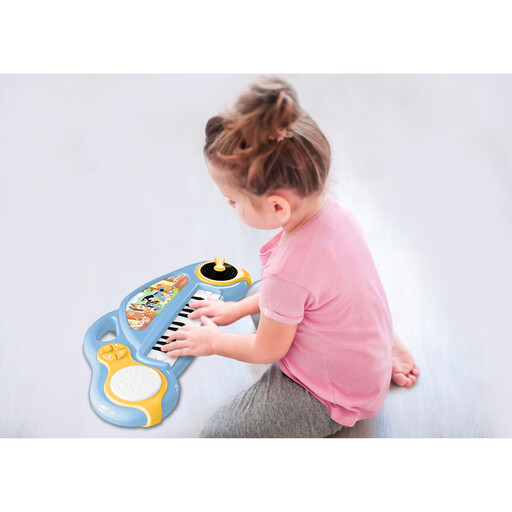
This selection concerns introductory melody play for a child. If you need structured lessons or a weighted piano action, check those requirements separately rather than assuming a play keyboard provides them.
 No image available
Princess Fun Electronic Keyboard with Lights
For a child exploring melody play, check whether its play-along approach covers the festive tune they want to learn. Confirm the key count, touch response and power arrangement if those matter to the intended practice setup. It is not suitable for children under 3, and direct adult supervision is recommended.
Joybuy
Common questions
Are 61 keys enough for learning one festive tune?
A 61-key keyboard can suit learning a tune when its range and practice method fit the arrangement you choose. If you are also buying for continued piano study, compare its action and range with an 88-key weighted model; Yamaha lists the PSR-E383 in the former format and Korg lists the B2 in the latter.
Can I play along with a recording from my phone?
Yes, on a model with the appropriate audio playback feature. Roland's GO:KEYS reference manual describes playing smartphone audio through the keyboard's speakers while you perform; confirm the feature on the exact model you are considering.
Which accessories should I check are included?
Check the power supply, pedal and stand contents for the exact keyboard. Casio says the CT-S300's AD-E95100L adaptor is optional and not included, while Korg lists a music stand and damper pedal with the B2 but treats its stand and three-pedal unit as optional.
What should I do with an unwanted electronic keyboard?
Consider reuse or an electrical-recycling collection point rather than putting it in general waste. Recycle Your Electricals includes items with a plug, battery or cable in its reuse and recycling guidance; follow the collection point's instructions for removable batteries.


