Bass-conscious flat listeners
You want kick and bass to have weight in the main living area, while keeping low-frequency output and listening levels manageable for neighbours.


Choose a separated stereo pair if you have a main listening area and space to position two speakers; choose an all-in-one Wi-Fi speaker if flexible placement and straightforward streaming matter more. Active studio monitors make more sense when you also play or produce music through a controller, mixer or audio interface. Whichever route you take, plan how you will control bass and volume in a flat rather than choosing by woofer size or amplifier rating alone.
You want kick and bass to have weight in the main living area, while keeping low-frequency output and listening levels manageable for neighbours.
You want simple wireless playback and source switching across an open-plan space, without arranging a production-style listening setup.
You use a controller, mixer or audio interface and want wired connections and a stereo setup, with room for deliberate speaker placement and cabling.
Choose the playback arrangement first: a pair for a defined stereo listening area, a single wireless speaker for flexible placement, or monitors for a wired DJ or production source. Then check the connections, placement and bass controls that arrangement needs.
Choose it when: You can position two speakers apart and want a conventional left-right image where you usually listen. KEF describes its LSX II as a separated stereo pair.
Allow for: Two speaker positions and, for the full LSX II feature set, a home Wi-Fi network.
Choose it when: Easy streaming and flexible placement matter more than a physically separated stereo pair. Sonos lists Wi-Fi, Bluetooth and room tuning for Era 300.
Allow for: A different listening arrangement from a two-speaker stereo setup; analogue line-in on Era 300 needs a separate adapter and cable.
Choose it when: You listen near a defined position or play from a compatible controller, mixer or interface. Yamaha lists analogue inputs and response controls across its HS monitors.
Allow for: Careful pair placement and compatible source connections; check whether each monitor is sold singly.
| Concern | What to check | Who this matters to |
|---|---|---|
| Controlled bass | Check accessible volume and bass or room-adjustment controls, and whether your planned placement allows you to manage low-frequency output. | I want to hear the kick and bass without making playback disruptive in my flat. Around 36% of consumers put controlled bass and neighbour considerations first. |
| Everyday streaming | Match the speaker’s Wi-Fi, Bluetooth and wired inputs to your sources; check network requirements and any adapters. | If I move between activities in an open-plan room, I want playback and source switching to stay simple. For around 29% of consumers, everyday streaming is the main concern. |
| Stereo presentation | Check whether you can separate two speakers around your main listening area, or whether you would use a single spatial-audio speaker instead. | I have a regular place to listen and care about a clear left-right presentation. That makes stereo or immersive presentation the priority for around 21% of consumers. |
| Wired DJ or production use | Check your controller, mixer or interface outputs against the speaker inputs, and confirm the number of speakers and cables needed. | When I play from a controller or interface, a dependable connection to a suitable speaker setup matters most. Around 14% of consumers put wired DJ or production use first. |
A power rating does not tell you how bass will sound or behave in your room. Yamaha publishes HS5 frequency-response figures at −3 dB and −10 dB, while Genelec uses a −6 dB figure for its 8020D; those figures cannot be treated as a like-for-like bass ranking.
Compare response figures only with their measurement conditions in view, and consider where you can place the speakers and how readily you can adjust their output.
Extra low-frequency output can be difficult to manage in a flat. For England, GOV.UK explains that councils investigate noise complaints that could amount to a statutory nuisance.
Start by assessing the speakers at sensible levels in your room. Consider a subwoofer only if you need it and can use it without avoidable disturbance.
A DJ controller or turntable needs a compatible connection path. Sonos says Era 300 requires its Line-In Adapter and an auxiliary cable for analogue line-in.
Identify your source’s output and confirm the required speaker input, adapter and cable before choosing a wireless system.
Wireless features can depend on the home network. KEF says a home Wi-Fi network is required for the full LSX II feature set and recommends a suitable 5 GHz network for more stable high-resolution streaming.
Check your network arrangement and decide whether Bluetooth or a wired input is important for your usual playback.
The HS active-monitor range is relevant if your music source is an interface, mixer or controller and you can arrange wired listening.
The 8000-series active monitors are relevant to a compact, wired nearfield setup rather than a Wi-Fi streaming arrangement.
LSX II illustrates the compact wireless stereo-pair route for a main listening area.
Era 300 illustrates the single-speaker, app-centred route for listeners prioritising streaming and flexible placement.
These options offer two different starting points for home music playback: a wireless tabletop speaker and passive bookshelf speakers for use with a compatible amplifier. Check what is supplied before planning a separated stereo setup.
 No image available
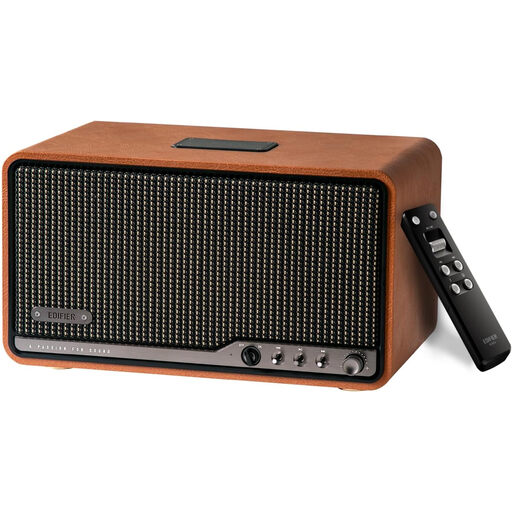
Consider this wireless tabletop option if you want music playback without a passive-speaker amplifier setup. Check its supported connections, power arrangement and whether a second unit is needed for the stereo layout you want.
 No image available
Consider these passive speakers if you have, or plan to use, a compatible amplifier for music listening. The stated configuration includes a 6.5-inch mid-bass driver, 28 mm soft-dome tweeter, rear bass-reflex port, 8-ohm impedance and 10–120 W power-handling range. Check amplifier compatibility, rear-port clearance and the number of speakers supplied.
Choose a stereo pair if you can separate the speakers and want a conventional left-right image in your main listening area. A single all-in-one speaker is easier to place flexibly, but it does not provide the same physical separation. KEF describes separated LSX II speakers as a stereo system; Sonos presents Era 300 as one speaker designed for streaming and Dolby Atmos Music.
Yes, if the source outputs and speaker inputs are compatible, so check the exact connections before buying. Yamaha lists XLR/TRS inputs for HS monitors and additional RCA and stereo-mini inputs on HS3 and HS4. Sonos Era 300 instead needs a separate Line-In Adapter and auxiliary cable for analogue input.
No: a subwoofer is an option, not a requirement. Listen for the bass balance you need at levels appropriate to your flat before deciding whether to add one. KEF lists a subwoofer output for LSX II, but that connection alone says nothing about how added bass will behave in your room or building.
Keep listening levels and low-frequency output manageable, particularly when sound may disturb neighbours. For England, GOV.UK says councils investigate complaints that could be a statutory nuisance, including noise that unreasonably and substantially interferes with the use or enjoyment of a home. Check applicable local guidance elsewhere in the UK and any tenancy or building rules for your flat.