Choose a compact active stereo pair if you have room to separate two speakers and want a conventional left-right layout with wired inputs. A single wireless speaker makes more sense if phone streaming and a tidier, one-unit setup matter more. Whichever format you choose, allow for placement: Bowers & Wilkins notes that a nearby back wall generally raises bass, which may not give you the balance you want for kick drums and bass lines.
Who is this for?
Bass-conscious small-room listeners
If your speakers must sit near a wall or neighbours, you may care more about controlling low frequencies and listening level than choosing the largest cabinet. Yamaha and PreSonus list tonal controls on the compact pairs discussed below.
Stereo-focused home listeners
If you can place two speakers apart and listen from roughly in front of them, a compact active pair lets you plan a left-right layout. Models from Yamaha, PreSonus and Edifier also offer physical inputs for wired sources.
Low-clutter streamers
If you mostly play music from a phone, one wireless speaker may suit your available space and everyday controls better than a pair. Check the precise Bluetooth, Wi-Fi and app requirements of the model you choose.
What matters when choosing?
Decide whether you can position two speakers before comparing inputs, wireless controls and bass adjustment. A small room makes the intended speaker position as important to consider as the features on the box.
Compact active stereo pair
Choose it when: You can separate two speakers and want a conventional stereo layout for listening from a defined position.
Allow for: Two cabinets, cabling and some space to adjust their positions; Cambridge Audio notes that the position giving the bass you prefer may not give the stereo image you prefer.
Single wireless speaker
Choose it when: Phone playback and a one-unit layout take priority over placing two separate cabinets.
Allow for: Model-specific setup and connection requirements. Sonos says Era 100 setup uses its app and Wi-Fi, while analogue line-in requires a separate adapter.
| Concern |
What to check |
Who this matters to |
| Bass near walls and neighbours |
Check your available wall clearance and whether the exact model offers low-frequency or room controls. |
If my only workable position is near a wall, I want the kick and bass line to remain distinct without turning the level up. Around 36% of consumers would put controlled bass and considerate volume first. |
| Music impact and stereo presentation |
For a pair, check that you can separate the speakers and sit in a useful listening position; compare placement options before relying on driver size. |
I want layered tracks to have a defined left-right presentation, and I can make space for two cabinets. Roughly 29% of consumers would make that presentation their primary concern. |
| Wireless playback and clutter |
Confirm the exact Bluetooth or Wi-Fi features you use, plus any app or home-network requirement. |
Most of my listening starts on my phone, and I would rather keep the living-room setup to one unit. Around 21% of consumers would prioritise that everyday simplicity. |
| Wired-source connections |
Match your source’s output to the speaker’s stated input; check separately for any cable or adapter you need. |
I use a computer, audio interface or DJ controller, so a workable physical connection decides the choice for me. About 14% of consumers would put wired compatibility first. |
Buying pitfalls
-
Choosing by bass claims without planning placement
Bowers & Wilkins notes that moving speakers close to a back wall generally raises bass. Extra bass at that position may not produce the clarity you want from electronic tracks.
Measure where each speaker could go, then check the exact model’s low-frequency controls if wall-adjacent placement is unavoidable. Try position changes before deciding that you need a larger driver.
-
Assuming a wireless speaker has a ready-to-use wired input
A phone-friendly wireless connection does not establish that your TV, turntable or DJ controller can connect directly.
List the outputs on every source and match them to the speaker’s inputs and required accessories before buying.
Sonos says analogue line-in on Era 100 requires its separate Line-In Adapter.
-
Treating a stated bass specification as the sound of your room
Manufacturer figures describe products under their stated conditions; Cambridge Audio and Bowers & Wilkins both explain why positioning changes the listening result.
Use specifications to narrow your choices, then assess the proposed position at your normal listening level. Check the retailer’s applicable returns terms before purchase if trying that position matters to your decision.
-
Overlooking disturbance from repeated loud bass
GOV.UK says councils must investigate noise complaints that could amount to a statutory nuisance. A setting that works for daytime listening may still disturb others later.
Keep control of the volume, particularly late at night, and check any applicable tenancy, lease or building rules separately.
Brands to consider for these speaker formats
These examples show how particular product lines address different layouts and connections; they do not establish that every model from a brand will suit your room.
Yamaha
The HS3 is a compact powered studio-monitor pair for a wired, two-speaker layout.
- Yamaha lists XLR/TRS, RCA and stereo-mini inputs, plus room-control and high-trim switches for the HS3.
- Its listed frequency response does not, by itself, tell you how bass will balance in your chosen living-room position.
PreSonus
The Eris 3.5 2nd Gen is an active pair for listeners considering several wired sources.
- PreSonus lists TRS, RCA and 3.5 mm inputs, a front headphone output and high- and low-frequency tuning controls for this pair.
- Those controls can be considered alongside placement; they do not establish the final bass balance in a particular room.
Edifier
The MR4 is a compact active pair with separate monitor and music modes.
- Edifier lists TRS, RCA and AUX connections and a front headphone output for the MR4.
- Edifier’s stated low-frequency extension is manufacturer information, not a promise of controlled bass beside every wall.
Sonos
Era 100 is relevant if you prefer one app-connected speaker to a wired pair.
- Sonos lists Wi-Fi, Bluetooth, AirPlay 2 and Trueplay room tuning for Era 100.
- Setup uses the Sonos app and Wi-Fi; analogue line-in requires a separate Sonos Line-In Adapter.
JBL
Authentics 300 is a one-unit option for someone who wants to move a speaker between rooms.
- JBL lists a built-in battery, handle, Wi-Fi and Bluetooth for Authentics 300.
- Its driver and passive-radiator specifications do not establish how controlled its bass will sound at your intended position.
Joybuy products for one-unit listening
These compact, single-unit choices are relevant if you favour a simpler layout over positioning a separate active stereo pair. Check the connections and bass controls you need for electronic music before choosing between a soundbar and a portable speaker.
 No image available
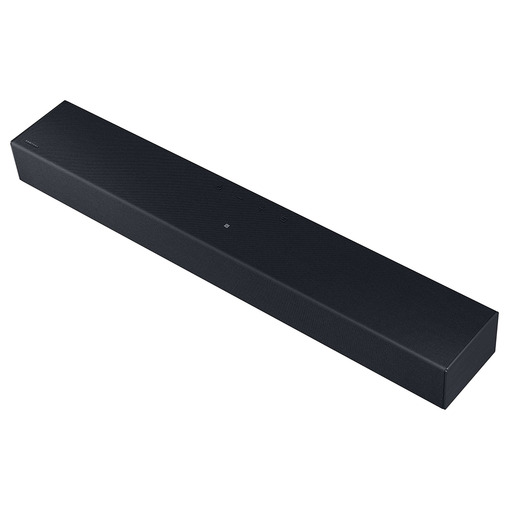
Samsung HW-C400/XU 2.0-channel soundbar, black
Consider this soundbar if one unit fits your living-room layout better than two separately positioned speakers. The listed configuration is 2.0 channels; check its music connections and bass-adjustment options against your sources and intended position.
View on Joybuy
 No image available
MIFA A1 portable Bluetooth speaker, black
Consider this compact portable speaker if Bluetooth playback and moving one unit around matter more than a fixed two-speaker layout. Confirm the inputs you need and whether its bass can be adjusted for your chosen position.
View on Joybuy
Common questions
Should I buy one speaker or a pair for electronic music in a small living room?
Choose a compact active pair if you can position two speakers apart and want a conventional stereo layout with wired-source options; choose one wireless speaker if phone playback and a one-unit setup matter more. Cambridge Audio notes that positioning for your preferred bass and positioning for your preferred stereo image may call for different compromises.
Where should I place a pair of speakers in a small living room?
Start with the speakers separated and your listening position in mind, rather than assuming a corner is the right spot for both. Cambridge Audio discusses the speaker-and-listener triangle, while Bowers & Wilkins notes that a nearby back wall generally raises bass. Try small position changes at your normal listening level.
Can I connect a DJ controller or another wired source?
You can connect a wired source when its output matches the speaker’s input and you have any required cable or adapter. Yamaha lists physical inputs on the HS3, as do PreSonus on the Eris 3.5 2nd Gen and Edifier on the MR4. Sonos says Era 100 needs a separate Line-In Adapter for an analogue source; check the exact connections before buying.
What should I consider about loud bass at home?
Keep the level considerate and check the rules that apply to your home. GOV.UK says councils must investigate complaints about noise that could be a statutory nuisance; tenancy, lease or building rules may also affect how you use a speaker. A bass control can help you adjust playback, but it does not replace managing the overall volume.


