
24/7 Customer Support

Free returns

Same-day & Next-day Delivery

Quality Guaranteed

Unlock Your Welcome Offers: FREE Delivery | Up to 80% OFF | Free 30-day JoyPlus trial
Download the APP
For owners of large and extra-large breeds, choosing elevated dog bowls for large dogs involves more than finding a stand that looks sturdy. A bowl that is too low may encourage excessive bending, while a lightweight frame can slide across the floor as soon as an enthusiastic dog starts eating. Poorly designed bowls may also be difficult to clean, awkward to refill or unsuitable for a dog that eats quickly.
Before buying, look beyond phrases such as “ergonomic”, “heavy duty” or “anti-choking”. Check the actual height range, bowl capacity, materials and base construction. These are the details that affect everyday use in a UK home.
A “large dog” can mean anything from a Labrador-sized dog to a Great Dane. Breed labels are not a reliable substitute for measuring your dog. A stand should allow your dog to eat without stretching upwards or bending sharply downwards.
Measure from the floor to your dog’s shoulder area while standing naturally, then compare this measurement with the stand’s usable bowl height. Height-adjustable dog bowls are useful where a dog is still growing or where two dogs of different sizes share the same feeding area.
A tall frame with a narrow base can tip or move when a dog nudges the bowl. This is particularly inconvenient on hard flooring, where water may spread quickly across the kitchen or utility-room floor.
Look for a non-slip dog bowl stand with a broad base, secure bowl holders and feet that remain in contact with the floor. A wooden tray and metal frame can offer a practical balance of appearance and support, but the joints and adjustment mechanism still need regular checks.
A slow feeder bowl for large dogs can make food harder to reach and may lengthen mealtime, but it does not replace suitable portion control or supervision. Dogs vary considerably in how they respond to ridges and raised sections. Choose a design that is large enough for your dog’s muzzle and easy to wash thoroughly.
An adjustable raised dog bowl stand should offer enough settings to match your dog’s current size. For large breeds, check the highest and lowest positions rather than relying only on the phrase “adjustable”.
The VVM stand, for example, lists five height settings: approximately 21 cm, 30 cm, 35 cm, 40 cm and 44 cm. This gives owners several positions to try, although the correct setting should still be selected according to the individual dog’s posture.
Large breeds need a large breed dog feeding bowl with enough room for a normal meal without food spilling over the rim. Capacity also matters for water, especially if the feeding station is placed away from the main kitchen area.
Two bowls with a capacity of 1,600 ml each can provide useful space for food and water. Check whether the stated capacity refers to the brim or practical fill level, and leave room to reduce splashing.
Stainless steel dog bowls are commonly chosen because they are durable, non-porous and straightforward to wash. Look for the stated grade rather than assuming all steel bowls are identical. The VVM product specification identifies its bowls as 304 stainless steel and states that they are dishwasher safe.
The stand itself may require different care. Wooden and metal sections should generally be wiped with a damp cloth and dried fully before the bowls are replaced. Check that bowls can be removed without dismantling the frame.
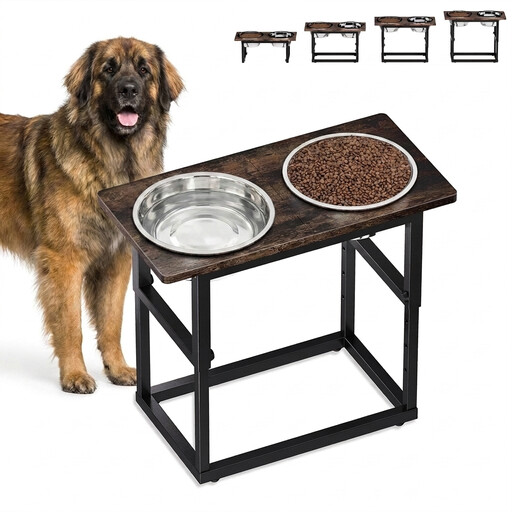
Why This Fits Their Persona: A practical choice for owners who want a substantial raised dog feeder with multiple height settings and removable metal bowls for routine cleaning.
It specifies five height levels, two 304 stainless steel bowls and non-slip feet, rather than relying only on general claims about comfort or stability.
Five listed heights up to approximately 44 cm; two 1,600 ml stainless steel bowls; bowl cleaning is dishwasher compatible.
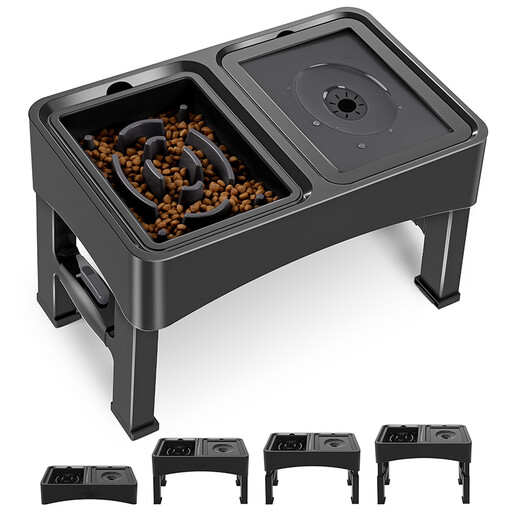
Why This Fits Their Persona: Suitable for households prioritising a combined eating and drinking setup, foldable storage and slower access to food.
Its specifications state the four height positions and identify the separate slow-feeder and floating-water functions, making the design easier to assess before purchase.
Four settings from 10 cm to 31 cm; foldable legs; floating water bowl designed to reduce splashing.
Why This Fits Their Persona: Designed for homes where a large dog needs separate food and water bowls, a higher feeding position and a frame intended for daily use.
The listed metal frame, wooden base, non-slip feet and two-bowl format address common concerns about movement, limited capacity and frequent refilling.
Approximate 2.62 kg net weight; two 1,600 ml bowls; adjustment mechanism and feet can be checked as part of routine maintenance.
We have compiled a complete, real-time list of products that fully satisfy these strict selection criteria and UK safety regulations.
Not automatically. Height should match the individual dog, and some dogs may prefer floor-level bowls. Measure carefully and monitor posture, comfort and eating behaviour.
There is no single height for every large breed. Use your dog’s standing shoulder measurement as a guide, then choose a setting that avoids excessive bending or reaching. Adjustable designs make it easier to refine the position.
Lifespan depends on weight, moisture exposure, cleaning habits and daily movement. Dry the frame after cleaning, avoid exceeding its stated capacity and replace damaged feet, bowls or structural parts promptly.