
24/7 Customer Support

Free returns

Same-day & Next-day Delivery

Quality Guaranteed

Unlock Your Welcome Offers: FREE Delivery | Up to 80% OFF | Free 30-day JoyPlus trial
Download the APP
A fast-eating dog can make mealtimes noisy, messy and difficult to manage. Water may splash across the floor, a conventional bowl may slide away, and a feeding stand that cannot adjust may become unsuitable as your pet grows. An elevated slow feeder dog bowl can address several of these everyday problems in one setup, but not every product delivers the same level of practicality.
Before choosing, look beyond phrases such as “anti-gulp” or “spill-proof”. Check the bowl’s actual dimensions, materials, height settings and cleaning requirements. The right option should match your pet’s size, eating habits and the space available in your home.
Breed labels do not provide a precise feeding height. Dogs of the same breed can have different leg lengths, body proportions and preferred eating positions. A stand that is too high may be awkward, while one that is too low may provide little benefit over a floor-level bowl.
Look for an adjustable height dog bowl and measure your pet while standing naturally. The bowl should allow comfortable access without forcing your dog to stretch upwards. Height adjustment is also useful for puppies and households with pets of different sizes.
Raised ridges, mazes and textured inserts can make food take longer to reach, which may help reduce rapid gulping. However, a slow feeder bowl for dogs is not a medical treatment and will not suit every pet. Some dogs may become frustrated by deep or complicated patterns.
Start with small food portions and supervise the first few meals. If your dog struggles to access food, coughs, becomes distressed or refuses to eat, stop using the bowl and seek advice from a qualified veterinary professional.
A standard water bowl can be easily nudged or overfilled. Some designs use a floating rim or insert to limit how much water is exposed at once, but this does not make the surrounding area completely spill-free. The stability of the stand, the floor surface and your pet’s drinking style still matter.
A floating water bowl for dogs can be useful for pets that lap energetically, particularly in kitchens with hard flooring. Check whether the water component is removable and how easily its moving parts can be washed.
Compare the available height settings rather than focusing solely on the word “elevated”. The Blinkit 0159-1 and Blinkit 0159-3 models each offer four levels: 10cm, 23cm, 27cm and 31cm. This range can accommodate different growth stages, although owners should still check the fit against their individual pet.
The listed footprint for both stands is 42 × 27 × 10cm. Measure the area beside your pet’s usual feeding position, especially if the bowl will sit near a wall, kitchen cabinet or door. A broader stand may be more stable, but it needs sufficient floor space.
A removable stainless steel pet bowl is generally straightforward to rinse and inspect. For silicone products, look for clear material information, such as food-grade silicone, and check whether the manufacturer provides dishwasher guidance. Do not assume that every bowl or stand is dishwasher-safe.
The Pecute set combines food-grade silicone and 201 stainless steel, with dishwasher-safe bowl components according to its product information. Inspect bowls regularly for cracks, rough edges, stains that cannot be removed or damage caused by chewing. Replace any damaged component rather than continuing to use it.
A non-slip base or a non-slip pet feeding mat can help limit movement, but the mat must sit on a clean, level surface. Foldable legs are convenient in smaller UK homes, caravans or when travelling, although folding joints should be checked periodically for looseness.
Also compare capacity with your pet’s normal portion size. A small bowl may require several refills, while a deep bowl can be unsuitable for some short-muzzled pets. A dog bowl with water bowl is convenient, but make sure both bowls can be removed independently for cleaning.
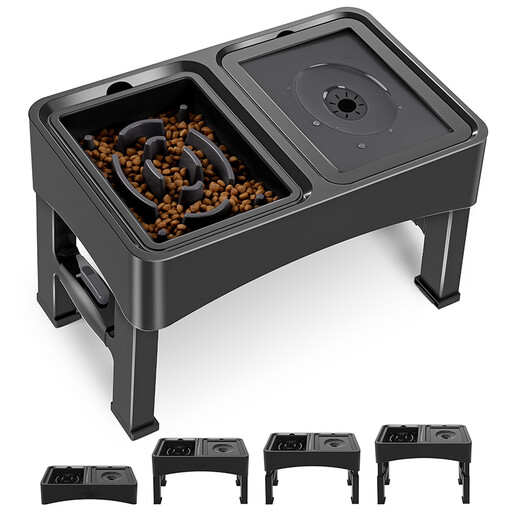
Why This Fits Their Persona: A practical starting point for owners wanting one setup for food and water without buying separate stands. It suits households with growing dogs or cats that need flexible positioning.
The four height levels make it less likely that the stand will be outgrown quickly, while the floating water design addresses the common problem of energetic drinking and splashing.
Two-in-one slow feeder and floating water bowl; foldable stand; four listed heights from 10cm to 31cm.
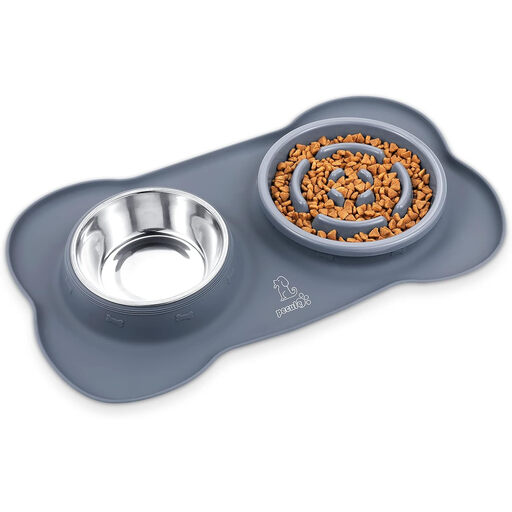
Why This Fits Their Persona: Suitable for owners who prioritise easy cleaning, a defined food-contact material specification and a contained feeding area for smaller dogs or cats.
Its integrated mat reduces sliding and separates the slow-feeding area from the water bowl, avoiding reliance on a loose bowl that may tip across the floor.
Includes a 400ml slow feeder, a 400ml stainless steel water bowl and a foldable silicone mat; listed bowl components are dishwasher-safe.

Why This Fits Their Persona: A flexible option for homes that want to switch between a slow feeder and a conventional bowl for different meals, pets or feeding routines.
The interchangeable bowl arrangement gives more control than a fixed two-bowl design, while the foldable stand helps with storage when the feeding area is not in use.
Four height positions; slow feeder paired with a stainless steel bowl; listed stand size of 42 × 27 × 10cm and weight of approximately 1,450g.
We have compiled a complete, real-time list of products that fully satisfy these strict selection criteria and UK safety regulations.
For cats, a slow feeder cat bowl should have a pattern and depth that match their smaller mouths. A raised feeding platform is not automatically suitable for every cat, so prioritise comfortable access and easy cleaning over height alone.
No. It may be useful for dogs that eat quickly or need a more organised feeding station, but individual comfort varies. Short-muzzled dogs, puppies and pets with mobility or digestive concerns may need a different bowl shape or veterinary guidance.
Lifespan depends on material, cleaning routine and whether your pet chews or scratches it. Check it before each use and replace it if the bowl develops cracks, sharp edges, deep scratches or loose components. A stainless steel insert can be practical for regular use when it remains undamaged.