Parents and carers choosing holiday snacks
A lower-sugar claim is not enough to make an energy drink suitable for a child. NHS guidance identifies water and milk as the best drinks to give children.


For a child’s school-holiday snack, choose water or milk rather than a no-added-sugar energy drink: NHS guidance identifies water and milk as the best drinks for children, and removing sugar does not remove caffeine. Adults choosing an energy drink should compare caffeine in the whole can alongside the sugars on the nutrition panel; “no added sugar” does not necessarily mean sugar-free.
A lower-sugar claim is not enough to make an energy drink suitable for a child. NHS guidance identifies water and milk as the best drinks to give children.
Compare the sugar claim with the nutrition panel, then check how much caffeine is in the whole can. Can sizes differ, so caffeine per 100ml alone does not tell you what one can contains.
The Department of Health and Social Care says a ban on sales of high-caffeine energy drinks to under-16s in England starts in April 2027. That future sales rule is separate from deciding what to give a child now.
Start with who will drink it. If the drink is for an adult, read the caffeine and sugars information for the amount they would actually consume.
| Priority | What to check | Your needs |
|---|---|---|
| Drink for a child | Check whether the drink is an energy drink, not just whether it has added sugar. The NHS identifies water and milk as the best drinks for children. | I’m choosing a school-holiday snack drink for a child, so I want an alternative to an energy drink even if its label says zero sugar. |
| Caffeine per can | Read the caffeine amount for the whole can and note its size. Red Bull UK lists 80mg in a 250ml Red Bull Sugarfree can; Monster Energy UK lists 150mg in a 500ml Monster Ultra can. | For an adult drink, I want to know the caffeine in one can before comparing different formats. |
| Sugar wording | Compare the front-of-pack claim with “of which sugars” on the nutrition panel, using the figure for the whole can. Tesco lists KX No Added Sugar Live with 3.5g sugars per 500ml can. | If I’m looking for a sugar-free drink, “no added sugar” alone does not answer that question. |
A drink can still list sugars in its nutrition information. Tesco’s KX No Added Sugar Live listing, for example, gives 3.5g sugars per 500ml can.
Check “of which sugars” for the full container if a sugar-free drink is what you want.
Sugar-free energy drinks can still contain caffeine. Red Bull UK lists 80mg per 250ml can of Red Bull Sugarfree, while Monster Energy UK lists 150mg per 500ml can of Monster Ultra.
Compare the caffeine in the whole can, and do not choose an energy drink as a child’s school-holiday snack drink.
The Department of Health and Social Care says the England ban on sales of high-caffeine energy drinks to under-16s begins in April 2027.
For a purchase before then, check the retailer’s current age policy. Outside England, check the rules in the relevant UK nation rather than assuming the England announcement applies.
Range names can help you locate a label, but the sugar and caffeine details need to be checked for the particular drink and can size.
Red Bull UK has a sugar-free energy-drink range that includes Red Bull Sugarfree.
Monster Ultra is a zero-sugar energy drink listed by Monster Energy UK in a 500ml can.
KX No Added Sugar Live illustrates why a no-added-sugar claim should be read alongside the nutrition panel.
Lucozade presents Lucozade Zero as a zero-sugar sparkling refreshment range, distinct from the energy drinks compared here.
Relentless Guava is a useful reminder to check the particular product rather than assume every energy drink has a no-added-sugar formulation.
These zero-sugar energy-drink options are for adults comparing sugar claims and caffeine, not for children’s school-holiday snacks.
 No image available
For an adult comparing energy-drink can sizes, this pack contains 250ml cans. Red Bull UK lists 80mg caffeine per 250ml can of Red Bull Sugarfree; it is not a caffeine-free option or a drink to choose for a child’s snack.
 No image available
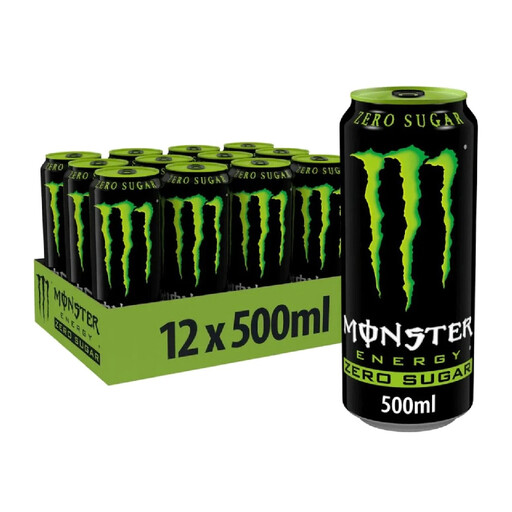
For an adult considering this zero-sugar 12-can pack, check the caffeine amount on the individual can before comparing it with another format. Do not use the caffeine figure for Monster Ultra as the figure for this different variant, or choose an energy drink as a child’s snack drink.
No: the sugar claim does not remove caffeine from an energy drink. NHS guidance identifies water and milk as the best drinks to give children.
No. Read “of which sugars” on the nutrition panel for the whole can. Tesco’s KX No Added Sugar Live listing gives 3.5g sugars per 500ml can despite its no-added-sugar claim.
Check the sugar claim and nutrition panel, then compare caffeine for the whole can rather than can size alone. Red Bull UK lists 80mg caffeine in 250ml of Red Bull Sugarfree; Monster Energy UK lists 150mg in 500ml of Monster Ultra. Those figures apply to those named drinks, not every variant from either brand.
Not necessarily. Red Bull UK lists 80mg caffeine in a 250ml Red Bull Sugarfree can, and Monster Energy UK lists 150mg in a 500ml Monster Ultra can. Check the caffeine statement on the specific drink.
The Department of Health and Social Care says a ban on sales of high-caffeine energy drinks to under-16s in England starts in April 2027. That announcement is not a current UK-wide rule; check the applicable rules and retailer policy where you are buying.