For a compatible plug-in appliance, choose a standalone meter if you want readings at the socket without setting up an app; choose an energy-monitoring smart plug if you also need supported history, schedules or remote access. Check the appliance load and the exact model’s restrictions either way. If your question is about total household use rather than one appliance, a smart meter and in-home display address a different measurement scope.
Who is each type of monitor for?
One-appliance investigators
If you want to compare the electricity used by compatible plug-in appliances, look for the readings your test needs: live watts for power draw and cumulative kWh for consumption over time. A local display can make a short test straightforward without remote control.
App-based smart-home users
An energy-monitoring smart plug suits a compatible appliance when you also want model-supported history, schedules or remote access. Check its network, app and firmware requirements before relying on those functions.
Whole-home usage checkers
If you need a view of total household use, Energy Saving Trust describes smart meters and their in-home displays as tools for monitoring energy used at home. A household total does not directly identify one appliance’s consumption.
What should you check before choosing?
Standalone plug-in meter
Choose it when: you want to read a compatible appliance’s use at the socket without setting up smart-home controls.
Trade-off: check the particular meter for any history or rate-entry function you need; an on-device display alone does not establish either.
Energy-monitoring smart plug
Choose it when: appliance-level readings need to sit alongside supported app history, schedules or remote control.
Trade-off: those functions depend on the model and its network and software setup; appliance-use exclusions still apply.
| Priority | What to check | Your needs |
|---|
| Plug and load |
Match the plug format and stated supply requirements. Compare the appliance rating with the monitor’s current and wattage limits, any extension-lead rating and model-specific exclusions. Electrical Safety First puts a single socket’s maximum at 13 A, or about 3 kW. |
I need a monitor I can use with this particular plug-in appliance, not merely one labelled 13 A. |
| Readings |
Check for live watts if you want power draw, and cumulative kWh if you want consumption over an observation period. If you want an estimated running cost, check whether the model accepts your applicable electricity rate. |
For a short spot check, I want a reading I can see at the socket; for comparisons over time, I need the relevant kWh reading or history. |
| History and access |
Check whether readings appear on the device, in an app or both. For smart functions, confirm network compatibility and any app, controller or firmware requirements for the exact model. |
I want to review recurring use or control the appliance away from the socket, and I can accommodate the required setup. |
| Measurement scope |
A plug-through monitor measures a connected, compatible appliance. Energy Saving Trust describes a smart meter as measuring home energy use; a household reading alone cannot directly assign consumption to one appliance. |
If my question is about the whole home, I need a household-level view. If it is about one appliance, I need a way to isolate that appliance’s use. |
Mistakes to avoid
-
Assuming a 13 A label suits every appliance
The monitor, socket and any extension lead each have limits, and a smart plug may exclude particular uses. TP-Link, for example, says its Tapo P110 is indoor-only, does not support EV charging and should not be used with motors or compressors above 1/6 HP.
Read the appliance rating plate and the exact monitor’s load and use restrictions before connecting it. Check any extension-lead rating too, and do not daisy-chain extension leads.
-
Treating an estimated running cost as a bill
A cost calculation depends on the electricity rate entered. One fixed rate may not reflect a tariff with different charging periods.
Compare kWh over a defined period first. If the monitor supports rate entry, use the applicable rate or periodic rates and treat the resulting cost as an estimate.
-
Choosing app controls for a task that needs only a display
History and remote functions depend on the particular smart plug and its setup. A display meter can be a simpler fit for a temporary reading at the socket.
Decide whether you will use history, automation or remote access before choosing a smart plug; then check its software and connectivity requirements.
Smart functions can also mean time spent setting up the app, maintaining connectivity and updating software.
-
Assigning whole-home use to one appliance
When several appliances run at once, a household reading does not directly show how much each one used.
Use a suitable plug-through monitor for a compatible individual appliance, and a smart meter or in-home display for the household-total view.
Relevant brand references
These examples illustrate different features and restrictions to compare; they do not describe every product from each brand.
Lowenergie
Lowenergie lists a standalone plug-in monitor with an on-device display for socket-level checks.
- Lowenergie specifies a UK plug, 240 V/50 Hz supply, 13 A/3000 W maximum load, 0.1 W minimum display and a cumulative 0.00–9999.9 kWh range for this model.
- Check the readings and any rate-entry function you require on the exact model; a minimum display value is not an independent accuracy measure.
Tapo (TP-Link)
The Tapo P110 is an energy-monitoring smart plug for app-based appliance checks and supported controls.
- TP-Link documents real-time power draw, consumption history and fixed- or periodic-rate calculation options for applicable energy-monitoring features.
- TP-Link specifies a 13 A maximum for P110, indoor use only, no EV charging and a restriction on motors or compressors above 1/6 HP. Check the app and firmware requirements for the functions you need.
Meross
Meross lists the MSS305UK for users considering an energy-monitoring smart plug with schedules.
- Meross specifies real-time reports, historical data, schedules and a 13 A maximum for MSS305UK.
- Meross says this model needs an existing 2.4 GHz Wi-Fi network and does not support Enterprise Wi-Fi.
Joybuy product options
This energy-monitoring smart-plug option is relevant if you want to monitor a compatible plug-in appliance within a Matter smart-home setup. Check the readings, connectivity and load requirements that matter to you before choosing it.
 No image available
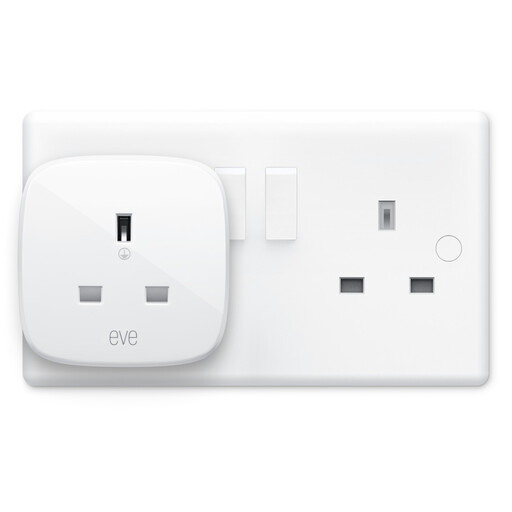
Eve Energy Matter Smart Plug with Power Meter, UK Type G
Consider this plug if you want energy monitoring alongside remote control in a compatible smart-home setup. Its name specifies a UK Type G plug and Thread technology; full Thread functionality requires a Matter controller and Thread Border Router. Check its exact connectivity method, load rating, available kWh readings and any tariff-entry function against your intended use.
View on Joybuy
Frequently asked questions
What should I check before connecting an appliance?
Check the plug format, the appliance rating and the monitor’s maximum current and wattage, as well as any extension lead’s rating and the model’s use restrictions. Electrical Safety First states that a single socket’s maximum is 13 A, or about 3 kW; that does not override a lower device rating or a manufacturer exclusion.
Will a plug-in monitor show what an appliance costs to run?
A model with electricity-rate entry can calculate an estimate from its readings and the rate you enter, not reproduce your supplier bill. TP-Link documents fixed- and periodic-rate inputs for applicable Tapo energy-monitoring features; check whether the meter you choose supports the tariff details you need.
Do I need Wi-Fi to read electricity use?
Not if you choose a standalone meter with readings on its display. Smart-plug behaviour differs by model: Meross says MSS305UK requires an existing Wi-Fi network for its smart functions, while Tough Leads says its meter’s on-board screen remains readable without Wi-Fi but remote readings require a connection. Check the exact device’s local and remote functions.
When is a smart meter more useful than a plug-in monitor?
Use a smart meter and in-home display when you want to see household-level energy use. Energy Saving Trust explains that a smart meter measures home energy use and sends readings to the supplier; it does not directly isolate the consumption of one appliance running alongside others.


