
24/7 Customer Support

Free returns

Same-day & Next-day Delivery

Quality Guaranteed

Unlock Your Welcome Offers: FREE Delivery | Up to 80% OFF | Free 30-day JoyPlus trial
Download the APP
Finding a gift that is both entertaining and educational can be a challenge. Many parents and relatives are looking for ways to encourage hands-on learning and steer children away from constant screen time. This is where engineering toys for kids come in. These kits offer a fantastic opportunity for young minds to develop critical thinking, problem-solving skills and a genuine interest in STEM subjects.
As the Joybuy Product Recommendation Officer, my role is to help you navigate the options. This guide offers practical advice for choosing the right kit and highlights a few standout products that encourage creativity and mechanical understanding.
Before diving into specific products, consider a few key factors to ensure you find the perfect fit for the young engineer in your life.
The most important factor is finding a balance between challenge and fun. A kit that is too simple may be boring, while one that is too complex can lead to frustration. Check the manufacturer's recommended age range, but also consider the child's individual patience and experience with construction toys. For beginners, look for STEM construction toys with fewer parts and clearer instructions. For older children or teens, more intricate mechanical model kits with hundreds of components can provide a deeply rewarding experience.
Different toys teach different principles. Are you looking for something that explains the basics of internal combustion? A build your own engine kit would be ideal. If the interest lies more in gears, levers and vehicle dynamics, then car building sets for kids might be a better choice. Look for kits with transparent parts or open designs that allow the builder to see exactly how their creation works, turning abstract concepts into tangible lessons.
For many aspiring engineers and hobbyists, realism is a major draw. Kits that replicate real-world machines, such as a detailed Haynes engine model, offer a deeper connection to the subject. These models often become proud display pieces after completion. Also, consider kits with interchangeable parts that allow for customisation and experimentation, extending their life beyond a single build.
Here are a few recommendations that exemplify the qualities of a great engineering toy, catering to different interests and skill levels.
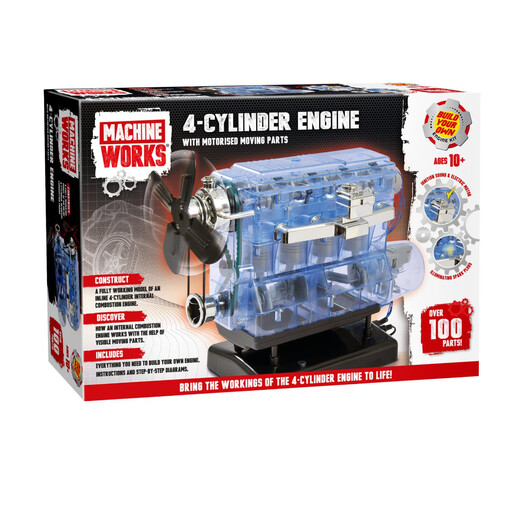
Why It Stands Out: This kit is a superb introduction to the world of automotive mechanics. It allows builders to construct a working 1:4 scale model of a petrol engine. The transparent casing is its key feature, providing a clear view of the moving pistons, crankshaft and valves. The inclusion of an electronic sound module and illuminating spark plugs brings the finished model to life.
Pros:
Who is it for? This is an excellent choice for children aged 10+ and beginners of any age who are curious about how a car engine functions. It's one of the most popular gifts for young engineers.
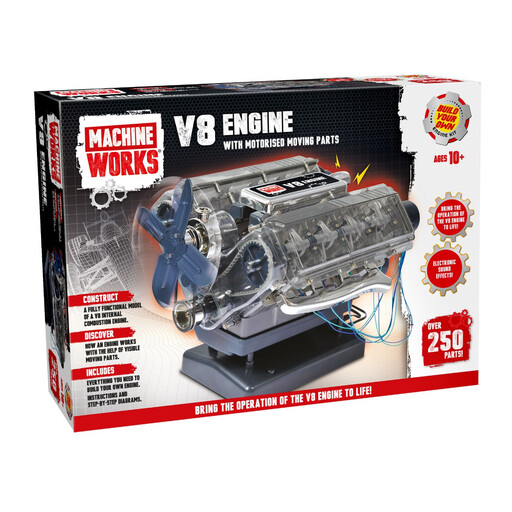
Why It Stands Out: For those seeking a more advanced project, the V8 engine kit takes the complexity up a notch. With over 250 parts, it provides a deeper and more involved building experience. This motorised model replicates a dual overhead cam V8, complete with all the satisfying sounds and lights of its smaller sibling, but with a more intricate assembly process.
Pros:
Who is it for? This kit is suited for experienced young builders (10+) or adult hobbyists who enjoy a meticulous and rewarding project. It's a fantastic follow-up for anyone who has mastered the 4-cylinder model.
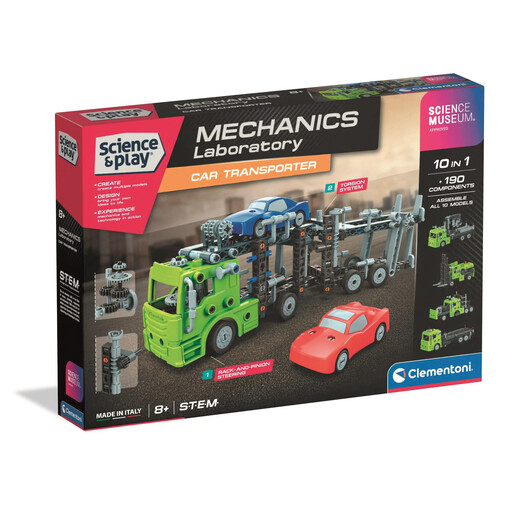
Why It Stands Out: Shifting focus from engines to vehicle systems, this Clementoni set explores the mechanics of heavy transport. Builders assemble not just a large car transporter, but also two smaller cars to go with it. The educational value lies in its functional parts, including a working steering system and ramps that lower and recline, demonstrating real-world engineering principles.
Pros:
Who is it for? Ideal for children aged 8-12 who are fascinated by large vehicles and want to understand how different mechanical parts work together to perform complex tasks. It's a great example of hands-on science and discovery toys.
The world of engineering toys is vast and varied. If the recommendations above aren't quite what you're looking for, or if you want to explore other themes like robotics, aviation or construction machinery, there are many more choices available.
Discover a wider selection of kits for all ages and interests in our full Technology Engineering Toy category.
1. What are the benefits of engineering toys for children? These toys are instrumental in developing a wide range of skills. They enhance problem-solving abilities, improve spatial reasoning and introduce fundamental STEM concepts in an accessible way. The process of building also helps develop fine motor skills, patience and the ability to follow complex instructions.
2. At what age can a child start with a build your own engine kit? While some simpler mechanical kits are suitable for children as young as eight, the more detailed engine models are typically recommended for ages 10 and up. Due to the number of small parts and the complexity of the assembly, adult supervision is often recommended, which can also make it a rewarding family activity.
3. Are these mechanical model kits just for boys? Absolutely not. An interest in mechanics, engineering and how things work is not gender-specific. These STEM construction toys are designed to spark curiosity and build confidence in any child. They are excellent tools for encouraging anyone to explore a future in science, technology, engineering or mathematics.