
24/7 Customer Support

Free returns

Same-day & Next-day Delivery

Quality Guaranteed

Unlock Your Welcome Offers: FREE Delivery | Up to 80% OFF | Free 30-day JoyPlus trial
Download the APP
As the line between home and the workplace continues to blur, many of us are spending more hours than ever at our desks. While this offers flexibility, it can also lead to discomfort, back pain and reduced focus. A standard dining chair simply isn't designed for an eight-hour workday. An ergonomic office chair, however, is an investment in your comfort and productivity.
This guide is designed to help you navigate the features that matter. We will outline key considerations for choosing the right chair and present a few of our top recommendations to help you create a more supportive home office environment.
Choosing a chair can feel overwhelming with all the technical specifications. Focusing on a few core principles can simplify the process and ensure you find a chair that truly fits your body and work style.
A one-size-fits-all approach rarely works for ergonomics. The ability to customise your chair to your body's unique proportions is crucial. Look for a desk chair with lumbar support that can be adjusted for height and depth to properly support the natural curve of your lower back.
Equally important are computer chair with adjustable armrests. These should move up and down, forwards and backwards and even pivot inwards or outwards to support your forearms and reduce strain on your shoulders and neck. Other key adjustments include seat height, seat depth and a recline function with tension control.
The material of your chair affects both comfort and durability. A mesh desk chair is a popular choice for good reason. The woven material allows for excellent air circulation, which helps keep you cool during long periods of sitting. It is also flexible and conforms to your body shape, providing support without creating pressure points. Look for high-quality, high-elasticity mesh that will resist sagging over time.
While you don't need to be an engineer to buy a chair, it's helpful to know what certain certifications mean. Standards like BIFMA (Business and Institutional Furniture Manufacturer's Association) and EN 1335 (European standard for office chairs) indicate that a chair has undergone testing for safety, durability and stability. These certifications can provide an extra layer of confidence in the chair's construction and longevity.
Based on their features and adjustability, here are some standout options to consider for your home office.

Why It Stands Out: The Doro C300 Pro is built for comprehensive customisation. Its most notable feature is the ultra-soft 6D armrests, which offer an exceptional range of motion to support your arms in virtually any posture, whether you are typing, reading or reclining. The dynamic lumbar support automatically adjusts to your movements, providing continuous support to your lower back.
Pros:
Who is it for? This chair is suited for professionals and individuals who spend the majority of their day at a desk and require the highest level of adjustability to fine-tune their seating posture.
View Details for the SIHOO Doro C300 Pro
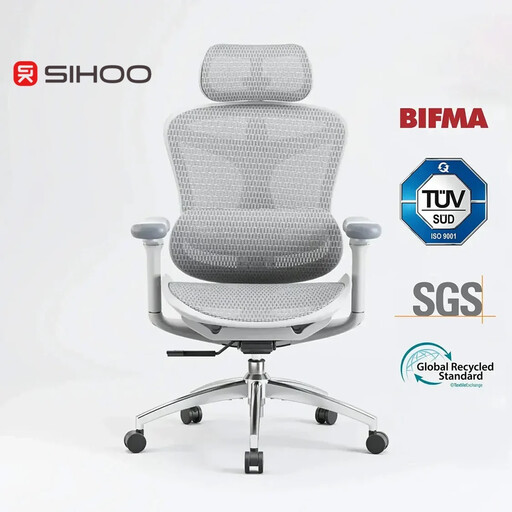
Why It Stands Out: The Doro C300 offers many of the core ergonomic benefits of its 'Pro' counterpart, making it a strong contender. It features the same self-adaptive lumbar support and an intelligent weight-sensitive mechanism that adjusts the recline tension automatically. The primary difference lies in the armrests, which are 3D adjustable instead of 6D.
Pros:
Who is it for? Ideal for users seeking advanced ergonomic features like dynamic support and automatic tension control, but who do not require the extensive armrest customisation of the Pro model.
View Details for the SIHOO Doro C300
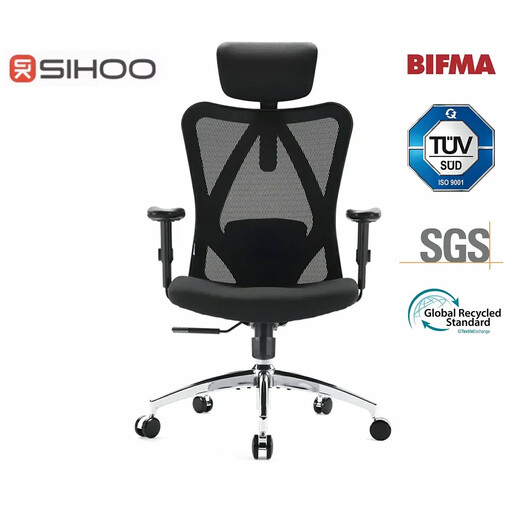
Why It Stands Out: The Sihoo M18 is a well-rounded high back office chair that delivers essential ergonomic features at an affordable price point. It includes an adjustable headrest, lumbar support and armrests, covering all the fundamentals needed for a comfortable workday. The W-shaped seat design and waterfall edge help to distribute weight evenly and reduce pressure on the back of the thighs.
Pros:
Who is it for? A great starting point for anyone looking to upgrade from a basic chair to a truly ergonomic solution. It is a versatile choice for a home office or study environment.
View Details for the Sihoo M18
The right chair is a personal choice, and what works for one person may not be the perfect fit for another. If you are still exploring different styles, features or price points, we have a wider selection available.
Explore our full range of ergonomic desk chairs for home office
A comfortable office chair for long hours combines three key elements: comprehensive adjustability (especially for lumbar, armrest and seat height), supportive design (like a contoured backrest and waterfall seat edge) and breathable materials (such as high-quality mesh) to prevent overheating and discomfort.
A high back office chair can be beneficial, particularly for taller individuals or those who frequently use the recline function. It provides additional support for the upper back, shoulders and neck, which can reduce strain during long periods of sitting. However, for users of average height who primarily sit upright, a mid-back chair with good lumbar support can also be very effective.
When seated, your feet should be flat on the floor with your knees at a 90-degree angle. Your lower back should be firmly supported by the lumbar cushion. Your forearms should rest comfortably on the armrests at a 90-degree angle to your desk, keeping your shoulders relaxed. Taking a few minutes to adjust these settings can make a significant difference.